


The Fish That Leads the Way into Autumn
秋の先頭を泳ぐ魚Words the Home Holds
家がつつむ言の葉
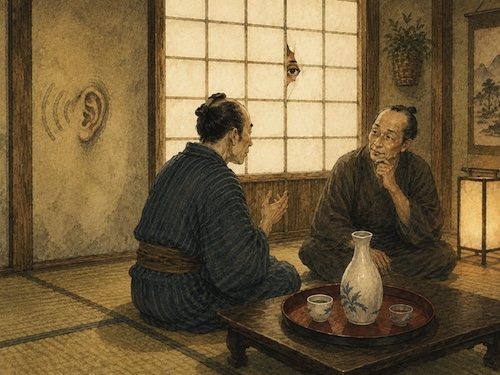
The House Has Ears, Eyes—and a Mouth
耳と目と口を持つ家
NIHONGO DO® | Voice – Word Art – Hiragana Times September 2026 issue
Listen to the Audio:
The House Has Ears, Eyes—and a Mouth
耳と目と口を持つ家
What we call kotowaza is written with the kanji 諺. Here, we go beyond proverbs—from the Analects and waka poetry to modern spoken Japanese—to explore the art of words (言技), in which 言波 (voice waves) and 言の葉 (word leaves) intermingle and nurture our sensibilities. The Japanese built their homes of wood and paper, allowing sounds and shadows to pass from room to room. In this issue, please enjoy a piece of word art born from the Japanese house.
「ことわざ」は、漢字で「諺」と書きます。ここでは諺にとどまらず、論語、和歌、現代口語まで、「言波」と「言の葉」が融合し、感性を育ててきた言葉のアート「言技」を紹介します。日本人は木と紙で家をつくり、音も影も部屋から部屋へと通してきました。今号では、日本の家から生まれた言技をお楽しみください。
The Walls Have Ears, the Shoji Have Eyes
壁に耳あり障子に目あり
“The walls have ears” appears in many languages. English says “Walls have ears,” while Spanish has “Las paredes oyen”—“the walls listen.” Similar warnings are found in Italian, Chinese, and Korean. The idea is universal: secrets may be overheard.
「壁に耳あり」という発想は、世界各地にあります。英語では “Walls have ears.”、スペイン語では「壁は聞いている」という意味の “Las paredes oyen.” と言います。イタリア語、中国語、韓国語にも似た戒めがあります。秘密はどこかで聞かれているかもしれない、という発想は世界共通です。
Japan added “Shoji ni me ari”—“the shoji have eyes.” Shoji are paper-covered sliding screens. Voices pass through them, shadows appear on them, and a small hole can become an eye. The wall listens; the shoji watches.
日本では、これに「障子に目あり」が加わりました。障子は、木の組子に紙を張った建具です。声は通り、影は映り、小さな穴はのぞく目にもなる。壁は聞き、障子は見るのです。
By the late Edo period, there was also a playful version:
“Kabe ni mimi ari, tokkuri ni kuchi ari.”
“The walls have ears, and the sake flask has a mouth.”
江戸時代後期には、こんなユーモラスな続け方もありました。
「壁に耳あり、徳利に口あり」
The opening of a tokkuri is called its kuchi, or “mouth.” The phrase also hints at the human mouth, loosened by drink. A universal warning thus took in familiar objects from Japanese life, adding vivid imagery and humor.
徳利の注ぎ口も「口」と呼びますが、酒で軽くなる人の口にも掛けています。世界共通の戒めに、日本の暮らしの道具と、鮮やかな情景、ユーモアが加わっています。
■ Meaning / 意味
- Kabe ni mimi ari: The walls have ears—someone may be listening.
壁に耳あり: どこで誰が聞いているか分からない。 - Shoji ni me ari: The shoji have eyes—someone may be watching.
障子に目あり: どこで誰が見ているか分からない。 - Tokkuri ni kuchi ari: The sake flask has a mouth—an old, humorous continuation warning that secrets may slip out.
徳利に口あり: 秘密は人の口から漏れるものだと戒める、かつてのユーモラスな続け方。
■ Usage / 使う場面
In a company meeting room / 会社の会議室で
Misaki: We should keep our voices down. The walls have ears.
ミサキ:声を落としたほうがいいね。壁に耳あり、だから。
Kenta: Right. And the shoji have eyes.
ケンタ:そうだね。それに、障子に目あり。
Misaki: Companies don’t have shoji, though.
ミサキ:会社には、障子はないけどね。
Kenta: True. (laughs)
ケンタ:確かに(笑)。
Misaki: But Kenta, you should keep “the sake flask has a mouth” in mind at drinking parties, too.
ミサキ:でもケンタは、飲み会では、「徳利に口あり」も気をつけなよ。
Discover More Articles | もっと記事を読む
Digital Packages
Read and listen in your browser — available in bundles.
誌面と音声を、パッケージでご利用いただけます。
More From Hiragana Times

Join the Hiragana Times Discord Community — Free!
Connect with readers worldwide — free, open, and always welcoming.
世界の読者とつながる、無料のDiscordコミュニティへようこそ。

Online Japanese lessons, run by Hiragana Times.
One month free for Hiragana Times subscribers.
ひらがなタイムズ定期購読者は、1ヶ月無料でご受講いただけます。




Information From Hiragana Times


Topics in Japan
-
![Words That Live with Insects <br src=]() 虫と暮らす言の葉" />
Words That Live with Insects
虫と暮らす言の葉" />
Words That Live with Insects
虫と暮らす言の葉 -
![Bugs Live in the Belly <br src=]() 腹に虫が住む" />
Bugs Live in the Belly
腹に虫が住む" />
Bugs Live in the Belly
腹に虫が住む -
![Voices of Insects — The Soundtrack of Autumn in Japan <br src=]() 虫の声 ― 日本の秋のBGM" />
Voices of Insects — The Soundtrack of Autumn in Japan
虫の声 ― 日本の秋のBGM" />
Voices of Insects — The Soundtrack of Autumn in Japan
虫の声 ― 日本の秋のBGM -
![The Worms Within Came from the Universe <br src=]() 腹の虫は、宇宙から来た" />
The Worms Within Came from the Universe
腹の虫は、宇宙から来た" />
The Worms Within Came from the Universe
腹の虫は、宇宙から来た -
![Ito Jakuchū — An Eye for Life <br src=]() 伊藤若冲 ―― いのちを見る眼" />
Ito Jakuchū — An Eye for Life
伊藤若冲 ―― いのちを見る眼" />
Ito Jakuchū — An Eye for Life
伊藤若冲 ―― いのちを見る眼
 虫と暮らす言の葉" />
 腹に虫が住む" />
 虫の声 ― 日本の秋のBGM" />
 腹の虫は、宇宙から来た" />
 伊藤若冲 ―― いのちを見る眼" />

