
Indian army pieces, Buddhist treasures and Japanese shogi pieces — Hiragana Times November 2026

Shogi: The Culture That Turned Enemies into Treasure
将棋 — 敵を宝に変えた文化

Japan Style – Hiragana Times November 2026 issue

Listen to the Audio:

Shogi: The Culture That Turned Enemies into Treasure

将棋しょうぎ — 敵てきを宝たからに変かえた文化ぶんか


Shogi Hidden in Everyday Japanese | 日本語にほんごの中なかの将棋しょうぎ

“Mou tsunda.” When there is nothing left to be done, Japanese people say this. “Tsumu” originally means, in shogi, that the king can no longer escape. There are others, too: “ote wo kakeru,” “sente wo utsu,” “sutegoma ni suru,” “narikin.” Shogi does not stay on the board; it has worked its way into everyday Japanese.
「もう詰つんだ」。どうすることもできなくなったとき、日本人にほんじんはこんな言いい方かたをします。「詰つむ」は、もともと将棋しょうぎで「王おう」が逃にげられなくなること。ほかにも、「王手おうてをかける」「先手せんてを打うつ」「捨すて駒ごまにする」「成金なりきん」。将棋しょうぎは盤ばんの上うえにとどまらず、日常にちじょうの日本語にほんごの中なかにまで入はいり込こんでいます。

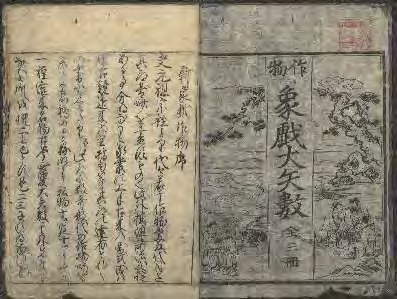
Look at the characters for “shogi” (将棋) and it certainly looks like a game of battle. In old books, however, it is written “象戯” or “象棋,” meaning “elephants at play.”
「将棋しょうぎ」という字じを見みると、いかにも戦たたかいのゲームに見みえます。しかし古ふるい書物しょもつでは、「象ぞうが戯たわむれる」と書かいて「象戯しょうぎ」、あるいは「象棋しょうぎ」と書かかれています。

Historical book showing the characters 象戯

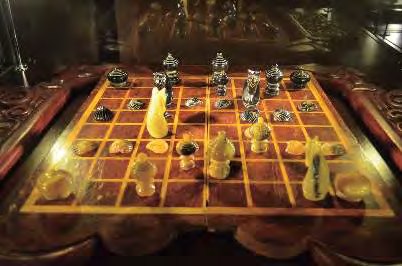
Why an elephant? It tells us that the ancestor of shogi came from ancient India. Ancient India had a game called chaturanga, which moved an army onto a board. With pieces standing for the king, elephant, horse, chariot and foot soldier, you corner the opponent’s king. The elephant was the star of the ancient Indian battlefield.
なぜ「象ぞう」なのか?それは、将棋しょうぎの祖先そせんが古代こだいインドから来きたことを物語ものがたっています。古代こだいインドには、軍隊ぐんたいを盤ばんの上うえに移うつしたゲーム「チャトランガ」がありました。王おう、象ぞう、馬うま、車くるま、兵へいにあたる駒こまで、相手あいての王おうを追おいつめます。象ぞうは、古代こだいインドの戦場せんじょうの主役しゅやくでした。

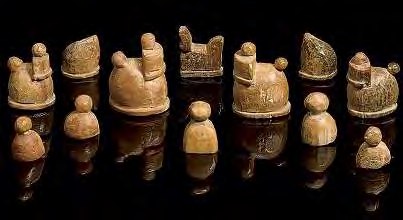
Ancient chaturanga pieces

When and how chaturanga was born is not clear. One story has it that a retainer created it to restrain a king who did nothing but wage war.
チャトランガがいつ、どのように生うまれたのかは、はっきりしていません。一説いっせつには、戦争せんそうばかりする王おうを諌いさめるために、家臣かしんが作つくったと伝つたえられています。

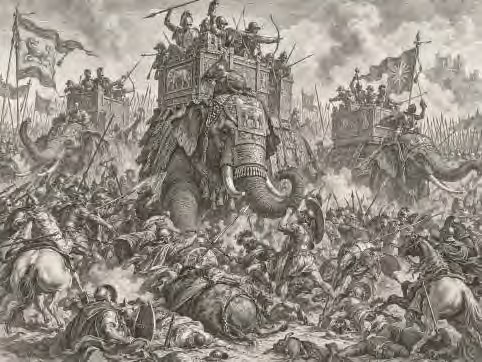
Elephants on an ancient Indian battlefield

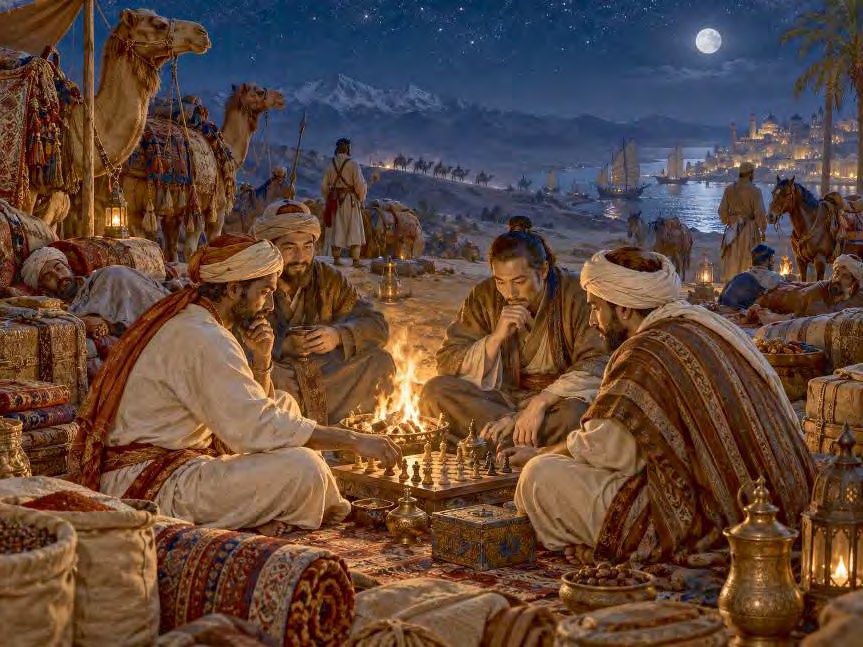
India in those days was a land people longed for, sending spices, jewels, cotton cloth and Buddhism out into the world. That rich culture was carried across the world by human hands. Westward it crossed the Silk Road; eastward it moved across the continent and over the sea. On the long nights of the journey, by the campfire, travelers must have enjoyed chaturanga.
当時とうじのインドは、香辛料こうしんりょうや宝石ほうせき、綿織物めんおりもの、そして仏教ぶっきょうを世界せかいに送おくり出だす、憧あこがれの地ちでした。その豊ゆたかな文化ぶんかは、人々ひとびとの手てで世界せかいへ運はこばれていきます。西にしへはシルクロードを越こえ、東ひがしへは大陸たいりくを進すすみ、海うみを渡わたりました。長ながい旅たびの夜よる、焚たき火びのそばで、旅人たびびとたちは「チャトランガ」を楽たのしんでいたのでしょう。

Travelers playing chaturanga by a campfire along the Silk Road

In this way chaturanga spread to many lands, changing its form in each. At the far end of the Silk Road, in Europe to the west, it became chess. In China it became xiangqi, which still keeps the character for “elephant”; in Thailand, makruk; and in Japan, shogi. Across the sea, the Korean Peninsula also has janggi, written with the same characters. It became the game of each land.
こうして「チャトランガ」は各地かくちへ伝つたわり、その土地とちごとに姿すがたを変かえていきました。シルクロードの先さき、西にしのヨーロッパではチェスに。中国ちゅうごくでは今いまも「象ぞう」の字じを残のこしてシャンチー(象棋しょうぎ)、タイではマークルック、そして日本にほんでは将棋しょうぎへ。海うみを挟はさんだ朝鮮半島ちょうせんはんとうにも、同おなじ字じを書かくチャンギ(将棋しょうぎ)があります。それぞれの土地とちの遊あそびになったのです。

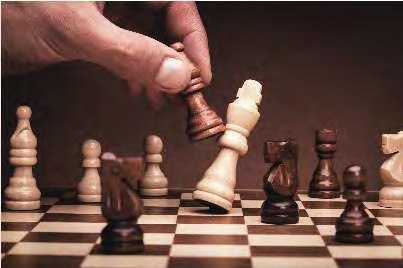
Chess

Chess
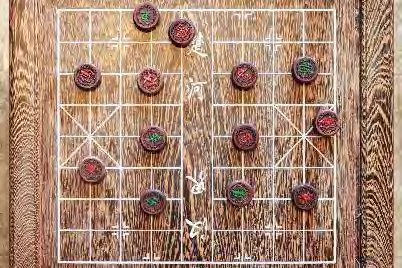
象棋

象棋
Thailand Makruk

Thailand Makruk

Two Worlds on One Piece of Wood | 一枚いちまいの駒こまに溶とけ合あう二ふたつの世界せかい

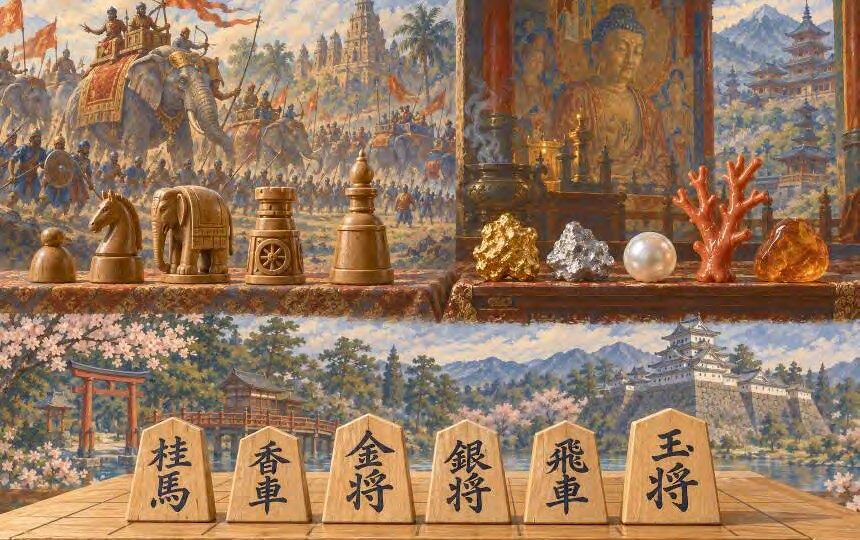
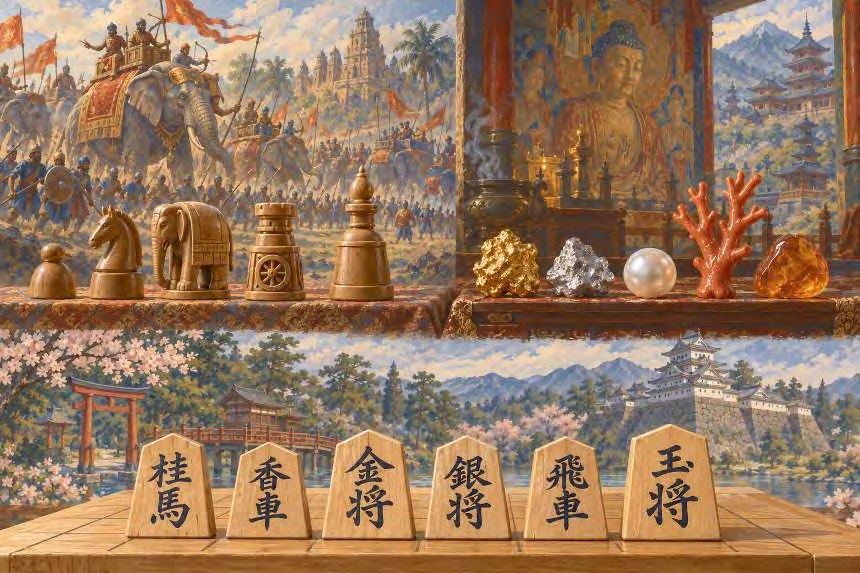
Indian army pieces, Buddhist treasures and Japanese shogi pieces

The pieces of chaturanga were general, elephant, horse, chariot and soldier. All are words of the army. The pieces of Japan, however, are jewel, gold, silver, cassia and incense. All are words of treasure. They are also said to overlap with the “Five Treasures” that came from China together with Buddhism.
「チャトランガ」の駒こまは、「将しょう・象ぞう・馬うま・車くるま・兵へい」。どれも軍隊ぐんたいの言葉ことばです。ところが日本にほんの駒こまは、「玉ぎょく・金きん・銀ぎん・桂けい・香きょう」。どれも宝物たからものの言葉ことばです。中国ちゅうごくから仏教ぶっきょうとともに渡わたってきた「五宝ごほう」と重かさなるとも言いわれます。

Take “keima” (桂馬), for example: the treasure “cassia” (桂) joined to India’s “horse” (馬). “Kyosha” (香車), too: the treasure “incense” (香) joined to India’s “chariot” (車). Without discarding the army words of India, the treasure words of Buddhism were laid on top. Accept both, mix them, and make them your own. Japan, at the eastern edge of the world, has always been a place where cultures blend in this way.
たとえば「桂馬けいま」。宝たからの「桂けい」に、インドの「馬うま」。「香車きょうしゃ」も、宝たからの「香こう」に、インドの「車くるま」。インドの軍隊ぐんたいの言葉ことばを捨すてずに、仏教ぶっきょうの宝たからの言葉ことばを重かさねる。どちらも受うけ入いれ、混まぜて、自分じぶんのものにする。東ひがしの果はての日本にほんは、常つねに、様々さまざまな文化ぶんかがそうして混まざり合あう場所ばしょでした。

Just as it fused its gods with the Buddha, Japan let different cultures melt together on a single piece of wood, the shogi piece. The reason a “gyokusho” (jewel general) still stands beside the “osho” (king general) today is a trace of the time when the pieces were treasures.
神かみと仏ほとけを習合しゅうごうさせたように、将棋しょうぎの駒こまも、一枚いちまいの木片もくへんの上うえで異文化いぶんかを溶とけ合あわせていたのです。今いまも「王将おうしょう」と並ならんで「玉将ぎょくしょう」があるのは、駒こまが宝物たからものだった頃ころの名残なごりです。

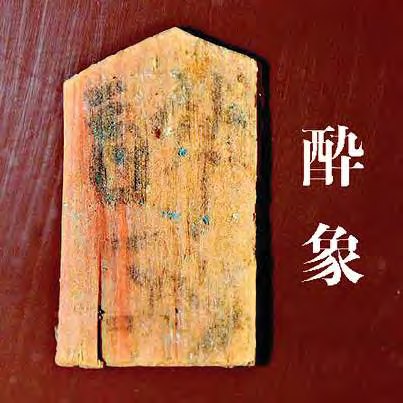
From the former grounds of Kofukuji Temple in Nara, shogi pieces from around 1058 have been excavated. Here, too, the piece was not “osho” but “gyokusho.” A piece inscribed “suizo” (drunken elephant) also came to light. The elephant that had made the long journey from India was still there in the shogi of Japan at that time.
奈良なら・興福寺こうふくじの旧境内きゅうけいだいからは、1058年ねんごろの将棋しょうぎの駒こまが発掘はっくつされています。ここでも、王将おうしょうではなく「玉将ぎょくしょう」でした。さらに、「酔象すいぞう」と書かかれた駒こまも出でてきました。インドから長ながい旅たびをしてきた「象ぞう」は、この頃ころの日本にほんの将棋しょうぎに、まだ残のこっていたのです。

An excavated suizo, or drunken elephant, piece

The Moment an Enemy Becomes an Ally | 敵てきが味方みかたになる瞬間しゅんかん

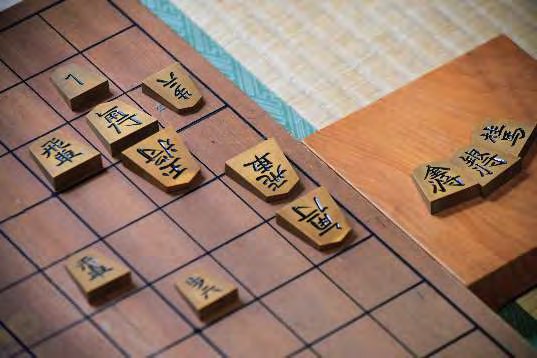
Chaturanga was born of battle. In its descendants, chess and Chinese xiangqi alike, when you take an opponent’s piece, that piece vanishes from the board. In other words, it is killed. In Japanese shogi, however, a captured piece does not die. It becomes a “piece in hand” for the side that took it, and returns to the board, this time as an ally.
戦たたかいから生うまれた「チャトランガ」。その子孫しそんであるチェスも、中国ちゅうごくの象棋しょうぎも、相手あいての駒こまを取とれば、その駒こまは盤ばんから消きえます。つまり、殺ころしてしまうのです。ところが日本にほんの将棋しょうぎでは、取とられた駒こまは死しにません。取とった側がわの「持もち駒ごま」となり、今度こんどは味方みかたとして、盤ばんの上うえに戻もどってきます。

A shogi board with captured pieces held at its side

The aim of shogi is not to kill the opponent’s king, but to leave it no escape: “tsumi,” checkmate. An enemy piece is not something to kill, but something to make your ally.
将棋しょうぎの目的もくてきは相手あいての王おうを殺ころすことではなく、逃にげ場ばをなくす「詰つみ」。敵てきの駒こまは、殺ころす相手あいてではなく、味方みかたにする相手あいてなのです。

So why did only the Japanese think of this? The hint lies in the color of the pieces. Chess is white and black; xiangqi is red and black. All of shogi’s relatives around the world use different colors for friend and foe. The shapes are the same to keep the forces equal; the colors differ to tell friend from foe.
では、なぜ日本人にほんじんだけがこれを思おもいついたのでしょうか。ヒントは、駒こまの色いろにあります。チェスは白しろと黒くろ、象棋しょうぎは赤あかと黒くろ。世界せかいの将棋しょうぎの親戚しんせきたちは、みな敵てきと味方みかたで駒こまの色いろを変かえます。形かたちが同おなじなのは、戦力せんりょくを同おなじにするため。色いろが違ちがうのは、敵てきと味方みかたを見分みわけるためです。

Yet it was precisely this color-coding that made “pieces in hand” impossible. If white used a captured black piece, an enemy would come back to life on the board.
ところが、この色分いろわけこそが「持もち駒ごま」を不可能ふかのうにしていました。取とった黒くろの駒こまを白しろが使つかえば、盤ばんの上うえで敵てきが復活ふっかつしてしまうからです。

Japanese shogi pieces are the same in both color and shape. The same wood, the same color, the same characters. Then how do you tell friend from foe? The answer is that pentagon. The pointed tip shows which way the piece is facing.
日本にほんの将棋しょうぎは、色いろも形かたちも同おなじです。同おなじ木き、同おなじ色いろ、同おなじ文字もじ。ではどうやって敵てきと味方みかたを見分みわけるのか。答こたえは、あの五角形ごかくけいです。とがった先さきが、その駒こまの向むいている方向ほうこうを示しめします。

A pentagonal fuhyo shogi piece

Turn a captured piece around and set it down, and from that moment it is an ally. Simple as it seems, it is an invention of genius.
取とった駒こまをくるりと回まわして置おけば、その瞬間しゅんかんから味方みかたです。シンプルなようで、天才的てんさいてきな発明はつめいです。

This pentagon existed hundreds of years before the rule of pieces in hand was born. Who made it this shape a thousand years ago, and why, is not known. Without relying on color, the shape of the wood alone separates friend from foe. It is a quiet ingenuity, very Japanese.
この五角形ごかくけいは、持もち駒ごまのルールが生うまれる何百年なんびゃくねんも前まえからありました。千年前せんねんまえに誰だれが、なぜ、この形かたちにしたのかは分わかっていません。色いろに頼たよらず、木きの形かたちひとつで敵てきと味方みかたを分わける。日本人にほんじんらしい、静しずかな工夫くふうです。

And hundreds of years later, this shape received the new rule of pieces in hand as if it had been waiting for it all along. The spirit dwelling in the form gave birth to the rule.
そして何百年なんびゃくねんののち、この形かたちは、まるで待まっていたかのように持もち駒ごまという新あたらしいルールを受うけ止とめました。形かたちに宿やどる魂たましいが、ルールを生うみ出だしたのです。

Not Soldiers, but Treasures | 駒こまは兵士へいしではなく宝物たからもの

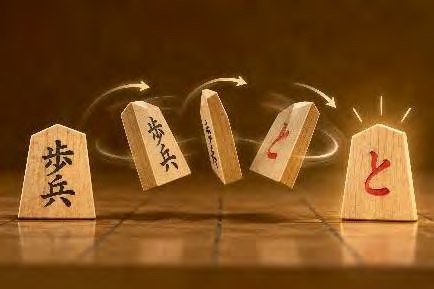
Shogi pieces have one more device found nowhere else in the world: a back side. When a piece advances into enemy territory, it can be flipped over to “promote.” Even the weakest piece, the “fuhyo” (foot soldier), works as a “kin” (gold) once turned over. The word “narikin,” the newly rich, comes from this.
将棋しょうぎの駒こまには、もう一ひとつ、世界せかいにない仕掛しかけがあります。裏面うらめんです。駒こまを敵てきの陣地じんちに進すすめると、裏返うらがえして「成なる」ことができます。いちばん弱よわい「歩兵ふひょう」でも、裏うらを返かえせば「金きん」の働はたらきをします。「成金なりきん」という言葉ことばは、ここから来きています。

A shogi pawn being turned over to promote

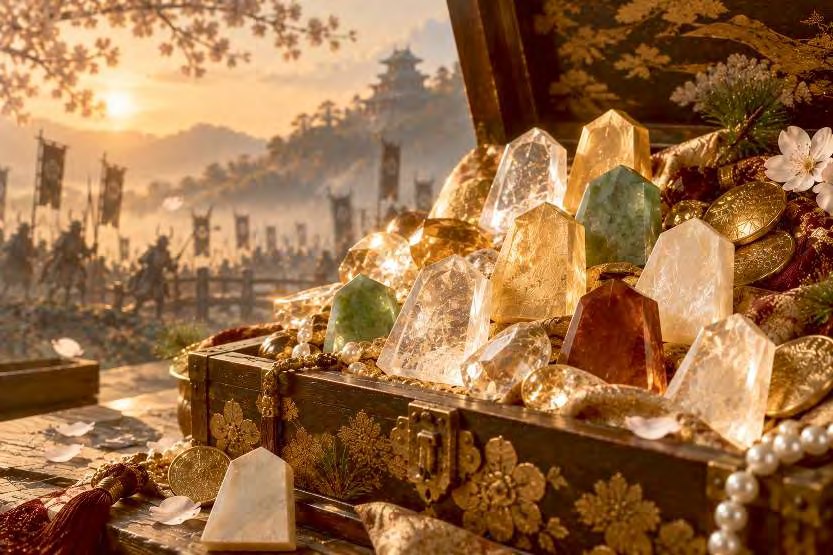
Why does a foot soldier become “gold” when it promotes? If a soldier distinguishes himself, his rank should rise. In shogi, though, he becomes a treasure. One answer is that what is being fought over in shogi is not soldiers but treasures. Jewel, gold, silver. A captured soldier cannot be used, but captured treasure can be used for yourself.
なぜ歩兵ふひょうは、成なると「金きん」になるのでしょうか。兵士へいしが手柄てがらを立たてたなら、位くらいが上あがるはずです。ところが将棋しょうぎでは、宝物たからものになる。答こたえの一ひとつは、将棋しょうぎで取とり合あっているものが、兵士へいしではなく、宝物たからものだということです。玉ぎょく、金きん、銀ぎん。奪うばった兵士へいしは使つかえませんが、奪うばった宝たからなら、自分じぶんのために使つかえます。

As long as it remained a game of killing, no one arrived at the idea of “using a captured piece.” By turning its pieces into treasure, Japan crossed that wall. Chaturanga, born as a game of war, became in Japan a game that lets the enemy live.
殺ころし合あいのゲームである限かぎり、誰だれも「取とった駒こまを使つかう」という発想はっそうには至いたりませんでした。日本にほんは駒こまを宝物たからものに変かえることで、その壁かべを越こえたのです。戦争せんそうのゲームとして生うまれたチャトランガは、日本にほんで、敵てきを生いかすゲームになりました。

Gold and jewels in a treasure chest

The Day Shogi Became a Culture | 将棋しょうぎが「文化ぶんか」になった日ひ

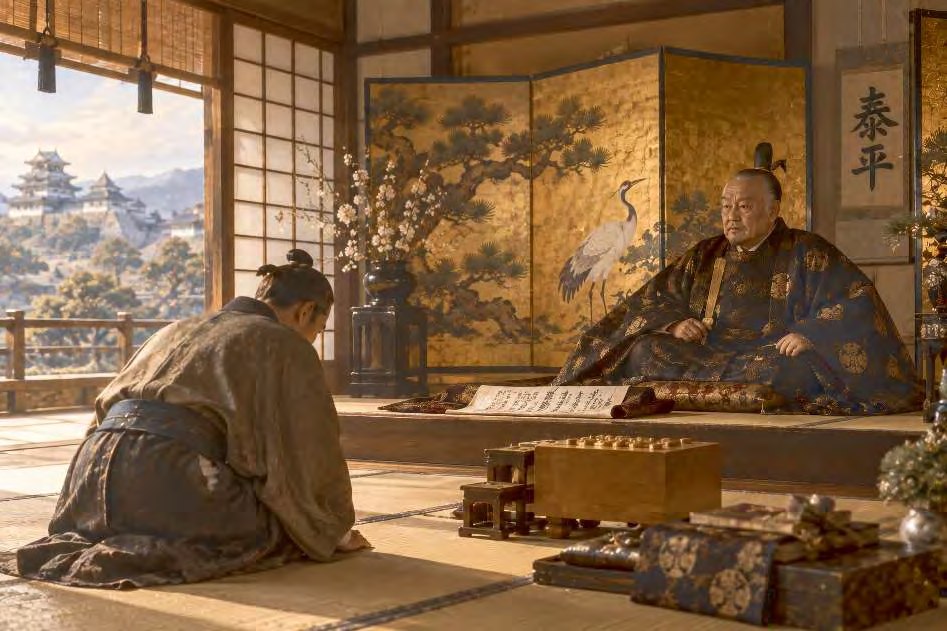
Ohashi Sokei receiving a stipend from Tokugawa Ieyasu

When the age of warring states ended, shogi showed a different face. In 1612, Tokugawa Ieyasu granted a stipend to the shogi master Ohashi Sokei: fifty koku and support for five retainers. A person who earned a salary simply for being strong at shogi had been born. He was Japan’s first professional shogi player.
戦国せんごくの世よが終おわると、将棋しょうぎは別べつの顔かおを見みせます。1612年ねん、徳川家康とくがわいえやすは、将棋しょうぎの名手めいしゅ・大橋宗桂おおはしそうけいに俸禄ほうろくを与あたえました。五十石五人扶持ごじっこくごにんぶち。将棋しょうぎが強つよいというだけで、給料きゅうりょうをもらう人間にんげんが生うまれたのです。日本にほんで最初さいしょのプロ棋士きしです。

Ieyasu, who had won the realm through war, built a world without war, and in that peaceful world he left the battle on the board. Thought of that way, there is something rather savory about it.
戦いくさで天下てんかを取とった家康いえやすが、戦いくさのない世よを作つくり、その泰平たいへいの世よに、盤ばんの上うえの戦いくさを残のこした。そう考かんがえると、少すこし味あじわい深ぶかいものがあります。

From Sokei’s house came the “Meijin,” a title passed down through the generations. By the time of the eighth shogun, Yoshimune, the “Oshiro Shogi,” played before the shogun every year on November 17, had become an annual event. That is today’s “Shogi Day.” The game became a profession, a house, and a way.
宗桂そうけいの家いえから「名人めいじん」が生うまれ、代々受だいだいうけ継つがれていきます。八代将軍はちだいしょうぐん・吉宗よしむねの頃ころには、毎年まいとし11月がつ17日にち、将軍しょうぐんの前まえで指さす「御城将棋おしろしょうぎ」が恒例こうれいになりました。今いまの「将棋しょうぎの日ひ」です。遊あそびは、職業しょくぎょうになり、家いえになり、道みちになっていきました。

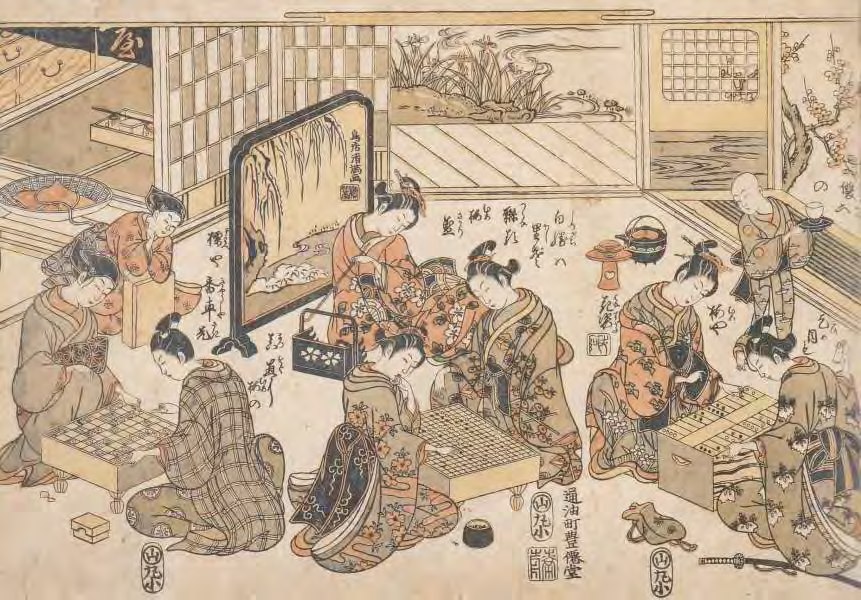
Historical illustration of shogi players

A person who plays shogi is called a “kishi.” Bushi, rikishi, kenshi. The character “shi” (士) is attached to those who stake their lives on a single path. From lawyers (bengoshi) to astronauts (uchu-hikoshi), Japan still has many professions that carry this character.
将棋しょうぎを指さす人ひとを「棋士きし」と呼よびます。武士ぶし、力士りきし、剣士けんし。「士し」は、一ひとつの道みちに命いのちを懸かける人ひとにつく字じです。弁護士べんごしから宇宙飛行士うちゅうひこうしまで、日本にほんには今いまもこの字じのつく職業しょくぎょうがたくさんあります。

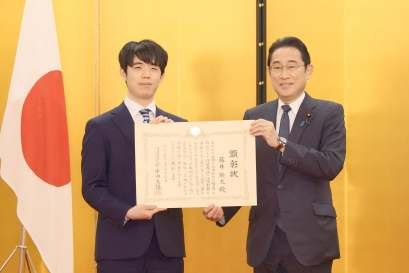
The path to becoming a kishi is still narrow. You enter the Shoreikai, the training body of the Japan Shogi Association, and if you have not reached fourth dan by the age of 26, you must leave. Beyond that lie eight titles, including Meijin and Ryuo. In 2023, Fujii Sota became the first in history to hold all eight.
棋士きしになる道みちは、今いまも狭せまい。日本将棋連盟にほんしょうぎれんめいの養成機関ようせいきかん「奨励会しょうれいかい」に入はいり、26歳さいまでに四段よだんに上あがれなければ、去さらなければなりません。その先さきに、名人めいじん、竜王りゅうおうをはじめとする八やっつのタイトルがあります。2023年ねん、藤井聡太ふじいそうたさんは史上初しじょうはじめて、その八やっつをすべて手てにしました。

Souta Fujii receiving the Prime Minister’s Award
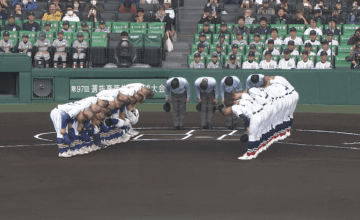
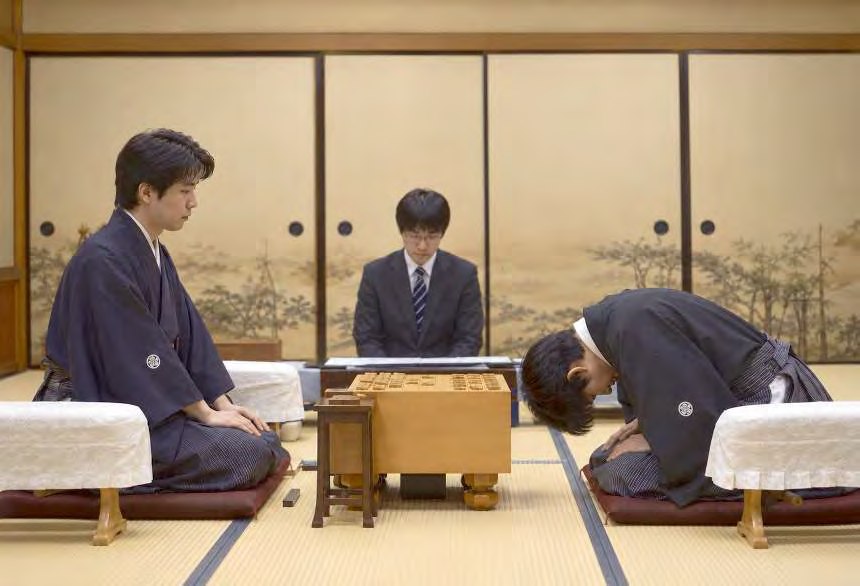
Players bowing at a shogi match

And shogi is not a world confined to the board. You sit seiza in a Japanese-style room, set out the pieces, begin with “onegaishimasu,” and the loser ends by saying “makemashita.” A folding fan in the player’s hand. Even the sound of a piece being placed is expected to be beautiful.
そして将棋しょうぎは、盤ばんの中なかだけの世界せかいではありません。和室わしつに正座せいざし、駒こまを並ならべ、「お願ねがいします」で始はじまり、負まけた側がわが「負まけました」と言いって終おわる。棋士きしの手てには扇子せんす。駒こまを打うつ音おとにまで、美うつくしさが求もとめられます。

The weave of the tatami, the stillness of the garden: everything there is part of the game. None of it is written in the rulebook. And yet all of it, taken together, is “shogi.”
畳たたみの目めも、庭にわの静しずけさも、そこにあるすべてが対局たいきょくの一部いちぶです。ルールブックには書かかれていません。しかし、そのすべてを含ふくめて「将棋しょうぎ」なのです。

Far From Checkmate | まだまだ詰つんでいない

Today, AI sits at that board. The world chess champion lost to a computer in 1997. The shogi Meijin lost in 2017, twenty years later.
その盤ばんに、今いまはAIが座すわっています。チェスの世界王者せかいおうじゃがコンピューターに敗やぶれたのは1997年ねん。将棋しょうぎの名人めいじんが敗やぶれたのは、20年遅ねんおくれて2017年ねんでした。

In chess, as the game goes on, the pieces dwindle and the position grows simpler. In shogi, captured pieces do not disappear. The closer to the end, the more moves there are to play. The rule of pieces in hand, born five hundred years ago, stood before the computer as a great wall.
チェスは、勝負しょうぶが進すすむほど駒こまが減へり、局面きょくめんが単純たんじゅんになっていきます。将棋しょうぎは、取とった駒こまが消きえない。終盤しゅうばんになるほど、指させる手てが増ふえるのです。五百年前ごひゃくねんまえに生うまれた持もち駒ごまのルールが、コンピューターの前まえに大おおきな壁かべとして立たちはだかったのです。

Computers facing human chess and shogi champions

Even so, shogi did not end. Habu Yoshiharu, who led the shogi world of the Heisei era, said, back when software could not yet match a Meijin, “In another twenty years, computers will catch up,” and that is exactly what happened. That same Habu now says he is receiving ideas from AI that he never had himself.
それでも将棋しょうぎは、終おわりませんでした。平成へいせいの将棋界しょうぎかいを率ひきいた羽生善治はぶよしはるさんは、まだソフトが名人めいじんに及およばなかった頃ころ、「あと20年ねんでコンピューターが追おいつく」と言いい、そのとおりになりました。その羽生はぶさんが今いま、AIから自分じぶんにはなかった発想はっそうをもらっていると語かたっています。

The players treat AI not as an enemy but as a partner in study. Humans read the moves AI shows them, and from there a new shogi is born again. Turning an enemy into an ally. The spirit of shogi lives on here, too.
棋士きしたちは、AIを敵てきではなく、研究けんきゅうの相手あいてにしているのです。AIの示しめす手てを人間にんげんが読よみ解とき、そこからまた新あたらしい将棋しょうぎが生うまれる。敵てきを味方みかたにする。将棋しょうぎの精神せいしんは、ここでも生いきています。

Come to think of it, a shogi board is a small thing. Eighty-one squares, forty pieces. Each piece is strictly limited in the directions it can move. Yet the depths of that small board go on forever. However much you play, you never see the bottom.
考かんがえてみれば、将棋盤しょうぎばんは小ちいさなものです。81マス、40枚まいの駒こま。一ひとつひとつの駒こまには、動うごける方向ほうこうが厳きびしく決きめられています。しかし、その小ちいさな盤ばんの奥おくは、どこまでも深ふかい。どれだけ指さしても、底そこが見みえません。

Rules do not take away freedom. It is precisely because there is the frame of the rules that, beyond it, a boundless world of imagination opens up.
ルールは、自由じゆうを奪うばうものではありません。ルールという枠わくがあるからこそ、その奥おくに、果はてしない想像そうぞうの世界せかいが開ひらけるのです。

A game that set out from the battlefields of ancient India reached Japan, was accepted, mixed, pared down, and remade, until at last it took root even in the Japanese language. And now, a thousand years on, new moves are still being born. Shogi is far, far from checkmate.
古代こだいインドの戦場せんじょうから旅立たびだった遊あそびは、日本にほんにたどり着つき、受うけ入いれられ、混まざり、削けずられ、作つくり直なおされ、ついには日本語にほんごの中なかにまで根ねを張はりました。そして千年せんねんたった今いまも、新あたらしい一手いってが生うまれ続つづけています。将棋しょうぎは、まだまだ詰つんでいません。

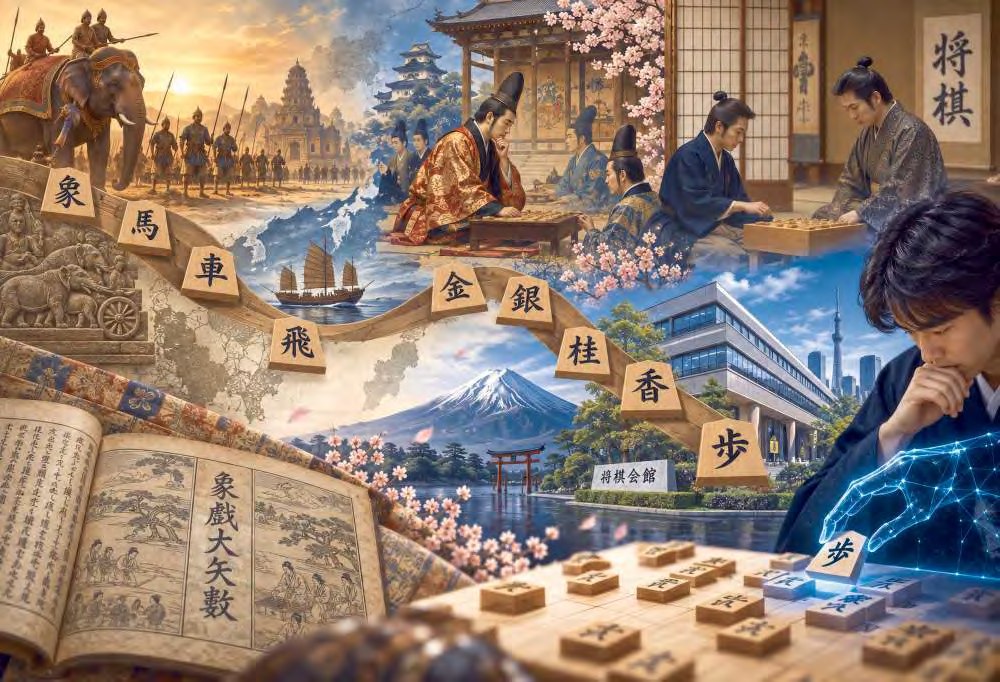
Shogi’s journey from ancient India to modern Japan

Online Japanese Language Courses

Learn Japanese The Fun Way!

🎁 1 Month FREE for Hiragana Times Subscribers

ひらがなタイムズ定期ていき購読者こうどくしゃは1ヶか月げつ無料むりょうでご受講じゅこういただけます

Start Learning →


Continue Reading in Hiragana Times
続きを読む — Hiragana Times 本誌へ


Direct Subscription
Direct Subscription RECOMMENDED
Special Rate Up To 30% Off
直販ページからのお申込で最大30%OFF

Digital Packages
Read and listen in your browser — available in bundles.
誌面と音声を、パッケージでご利用いただけます。

Print Back Issues
Print Back Issues
Explore our archive of past editions.
過去の号を探す。

More From Hiragana Times

Hiragana Times Discord Community
Join the Hiragana Times Discord Community — Free!
Connect with readers worldwide — free, open, and always welcoming.
世界の読者とつながる、無料のDiscordコミュニティへようこそ。

nihongo.net
Online Japanese lessons, run by Hiragana Times.
One month free for Hiragana Times subscribers.
ひらがなタイムズ定期購読者は、1ヶ月無料でご受講いただけます。
Leave a Reply