

Words the Home Holds
家がつつむ言の葉Word Policing or Adaptation? | Rethinking Baseball Terms and the Times They Reflect
言葉狩りか時代適応か。|野球用語見直しが問う、言葉と時代。
Living Like Wood, Flowing Like Water
木のように生き、水のように続く
NIHONGO DO® | Voice Wave – Hiragana Times September 2026 issue
Listen to the Audio:
Living Like Wood, Flowing Like Water
木のように生き、水のように続く
Japan is said to be a “culture of wood,” and the West a “culture of stone.” In Japan, blessed with forests, wooden architecture became the basis of building. In the West, on the other hand, stone construction is the basis.
日本は「木の文化」、西洋は「石の文化」といわれます。森林に恵まれた日本では、木造建築が建物の基本になりました。一方、西洋では石造りが基本です。
If the carpenter represents the craftsmen of Japan, in the West it was the stonemason. In the West, stonemasons were valued everywhere, and it is said that they worked across countries and territories. There is also a theory that such guilds of stonemasons became the origin of the Freemasons.
日本の職人を代表するのが大工なら、西洋のそれは石工でした。西洋では、石工は各地で重宝され、国や領地を越えて仕事をしたともいわれます。そうした石工の組合が、フリーメイソンの源流と考えられています。
Styles of architecture go on to influence the ways of thinking and the views of religion of the people who live there. Wood has a quality that calls to mind reincarnation. A decayed tree does not simply vanish as it is. It is broken down into soil, and from that soil a new bud comes out again. Even when a tree ends its life, it returns to the soil and keeps circulating into the next life.
建築の様式は、そこに暮らす人の考え方や宗教観にも影響していきます。木には、輪廻を思わせる性質があります。朽ちた木は、そのまま消えてなくなるのではありません。土に分解され、その土からまた新しい芽が出てきます。木は、その命を終えても、土へ還り、次の命へと循環し続けるのです。
In Japanese, one sound has one meaning. The same sound should have a connection of meaning. Ki is 木 (tree), and it is also 氣 (energy). Wood could also be called the energy of life itself.
日本語は一音一義。同じ音には、意味のつながりがあるはずです。「キ」は「木」であり、「氣」でもあります。木とは、生命のエネルギーそのものともいえるでしょう。
If Japan, a culture of wood, values kimochi (feeling), then the West, a culture of stone, values ishi (will). The ki of kimochi is the ki of 木 (tree). And ishi (will) is also ishi (stone). I want it this way, I am like this — to show one’s own will clearly. Stone is hard, and its outline is clear. Each one is like a piece of clear logic.
木の文化である日本が「気持ち」を大切にするなら、石の文化である西洋は「意思」を大切にします。「気持ち」の「キ」は、木の「キ」。そして「意思」もまた「イシ」です。私はこうしたい、私はこうである——自分の意思をはっきりと示す。石は硬く、輪郭がはっきりしています。ひとつひとつが、明確なロジックのようです。
What about a tree? Roots stretching into the depths of the earth, a trunk rising toward the sky, spreading branches, and leaves. From where to where is it a tree — that boundary is not clear. The West, which values individual identity, and Japan, whose outlines are vague. That difference overlaps with the difference between stone and wood.
木はどうでしょうか。地の底へ伸びる根、天に向かう幹、広がる枝、そして葉。どこからどこまでが木なのか、その境目は明確ではありません。個のアイデンティティを重んじる西洋と、輪郭のあいまいな日本。その違いは、石と木の違いに重なります。
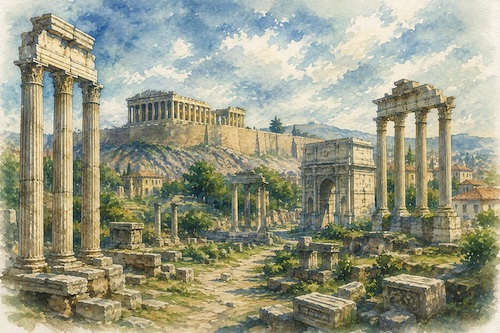
Stone is strong and lasts long. In Greece and Italy, many ancient ruins can still be seen today. Wood, by contrast, has life, and one day it decays. And yet, that cycle continues without ending.
石は強く、長持ちします。ギリシャやイタリアでは、今も古代の遺跡を数多く見ることができます。それに対して木には命があり、いつか朽ちていきます。けれども、その巡りは終わることなく続いていきます。
At Ise Jingu there is the Shikinen Sengu, in which the shrine buildings are rebuilt every twenty years. An exactly identical shrine is built on the neighboring site, and the old one is not destroyed but taken apart. This has been repeated for more than 1,300 years. In other words, the shrine standing there now is, as timber, at most twenty years old.
伊勢神宮には、二十年ごとに社殿を建て替える「式年遷宮」があります。隣の敷地にそっくり同じ社殿を建て、古いほうは、壊すのではなく解かれます。それを千三百年以上、繰り返してきました。つまり、いまそこに建っている社殿は、木材としてはたかだか二十年のものです。
Seen through Western eyes, it would mean that the real thing was lost long ago. Yet Japanese people do not feel that the real thing has been lost. They think that the life of the old shrine moves over entirely into the new wood. Even if the form perishes, the wood (ki) that is there goes on. Rather than leaving the form forever, they let the form perish and keep moving only the life into the next form. Stone leaves the form, and wood carries on the life.
西洋の目から見れば、本物はとうに失われた、ということになるでしょう。ところが日本人は、本物が失われたとは感じません。新しい木に、古い社殿の命がそっくり乗り移ると考えます。形は滅びても、そこにある木(氣)は続いていく。形を永遠に残すのではなく、形は滅びるにまかせ、命だけを次の形へ移し続ける。石は形を残し、木は命をつなぐのです。
Unlock Full Article | 記事全文を読む
Digital Packages
Read and listen in your browser — available in bundles.
誌面と音声を、パッケージでご利用いただけます。
More From Hiragana Times

Join the Hiragana Times Discord Community — Free!
Connect with readers worldwide — free, open, and always welcoming.
世界の読者とつながる、無料のDiscordコミュニティへようこそ。

Online Japanese lessons, run by Hiragana Times.
One month free for Hiragana Times subscribers.
ひらがなタイムズ定期購読者は、1ヶ月無料でご受講いただけます。

Information From Hiragana Times


Topics in Japan
-
![Words That Live with Insects <br src=]() 虫と暮らす言の葉" />
Words That Live with Insects
虫と暮らす言の葉" />
Words That Live with Insects
虫と暮らす言の葉 -
![Bugs Live in the Belly <br src=]() 腹に虫が住む" />
Bugs Live in the Belly
腹に虫が住む" />
Bugs Live in the Belly
腹に虫が住む -
![Voices of Insects — The Soundtrack of Autumn in Japan <br src=]() 虫の声 ― 日本の秋のBGM" />
Voices of Insects — The Soundtrack of Autumn in Japan
虫の声 ― 日本の秋のBGM" />
Voices of Insects — The Soundtrack of Autumn in Japan
虫の声 ― 日本の秋のBGM -
![The Worms Within Came from the Universe <br src=]() 腹の虫は、宇宙から来た" />
The Worms Within Came from the Universe
腹の虫は、宇宙から来た" />
The Worms Within Came from the Universe
腹の虫は、宇宙から来た -
![Ito Jakuchū — An Eye for Life <br src=]() 伊藤若冲 ―― いのちを見る眼" />
Ito Jakuchū — An Eye for Life
伊藤若冲 ―― いのちを見る眼" />
Ito Jakuchū — An Eye for Life
伊藤若冲 ―― いのちを見る眼
 虫と暮らす言の葉" />
 腹に虫が住む" />
 虫の声 ― 日本の秋のBGM" />
 腹の虫は、宇宙から来た" />
 伊藤若冲 ―― いのちを見る眼" />

