

Women are trouble
「おんな」はやっかい
[JAPAN MAZE | 迷宮ニホン – April 2026 Issue]
Women are trouble「おんな」はやっかい
You may understand the words, but still get lost in communication. This corner takes you on a fun journey through the maze of Japanese language and culture with four-panel manga. Unlocking the punchline is the key-it reveals the essence of Japanese expression and leads you to the exit, with a smile and a fresh insight.
言葉の意味はわかるのに、なぜか通じない――。日本語と日本文化の迷宮を、4コマ漫画で楽しく探検するコーナーです。 “オチ”を読み解けば、日本語の本質が見えてくる。迷宮の出口には、気づきと笑いが待っています。
Scene 1
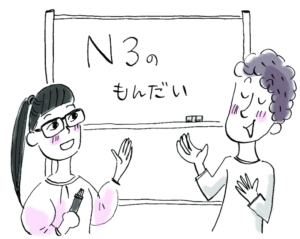
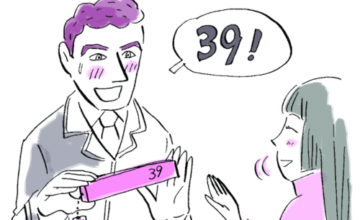
Yumi: Type it in using the Roman alphabet on your computer, then convert it into the hiragana “おんな” (woman).
Jimmy: Easy! Is this really an N3 question?
ゆみ:パソコンにアルファベットで入力し、ひらがなの「おんな」に変換してください。
ジミー :とても簡単です。ほんとにN3の問題ですか。
Scene 2
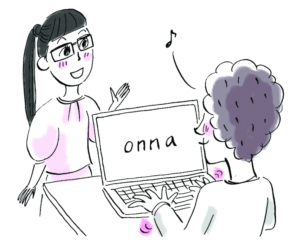
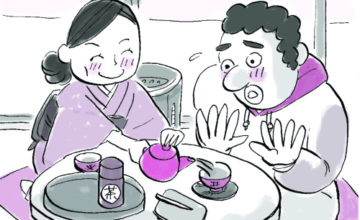
Yumi: This is an n3 question, not n2.
Jimmy: “Oh! Nice, nice, Amicable Women!”
ゆみ: これはn2ではなく、n3の問題です。
ジミー: 「オー! ナイスナイス、アミカブルウーメン」
Scene 3
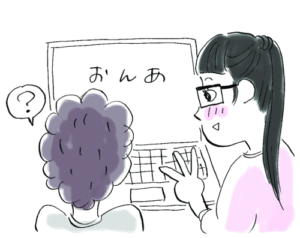
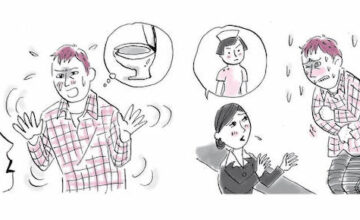
Jimmy: Wait – it won’t convert to “おんな.” How come?
Yumi: “おんな,” you have to type three n’s in a row like “nice, nice, nice.”
ジミー: あれ? 「おんな」にならない。どうして?
ゆみ:「おんな」はnice, nice, niceとnを 3回続けて入力しないとだめです。
Scene 4
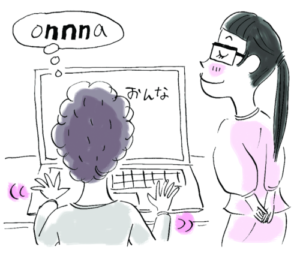
Jimmy: Oh wow, it worked! It’s “おんな”r now.
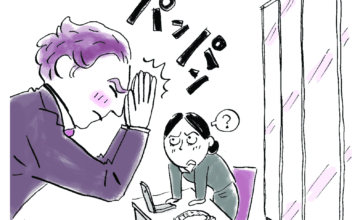
Yumi: See? “おんな” looks innocent enough – but she’s trouble. Get it?
ジミー: ほんとだ。今度は素直に「おんな」になった。
ゆみ:「おんな」はやさしく見えるけど、 やっかいなんです。わかった?
Maze Navigation / 迷宮ナビ
Let’s break down each scene | それぞれのシーンを理解しよう。
Scene 1
Yumi gives Jimmy a simple-sounding task: type “おんな” (woman) in the Roman alphabet and convert it to hiragana. Easy enough, right? Jimmy certainly thinks so. But that confidence is exactly what makes the trap so satisfying.
ゆみ先生がジミーに課題を出します。「おんな」をローマ字入力してひらがなに変換してください。――一見、簡単そうです。ジミーも余裕の表情。しかしこの「簡単そう」が罠なんです。
■ 課題 [task, assignment]
■ 変換 [conversion, to convert]
■ 表情 [facial expression]
■ 余裕 [composure, easy]
Scene 2
Yumi reminds him it’s an N3-level question — but Jimmy is all confidence. He types “onna” and gets ready to convert. So easy, in fact, that he can’t help but sing: “Nice, nice, Amicable Women!”
ゆみ先生の「N3レベルの問題ですよ」とhttps://hiraganatimes.com/audio/2026/04/maze_n.mp3いう言葉に、ジミーは余裕の笑顔。“onna” と入力して「おんな」に変換――簡単すぎる、とばかりに、思わず「ナイスナイス、アミカブルウーメン!」と口ずさんでしまいます。
■ 問題 [question, problem]
■ 笑顔 [smile]
■ 思わず [without thinking, involuntarily]
■ 口ずさむ [to hum, to sing to oneself]
Scene 3
It won’t convert. The answer “おんな” needs three N’s. In Japanese, “ん” is the only character that stands alone, without a vowel. The double N speaks to that solitary strength of “ん.”
変換しても「おんな」にならない。答えは――「おんな」には、n が3つ必要。「ん」は日本語で唯一、母音なしに単独で存在します。二重のnは「ん」の孤高な強さを感じさせます。
■ 母音 [vowel]
■ 孤高 [solitary, standing alone]
■ 単独 [solo, independent]
■ 二重 [double, twofold]
Scene 4
Yumi then “nudges” — and it finally converts. “Women look gentle, but they’re trouble” — through the simple act of typing, Yumi leads Jimmy toward a deeper understanding of women.
今度は素直に「おんな」に変換されました。「女はやさしく見えるけど、やっかい」――ゆみ先生はジミーに、文字の変換を通して、女性への理解を促しました。
■ やっかい [trouble, troublesome]
■ 理解 [understanding, comprehension]
■ 促す [to encourage, to nudge]
Maze Exit / 迷宮出口
What did the punchline reveal? / 今回のオチでわかったこと
Cultural Insight / 新しい発想・文化知識
Glomaji: Unlocking the Sound World of Japanese
グローマ字が開く、日本語の音の世界
Station names, place names, people’s names — romaji is everywhere in Japan. It is helpful for foreign visitors, but once learners begin studying Japanese, this same romaji can become a source of confusion.
駅名や地名、人名など、日本の街にはローマ字があふれています。外国人旅行者のガイドとしては便利ですが、いざ日本語学習を始めると、このローマ字がかえって混乱の原因になることがあります。
For example, は is often written “wa,” and 富士山 as “Fuji-san” — yet in English “f,” with lip touching teeth. It is closer to “hu,” a soft fricative. In Glomaji, 富士山 is “Hujisan.” Type it, and it converts — the sound, faithfully reproduced.
たとえば、「は」が “wa” と表記されていたり、「富士山」が “Fuji-san” と書かれていたり――しかし実際の「ふ」は、英語の “f” のように唇を歯に当てる音ではなく、“hu” に近い、やわらかな摩擦音です。グローマ字では、富士山は “Hujisann” と入力されそのまま変換され、音も忠実に再現できます。
To solve this confusion, Hiragana Times developed Glomaji (Global Romaji) — a highly practical system that converts directly into Japanese when typed on a keyboard. The particle は is written “ha.” This is not simply a rule, but a deliberate choice to pass on the written culture of Japanese to learners.
この混乱を解決するために、ひらがなタイムズが考案したのが「グローマ字(Global Romaji)」です。キーボードではそのまま日本語に変換される、実用性の高いシステムです。「わ」とは書かず「は」は “ha” と書きます。これは単なるルールではなく、日本語の表記文化そのものを学習者に伝えるための選択です。
And Glomaji’s deepest gift is the way it makes Japanese phonology visible. The single character か holds within it both “k” and “a.” In the Japanese tradition of kotodama(言霊), “k” is called the “father sound” and “a” the “mother sound.” Where father sound and mother sound meet, the “child sound” — か — is born. Sound is energy; sound is life itself — and that story is encoded in every character of Japanese.
そしてグローマ字の最も深い贈り物は、日本語の音韻体系を可視化することです。「か」という一文字の中に、k と a が宿っています。日本の言霊学では、k を父音、a を母音と呼びます。父音と母音が出会うところに、子音として「か」が生まれます。音はエネルギーであり、命そのもの――日本語の文字には、そのような世界観が刻まれているのです。
Glomaji is not only a tool for typing — it is a window through which to feel the essence of language.
グローマ字は、文字を「打つ」道具であると同時に、言語の本質を「感じる窓」でもあります。
This article is from the April 2026 issue of Hiragana Times.
この記事は、月刊誌『ひらがなタイムズ』2026年4月号より掲載しています。
Information From Hiragana Times


Topics in Japan
-
![Nobody Tells You <br src=]() でも、伝わってくる" />
Nobody Tells You
でも、伝わってくる" />
Nobody Tells You
でも、伝わってくる -
![People Who Can’t Help Making Things <br src=]() 作らずにいられない人々" />
People Who Can’t Help Making Things
作らずにいられない人々" />
People Who Can’t Help Making Things
作らずにいられない人々 -
![Shogi: The Culture That Turned Enemies into Treasure <br src=]() 将棋 — 敵を宝に変えた文化" />
Shogi: The Culture That Turned Enemies into Treasure
将棋 — 敵を宝に変えた文化" />
Shogi: The Culture That Turned Enemies into Treasure
将棋 — 敵を宝に変えた文化 -
![The Story of “Wa” (倭 and 和) and “Yamato” (大和) <br src=]() 「倭」と「和」と「大和」の物語" />
The Story of “Wa” (倭 and 和) and “Yamato” (大和)
「倭」と「和」と「大和」の物語" />
The Story of “Wa” (倭 and 和) and “Yamato” (大和)
「倭」と「和」と「大和」の物語 -
![The United Nations That Runs on “Victors’ Justice” <br src=]() 「勝者の正義」で動く国連" />
The United Nations That Runs on “Victors’ Justice”
「勝者の正義」で動く国連" />
The United Nations That Runs on “Victors’ Justice”
「勝者の正義」で動く国連
 でも、伝わってくる" />
 作らずにいられない人々" />
 将棋 — 敵を宝に変えた文化" />
 「倭」と「和」と「大和」の物語" />
 「勝者の正義」で動く国連" />

