
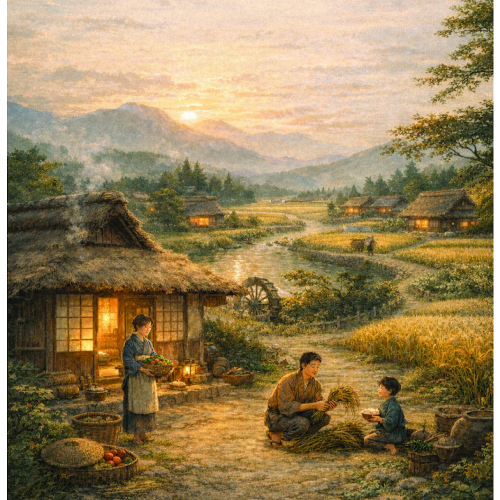
“Good feeding before good breeding.”
「衣食足りて礼節を知る」
[NIHONGO DO – Voice-word Art– May 2026 Issue]
“Good feeding before good breeding.” – When people are well fed and clothed, they come to know courtesy and propriety.
「衣食(いしょく)足(た)りて礼節(れいせつ)を知(し)る」– 国(くに)の品格(ひんかく)は、まず民(たみ)の暮(く)らしの安定(あんてい)から始(はじ)まる。
This “Voice-Word Art” section introduces seasonal words related to the time of year. Enjoy the timeless beauty of these artistic expressions.
この「言技(ことわざ)」セクションでは、季節(きせつ)にちなんだ季語(きご)を紹介(しょうかい)しています。時代(じだい)を超(こ)えて響(ひび)く言葉(ことば)のアート(言技(ことわざ))をお楽(たの)しみください。
Good feeding before good breeding.
衣食足(いしょくた)りて礼節(れいせつ)を知(し)る
“Ishoku tarite reisetsu wo shiru.”
“Ishoku tarite reisetsu wo shiru” is an expression meaning that only when clothing and food are sufficient do people come to understand courtesy and proper conduct. In other words, human morality and dignity can be nurtured only when they rest on the foundation of a stable daily life.
「衣食足(いしょくた)りて礼節(れいせつ)を知(し)る」とは、衣服(いふく)と食(た)べ物(もの)が満(み)たされてこそ、人(ひと)は礼儀(れいぎ)や節度(せつど)をわきまえるようになる、という意味(いみ)のことばです。言(い)い換(か)えれば、人(ひと)としてのモラル(morality)や品位(ひんい)は、まず暮(く)らしの安定(あんてい)という土台(どだい)があってこそ育(はぐく)まれる、ということです。
In this month’s Japan Style feature, Emperor Nintoku is introduced as a ruler who first turned his attention to the people’s food. The well-known story tells how, seeing no smoke rising from the hearths of the people, he realized their hardship and chose to lighten their burden. Only when the lives of the people are protected can a nation become stable, and only then can great undertakings and culture begin to flourish. Even those magnificent kofun may be seen as having been built upon such a foundation of prosperity.
今月号(こんげつごう)の Japan Style で紹介(しょうかい)した仁徳天皇(にんとくてんのう)も、まず民(たみ)の「食(しょく)」に目(め)を向(む)けました。民(たみ)のかまどに煙(けむり)が立(た)たないのを見(み)て、その困窮(こんきゅう)を察(さっ)し、負担(ふたん)を軽(かる)くしたという逸話(いつわ)はよく知(し)られています。民(たみ)の暮(く)らしが守(まも)られてこそ、国(くに)は安定(あんてい)し、その先(さき)に大(おお)きな営(いとな)みや文化(ぶんか)も育(そだ)っていく――あの壮大(そうだい)な古墳(こふん)も、そうした豊(ゆた)かな土台(どだい)の上(うえ)に築(きず)かれたものと見(み)ることができるでしょう。
Eiichi Shibusawa, whose portrait appears on today’s 10,000-yen note and who is often called the father of Japanese capitalism, is known for the phrase, “The Analects in one hand, the abacus in the other.” In those words lies the idea that while morality and compassion for others must be cherished, economic activity must also be kept moving so that such ideals do not remain mere abstractions.
現在(げんざい)の一万円札(いちまんえんさつ)の肖像(しょうぞう)であり、「日本資本主義(にほんしほんしゅぎ)の父(ちち)」とも呼(よ)ばれる渋沢栄一(しぶさわえいいち)は、「片手(かたて)に論語(ろんご)、片手(かたて)にそろばん(abacus)」という言葉(ことば)で知(し)られています。そこには、道徳(どうとく)や人(ひと)への思(おも)いやりを大切(たいせつ)にしながらも、それを空論(くうろん)に終(お)わらせないために、経済(けいざい)をしっかりと回(まわ)していくことの重要性(じゅうようせい)が込(こ)められています。
Another famous saying comes from Ninomiya Sontoku, known for the philosophy of Hōtoku: “Economy without morality is a crime; morality without economy is empty talk.” A society cannot be sustained by moral teachings alone. Yet if it pursues profit alone, it will inevitably fall into ruin. What matters is to uphold both morality and economy, both ideals and reality.
また、報徳思想(ほうとくしそう)で知(し)られる二宮尊徳(にのみやそんとく)の「道徳(どうとく)なき経済(けいざい)は犯罪(はんざい)であり、経済(けいざい)なき道徳(どうとく)は寝言(ねごと)である」という言葉(ことば)も有名(ゆうめい)です。人(ひと)の道(みち)を説(と)くだけでは社会(しゃかい)は成(な)り立(た)たず、かといって利益(りえき)だけを追(お)えば、そこには荒廃(こうはい)が生(う)まれます。大切(たいせつ)なのは、道徳(どうとく)と経済(けいざい)、理想(りそう)と現実(げんじつ)、その両方(りょうほう)を支(ささ)えることなのでしょう。
If daily life is not secure, it is difficult for people to maintain calmness, compassion, and the dignity proper to human beings. The phrase “Ishoku tarite reisetsu wo shiru” is a kotowaza that teaches this simple yet profoundly essential truth.
まず日々(ひび)の暮(く)らしが安定(あんてい)していなければ、人(ひと)は落(お)ち着(つ)きや思(おも)いやり、そして人(ひと)としての品位(ひんい)を十分(じゅうぶん)に保(たも)つことが難(むずか)しい――「衣食足(いしょくた)りて礼節(れいせつ)を知(し)る」ということばは、そうした素朴(そぼく)でありながらも、きわめて本質的(ほんしつてき)な現実(げんじつ)を教(おし)えてくれる言技(ことわざ)です。
This article is from the May 2026 issue of Hiragana Times.
この記事(きじ)は、月刊誌(げっかんし)『ひらがなタイムズ』2026年(ねん)5月号(がつごう)より掲載(けいさい)しています。
節句 —— 一年を整える、五つの節目Seasonal Words: Japan’s May, Satsuki — A Month When Life Grows and Gratitude Blooms.
季節の言の葉:日本の5月「皐月(さつき)」— 命が伸び、感謝が芽生える月。

Information From Hiragana Times


Topics in Japan
-
![Japanese Minka—Homes Alive with Nature <br src=]() 自然の中で生きている日本民家" />
Japanese Minka—Homes Alive with Nature
自然の中で生きている日本民家" />
Japanese Minka—Homes Alive with Nature
自然の中で生きている日本民家 -
![The Man Who Chose Harmony in an Age of Blood | Prince Shōtoku <br src=]() 血の時代に、和を選んだ人 | 聖徳太子" />
The Man Who Chose Harmony in an Age of Blood | Prince Shōtoku
血の時代に、和を選んだ人 | 聖徳太子" />
The Man Who Chose Harmony in an Age of Blood | Prince Shōtoku
血の時代に、和を選んだ人 | 聖徳太子 -
![The Fish That Leads the Way into Autumn <br src=]() 秋の先頭を泳ぐ魚" />
The Fish That Leads the Way into Autumn
秋の先頭を泳ぐ魚" />
The Fish That Leads the Way into Autumn
秋の先頭を泳ぐ魚 -
![The House Has Ears, Eyes—and a Mouth <br src=]() 耳と目と口を持つ家" />
The House Has Ears, Eyes—and a Mouth
耳と目と口を持つ家" />
The House Has Ears, Eyes—and a Mouth
耳と目と口を持つ家 -
![Words the Home Holds <br src=]() 家がつつむ言の葉" />
Words the Home Holds
家がつつむ言の葉" />
Words the Home Holds
家がつつむ言の葉
 自然の中で生きている日本民家" />
 血の時代に、和を選んだ人 | 聖徳太子" />
 秋の先頭を泳ぐ魚" />
 耳と目と口を持つ家" />
 家がつつむ言の葉" />

