
Another Drink
もういっぱい
[JAPAN MAZE | 迷宮ニホン – January 2026 Issue]
You may understand the words, but still get lost in communication. This corner takes you on a fun journey through the maze of Japanese language and culture with four-panel manga. Unlocking the punchline is the key – it reveals the essence of Japanese expression and leads you to the exit, with a smile and a fresh insight.
言葉の意味はわかるのに、なぜか通じない――。日本語と日本文化の迷宮を、4コマ漫画で楽しく探検するコーナーです。 “オチ”を読み解けば、日本語の本質が見えてくる。迷宮の出口には、気づきと笑いが待っています。
もういっぱい | Another Drink
Scene 1
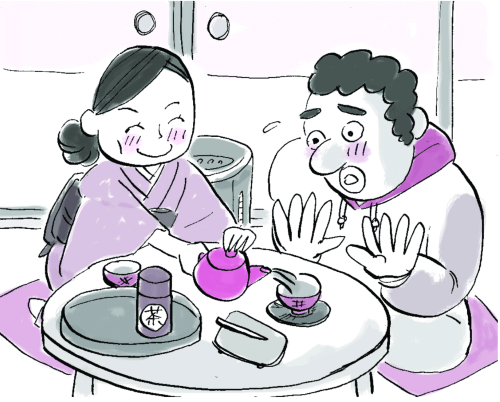
ホストマザー:お茶はいかがですか。
Host Mother: How about a cup of tea?
留学生:ありがとう。
Foreign Student: Thank you.
Scene 2
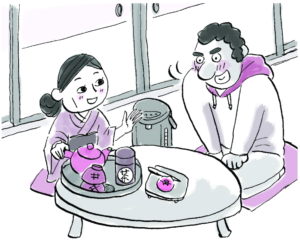
留学生:とてもおいしい。
Foreign Student: It’s really good.
ホストマザー:そう、それではもう一杯いかがですか。
Host Mother: Well then, how about another cup?
Scene 3
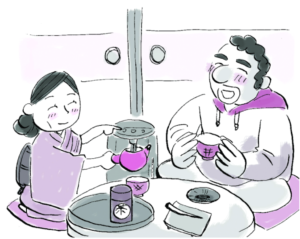
留学生:すみません。もういっぱい。
Foreign Student: Thank you, I have had enough.
ホストマザー:あなた、本当にお茶が好きなんですね。
Host Mother: You really like tea.
さあ、さあ。
Please please.
Scene 4
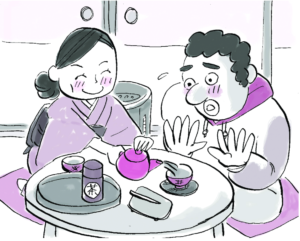
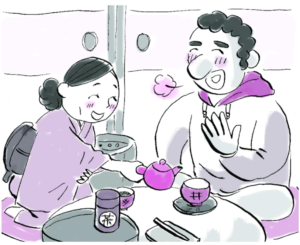
留学生:もういっぱい。たくさんです
Foreign Student: I have had enough, no more thanks.
ホストマザー:そう、どうぞ、どうぞ。たくさん飲んで!
Host Mother: Good, please, please. Drink a lot!
Maze Navigation / 迷宮ナビ
Let’s break down each scene | それぞれのシーンを理解しよう。
Scene 1
When visiting a Japanese home, it is common to be welcomed with a warm cup of tea. In this scene, the host mother offers tea to a student who has just arrived in Japan. Serving tea is a Japanese custom that expresses “welcome,” and the student gladly responds.
日本の家庭を訪問すると、温かいお茶でもてなされることがよくあります。このシーンでは、訪日したばかりの留学生に、ホストマザーがお茶を勧めています。お茶は「ようこそ」の気持ちを伝える日本の習慣で、留学生も喜んで応じています。
■ 家庭 [home]
■ もてなす [to welcome / to treat]
■ 勧める [to offer / to recommend]
■ 習慣 [custom]
Scene 2
In many Japanese homes, a hot-water pot is kept so that tea can be prepared anytime. The host mother pours hot water into a teapot and carefully serves the tea into a cup. The student relaxes and smiles, saying it tastes good.
日本の家庭では、温かいお茶をすぐ入れられるよう、保温ポットを置いていることがよくあります。ホストマザーは急須にお湯を注ぎ、丁寧に湯呑みにお茶をついでいます。留学生はリラックスし、おいしいと、笑顔を見せています。
■ 保温 [keep warm]
■ 急須 [teapot]
■ お湯 [hot water]
■ 注ぐ [to pour]
■ 丁寧に [carefully / politely]
Scene 3
The student thinks he is saying “mō ippai,” meaning “I’ve had enough,” but the host mother hears it as “mō ippai,” meaning “one more cup.” This misunderstanding leads her to assume he reallyt loves tea, and she continues to offer him more.
留学生は「もういっぱい、イコール、もう十分です、と断っているつもりですが、ホストマザーはそれを、もう一杯、イコール、おかわり、と受け取りました。行き違いが生まれ、お茶好きだと思い込んだホストマザーは、さらに勧めています。
■ 断る[to refuse]
■ 受け取る[to take, to interpret as]
■ 行き違い[misunderstanding]
■ 思い込む[to assume]
Scene 4
Finally, the student says, “Mō ippai, takusan desu,” meaning he’s had more than enough. However, the host mother hears it as “One more cup, a lot please,” and continues pouring tea for him.
とうとう、留学生は「もういっぱい、たくさんです」と断っていますが、ホストマザーはそれを「もう一杯、たくさん欲しい」と受け取り、さらにお茶を注ぎます。
■ もう一杯 [one more cup]
■ いっぱい [enough / full]
■ たくさん [a lot]
■ さらに [further / additionally]
Maze Exit / 迷宮出口
What did the punchline reveal? / 今回のオチでわかったこと
Cultural Insight / 新しい発想・文化知識
Japanese has an exceptionally large number of homophones—words that sound the same but have different meanings. This may seem difficult at first, but English has similar examples such as “knight” and “night,” or “pair” and “pear.” Even when words sound identical, their meanings become clear from context.
日本語には、音が同じで意味が異なる言葉(同音異義語)が非常に多く存在します。最初は難しく感じるかもしれませんが、英語にも “knight / night” や “pair / pear” のような例があります。音が同じでも、文脈によって意味は自然に理解されます。
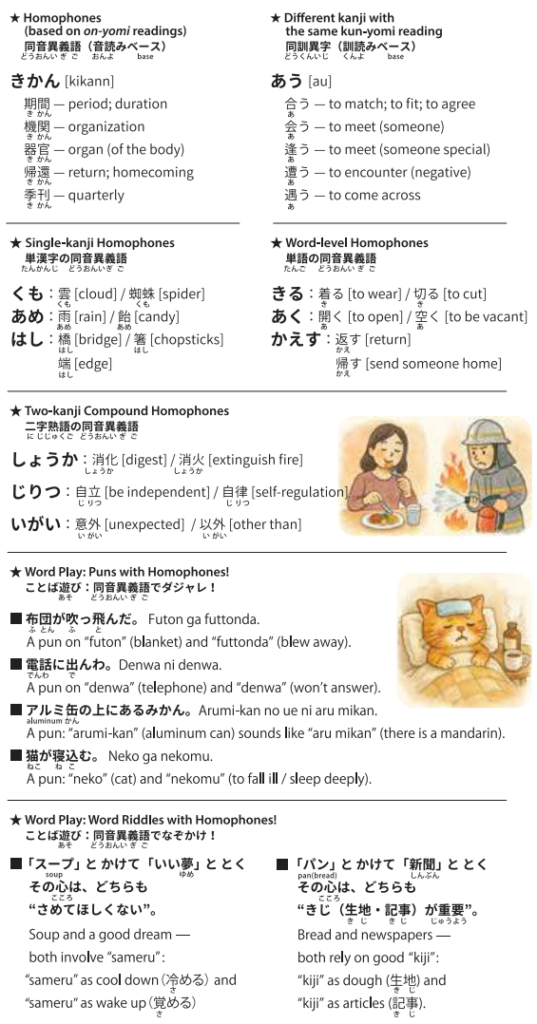
Homophones in Japanese form a world where depth and playfulness coexist. They sound the same to the ear, yet look and feel different to the eye—this duality is part of the charm of the Japanese language.
同音異義語は、日本語の奥深さと遊び心が混ざり合った世界。耳では同じ、目では違う、その二重性こそが、日本語の魅力です。
This article is from the January 2026 issue of Hiragana Times.
この記事は、月刊誌『ひらがなタイムズ』2026年1月号より掲載しています。
大相撲初場所 ―― 土俵入りShogatsu—Osechi Cuisine Celebrating the “Fushi” (Nodes) of the Sun and Moon
正月――太陽と月の節(ふし)を祝うお節料理
Information From Hiragana Times


Topics in Japan
-
![Japanese Minka—Homes Alive with Nature <br src=]() 自然の中で生きている日本民家" />
Japanese Minka—Homes Alive with Nature
自然の中で生きている日本民家" />
Japanese Minka—Homes Alive with Nature
自然の中で生きている日本民家 -
![The Man Who Chose Harmony in an Age of Blood | Prince Shōtoku <br src=]() 血の時代に、和を選んだ人 | 聖徳太子" />
The Man Who Chose Harmony in an Age of Blood | Prince Shōtoku
血の時代に、和を選んだ人 | 聖徳太子" />
The Man Who Chose Harmony in an Age of Blood | Prince Shōtoku
血の時代に、和を選んだ人 | 聖徳太子 -
![The Fish That Leads the Way into Autumn <br src=]() 秋の先頭を泳ぐ魚" />
The Fish That Leads the Way into Autumn
秋の先頭を泳ぐ魚" />
The Fish That Leads the Way into Autumn
秋の先頭を泳ぐ魚 -
![The House Has Ears, Eyes—and a Mouth <br src=]() 耳と目と口を持つ家" />
The House Has Ears, Eyes—and a Mouth
耳と目と口を持つ家" />
The House Has Ears, Eyes—and a Mouth
耳と目と口を持つ家 -
![Words the Home Holds <br src=]() 家がつつむ言の葉" />
Words the Home Holds
家がつつむ言の葉" />
Words the Home Holds
家がつつむ言の葉
 自然の中で生きている日本民家" />
 血の時代に、和を選んだ人 | 聖徳太子" />
 秋の先頭を泳ぐ魚" />
 耳と目と口を持つ家" />
 家がつつむ言の葉" />

