

Is AI a Threat to Humanity?
AIは人類の脅威か?The Origin of Games Is Still Alive
ゲームの原点は、今も生きている
A Horse from a Gourd
瓢箪から駒
NIHONGO DO® | Voice – Word Art – Hiragana Times November 2026 issue
Listen to the Audio:
A Horse from a Gourd
瓢箪から駒
What we call kotowaza is written with the kanji 諺. Here, we go beyond proverbs—from the Analects and waka poetry to modern spoken Japanese—to explore the art of words (言技), in which 言波 (voice waves) and 言の葉 (word leaves) intermingle and nurture our sensibilities. A joke comes true. The Japanese have called this wonder “a horse from a gourd” (hyotan kara koma). In this issue, please enjoy the word art that comes out of the gourd.
「ことわざ」は、漢字で「諺」と書きます。ここでは諺にとどまらず、論語、和歌、現代口語まで、「言波」と「言の葉」が融合し、感性を育ててきた言葉のアート「言技」を紹介します。冗談が、本当になる。日本人は、その不思議を「瓢箪から駒」と呼んできました。今号では、瓢箪から出てくる言技をお楽しみください。
A Horse Comes Out of a Gourd
瓢箪から駒が出る
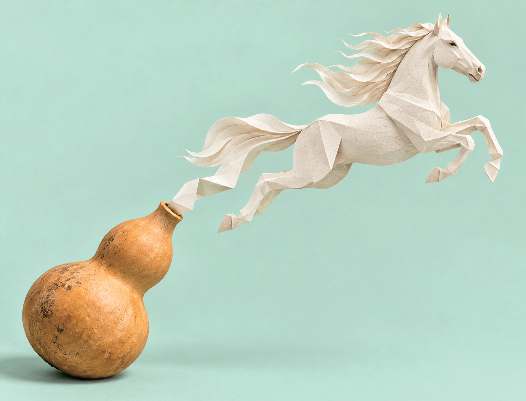
Hyotan, the bottle gourd, is a plant of the gourd family. It is said to have originated in Africa and is one of the oldest cultivated plants in the world. It has been used as a container, not as food, all over the world. A ripe gourd with its flesh removed and dried becomes a light, sturdy water bottle, sake container, or medicine container. Six gourds together are called “mubyo” (六瓢) and are regarded as a lucky charm for good health. Because the gourd has many seeds, it is also a sign of prosperity for one’s descendants. “Hyotan kara koma ga deru” (a horse comes out of a gourd) means that something unexpected comes out of an unexpected place. It is also used when a joke comes true. “Koma” is not a shogi piece, but a horse. It comes from a tale of Zhang Guolao, a Chinese immortal. Traveling on a white donkey, he folded it like paper into a gourd when not in use, and sprayed it with water to bring it back. In Japan, the tale became a picture, the donkey became a horse, and the phrase came to express the surprise of a horse coming out of a gourd.
瓢箪は、ウリ科の植物です。アフリカ原産とされ、世界で最も古い栽培植物の一つ。食べ物ではなく入れ物として、世界各地で使われてきました。熟した実の中身を抜いて乾かせば、軽くて丈夫な水筒や酒入れ、薬入れになります。六つそろえて「六瓢」と呼び、無病息災の縁起物とされます。種が多いことから、子孫繁栄の印にも。「瓢箪から駒が出る」は、意外な所から思わぬ物が出ること。冗談が本当になる時にも使います。「駒」は将棋の駒ではなく、馬のこと。もとは中国の仙人・張果老の話。白いロバで旅をし、使わない時は紙のようにたたんで瓢箪にしまい、乗る時は水を吹きかけて戻しました。日本ではこの話が絵になり、ロバは馬に変わり、瓢箪から馬が出る驚きを表す言葉になりました。
■ Meaning / 意味
- Hyotan kara: From a gourd—out of a small container that could never hold a horse.
瓢箪から:馬など入らない、小さな入れ物から。 - Koma ga deru: A horse comes out—that horse leaps out, a truly unexpected event.
駒が出る:その馬が飛び出す、まさかの出来事。
■ Usage / 使う場面
Kenta: I joked, “I’ll treat you if we win,” and we actually won.
ケンタ:冗談で「優勝したらおごる」と言ったら、優勝しちゃった。
Misaki: A horse from a gourd, huh.
ミサキ:瓢箪から駒だね。
Kenta: Is “koma” the shogi piece?
ケンタ:「駒」って、将棋の駒のこと?
Misaki: It’s a horse.
ミサキ:馬のことだよ。
Kenta: Well then, as promised, tonight’s on me.
ケンタ:じゃあ、約束どおり、今夜はおごるよ。
Discover More Articles | もっと記事を読む
Digital Packages
Read and listen in your browser — available in bundles.
誌面と音声を、パッケージでご利用いただけます。
More From Hiragana Times

Join the Hiragana Times Discord Community — Free!
Connect with readers worldwide — free, open, and always welcoming.
世界の読者とつながる、無料のDiscordコミュニティへようこそ。

Online Japanese lessons, run by Hiragana Times.
One month free for Hiragana Times subscribers.
ひらがなタイムズ定期購読者は、1ヶ月無料でご受講いただけます。


Information From Hiragana Times


Topics in Japan
-
![Nobody Tells You <br src=]() でも、伝わってくる" />
Nobody Tells You
でも、伝わってくる -
![People Who Can’t Help Making Things <br src=]() 作らずにいられない人々" />
People Who Can’t Help Making Things
作らずにいられない人々 -
![Shogi: The Culture That Turned Enemies into Treasure <br src=]() 将棋 — 敵を宝に変えた文化" />
Shogi: The Culture That Turned Enemies into Treasure
将棋 — 敵を宝に変えた文化 -
![The Story of “Wa” (倭 and 和) and “Yamato” (大和) <br src=]() 「倭」と「和」と「大和」の物語" />
The Story of “Wa” (倭 and 和) and “Yamato” (大和)
「倭」と「和」と「大和」の物語 -
![The United Nations That Runs on “Victors’ Justice” <br src=]() 「勝者の正義」で動く国連" />
The United Nations That Runs on “Victors’ Justice”
「勝者の正義」で動く国連
 でも、伝わってくる" />
 作らずにいられない人々" />
 将棋 — 敵を宝に変えた文化" />
 「倭」と「和」と「大和」の物語" />
 「勝者の正義」で動く国連" />

