
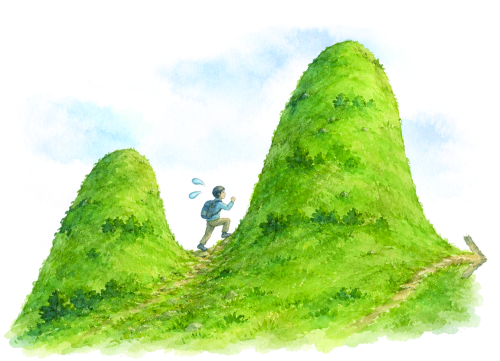
Mountains, and the Shape of a Life
山が語る、人生のかたち
[NIHONGO DO – Voice-word Art – June 2026 Issue]
Mountains, and the Shape of a Life
山(やま)が語(かた)る、人生(じんせい)のかたち
What we call kotowaza is written 諺. Here we go beyond its original sense — to the Analects, waka poetry, and modern spoken Japanese — introducing the art of words (言技), where 言波 (voice waves) and 言の葉 (word leaves) intermingle and nurture our sensibilities. The Japanese, living in a “land of mountains,” have created a wealth of mountain-inspired expressions. In this issue, please enjoy the word art (言技) born only of mountainous Japan.
「ことわざ」は「諺(ことわざ)」と書(か)きます。ここでは諺(ことわざ)にとどまらず、論語(ろんご)、和歌(わか)、現代口語(げんだいこうご)まで、「言波(ことなみ)」と「言(こと)の葉(は)」が融合(ゆうごう)し感性(かんせい)を育(そだ)ててきた言葉(ことば)のアート(言技(ことわざ))を紹介(しょうかい)します。山(やま)の国(くに)に暮(く)らしてきた日本人(にほんじん)は、山(やま)にまつわる豊(ゆた)かな表現(ひょうげん)を数多(かずおお)く生(う)み出(だ)してきました。今号(こんごう)では、山(やま)の国(くに)・日本(にほん)ならではの言技(ことわざ)をお楽(たの)しみください。
Life has its ups and downs.
人生(じんせい)、山(やま)あり谷(たに)あり。
In life, there are smooth times and there are hard times. This is an expression that overlays those ups and downs onto the landscape of mountains and valleys.
人生(じんせい)には、順調(じゅんちょう)な時(とき)もあれば、苦(くる)しい時(とき)もあります。その浮(う)き沈(しず)みを、山(やま)と谷(たに)の風景(ふうけい)に重(かさ)ねて表(あらわ)した言葉(ことば)です。
Japan is a land of mountains. Since ancient times, people have lived their lives crossing peaks and traversing valleys. In time, “mountain” came to symbolize hardship or a great turning point, and “valley” a downturn or sorrow.
日本(にほん)は山(やま)の多(おお)い国(くに)です。人々(ひとびと)は古(ふる)くから山(やま)を越(こ)え、谷(たに)を渡(わた)りながら暮(く)らしてきました。そのため、「山(やま)」は困難(こんなん)や大(おお)きな節目(ふしめ)を、「谷(たに)」は落(お)ち込(こ)みや苦(くる)しみを象徴(しょうちょう)する言葉(ことば)として使(つか)われるようになりました。
Yet mountains open up the view, and valleys let the water flow. The phrase yama ari, tani ari carries a distinctly Japanese sensibility: the will to walk on, embracing life’s very changes.
しかし、山(やま)があるからこそ景色(けしき)が広(ひろ)がり、谷(たに)があるからこそ水(みず)が流(なが)れます。「山(やま)あり谷(たに)あり」という言葉(ことば)には、人生(じんせい)の変化(へんか)そのものを受(う)け入(い)れながら歩(あゆ)んでいこうとする、日本人(にほんじん)らしい感覚(かんかく)が込(こ)められています。
■ Meaning / 意味(いみ)
Yama ari: there are good times and great turning points.
山(やま)あり:良(よ)い時期(じき)や大(おお)きな節目(ふしめ)がある。
Tani ari: there are also hard times and moments of decline.
谷(たに)あり:苦(くる)しい時期(じき)や落(お)ち込(こ)む時(とき)もある。
■ Usage / 使(つか)う場面(ばめん)
A: How’s the new project going?
A: 新(あたら)しいプロジェクト(project)は順調(じゅんちょう)?
B: Well, it’s been yama ari, tani ari — ups and downs. We’re right at the yamaba (climax) now.
B: いやあ、山(やま)あり谷(たに)ありだよ。今(いま)ちょうど山場(やまば)でさ。
A: Sounds like the challenges are yamazumi (piled up like a mountain)?
A: 課題(かだい)が山積(やまづ)みって感(かん)じ?
B: Yeah. Everyone’s got a bit of yamakke (an adventurous, risk-taking spirit), so we tend to aim big.
B: そう。みんな山(やま)っ気(け)あるから、つい大(おお)きく構(かま)えちゃってね。
A: But once you get over the mountain, things should settle down, right?
A: でも、山(やま)を越(こ)えれば落(お)ち着(つ)くんじゃない?
B: I hope so. This time we can’t just rely on yamakan (gut instinct) and yama wo haru (take a wild bet), so we’re moving carefully.
B: だといいけどね。今回(こんかい)は山勘(やまかん)だけで山(やま)を張(は)れないから、慎重(しんちょう)に進(すす)めてるよ。
This article is from the June 2026 issue of Hiragana Times.
この記事(きじ)は、月刊誌(げっかんし)『ひらがなタイムズ』2026年(ねん)6月号(がつごう)より掲載(けいさい)しています。


Information From Hiragana Times


Topics in Japan
-
![Shogi: The Culture That Turned Enemies into Treasure <br src=]() 将棋 — 敵を宝に変えた文化" />
Shogi: The Culture That Turned Enemies into Treasure
将棋 — 敵を宝に変えた文化" />
Shogi: The Culture That Turned Enemies into Treasure
将棋 — 敵を宝に変えた文化 -
![The Story of “Wa” (倭 and 和) and “Yamato” (大和) <br src=]() 「倭」と「和」と「大和」の物語" />
The Story of “Wa” (倭 and 和) and “Yamato” (大和)
「倭」と「和」と「大和」の物語" />
The Story of “Wa” (倭 and 和) and “Yamato” (大和)
「倭」と「和」と「大和」の物語 -
![People Who Can’t Help Making Things <br src=]() 作らずにいられない人々" />
People Who Can’t Help Making Things
作らずにいられない人々" />
People Who Can’t Help Making Things
作らずにいられない人々 -
![Nobody Tells You <br src=]() でも、伝わってくる" />
Nobody Tells You
でも、伝わってくる" />
Nobody Tells You
でも、伝わってくる -
![The United Nations That Runs on “Victors’ Justice” <br src=]() 「勝者の正義」で動く国連" />
The United Nations That Runs on “Victors’ Justice”
「勝者の正義」で動く国連" />
The United Nations That Runs on “Victors’ Justice”
「勝者の正義」で動く国連
 将棋 — 敵を宝に変えた文化" />
 「倭」と「和」と「大和」の物語" />
 作らずにいられない人々" />
 でも、伝わってくる" />
 「勝者の正義」で動く国連" />

