
Hiyashi Chuka — Now Serving
冷やし中華はじめました。Words Nourished by Food
食に育まれた言の葉
Food, and the Shape of a Life
食が映す、生き方のかたち
Nihongo Do | Word Art – Hiragana Times July 2026 issue
Listen to the Audio:
『言技』 Voice / Word Art
Food, and the Shape of a Life
食(しょく)が映(うつ)す、生(い)き方(かた)のかたち
What we call kotowaza is written 諺. Here we go beyond its original sense — to the Analects, waka poetry, and modern spoken Japanese — introducing the art of words (言技), where 言波 (voice waves) and 言の葉 (word leaves) intermingle and nurture our sensibilities. The Japanese have long found wisdom, restraint, and beauty in the act of eating. In this issue, please enjoy the word art (言技) born from Japan’s rich culture of food.
「ことわざ」は「諺(ことわざ)」と書(か)きます。ここでは諺(ことわざ)にとどまらず、論語(ろんご)、和歌(わか)、現代口語(げんだいこうご)まで、「言波(ことなみ)」と「言(こと)の葉(は)」が融合(ゆうごう)し感性(かんせい)を育(そだ)ててきた言葉(ことば)のアート(言技(ことわざ))を紹介(しょうかい)します。日本人(にほんじん)は古(ふる)くから、食(た)べるという営(いとな)みの中(なか)に、知恵(ちえ)や節度(せつど)、美(うつく)しさを見(み)いだしてきました。今号(こんごう)では、日本(にほん)の豊(ゆた)かな食文化(しょくぶんか)から生(う)まれた言技(ことわざ)をお楽(たの)しみください。
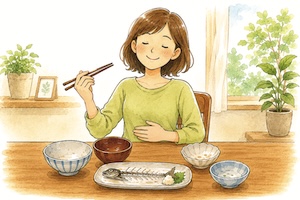
Eating Until Eight-Tenths Full Keeps the Doctor Away
腹八分目(はらはちぶんめ)に医者(いしゃ)いらず
Eating without overdoing it, and stopping when you are about eight-tenths full, leads to good health. In Japan, it has long been believed that moderation is best in all things.
食(た)べ過(す)ぎず、腹八分目(はらはちぶんめ)でやめることが健康(けんこう)につながる――日本(にほん)では古(ふる)くから、何事(なにごと)も「ほどほど」が良(よ)いとされてきました。
This saying points to more than just the amount we eat. The Japanese have found beauty in leaving something unfilled — in vessels, gardens, waka poetry, and even conversation.
この言葉(ことば)が示(しめ)すのは、食事(しょくじ)の量(りょう)だけではありません。日本人(にほんじん)は、器(うつわ)や庭(にわ)、和歌(わか)、そして会話(かいわ)の中(なか)にも、すべてを満(み)たしきらない余白(よはく)の美(うつく)しさを見(み)いだしてきました。
The same can be said of words. Rather than defeating the other person in argument, one leaves space for both sides to stand. The Japanese sense of “not saying everything” also carries the aesthetics of hara hachibunme.
それは言葉(ことば)も同(おな)じです。相手(あいて)を言(い)い負(ま)かすのではなく、互(たが)いの余白(よはく)を残(のこ)す。日本語(にほんご)に息(い)づく「言(い)い切(き)らない」感覚(かんかく)にも、「腹八分目(はらはちぶんめ)」の美学(びがく)が通(とお)っています。
This saying is not only wisdom for health, but also a reflection of a Japanese way of life: knowing what is enough and finding meaning in the space left unfilled.
この言葉(ことば)は、健康(けんこう)のための知恵(ちえ)であると同時(どうじ)に、足(た)るを知(し)り、余白(よはく)に意味(いみ)を見出(みいだ)してきた日本人(にほんじん)の生(い)き方(かた)を映(うつ)した言葉(ことば)でもあるのです。
■ Meaning / 意味
Hara hachibunme: Finishing a meal while leaving a little room in the stomach.
腹八分目(はらはちぶんめ): お腹(なか)が少(すこ)し余(あま)るくらいで食事(しょくじ)を終(お)えること。
Isha irazu: Being healthy enough not to need a doctor.
医者(いしゃ)いらず: 医者(いしゃ)が必要(ひつよう)ないほど健康(けんこう)でいられること。
■ Usage / 使(つか)う場面(ばめん)
A: Shall we order something else?
A: もう少(すこ)し何(なに)か頼(たの)む?
B: No, I think this is enough for today.
B: いや、今日(きょう)はこのくらいで。
A: Oh? Are you on a diet?
A: あれ、ダイエット中(ちゅう)?
B: You know what they say, “Eating until eight-tenths full keeps the doctor away.”
B: 「腹八分目(はらはちぶんめ)に医者(いしゃ)いらず」って言(い)うでしょ。
A: I see. I tend to eat too much.
A: なるほど。つい食(た)べ過(す)ぎちゃうんだよね。
B: Exactly. Stopping at eight-tenths full is hard.
B: そう。腹八分(はらはちぶん)でやめるのが難(むずか)しいよね。
Information From Hiragana Times


Topics in Japan
-
![Japanese Minka—Homes Alive with Nature <br src=]() 自然の中で生きている日本民家" />
Japanese Minka—Homes Alive with Nature
自然の中で生きている日本民家" />
Japanese Minka—Homes Alive with Nature
自然の中で生きている日本民家 -
![The Man Who Chose Harmony in an Age of Blood | Prince Shōtoku <br src=]() 血の時代に、和を選んだ人 | 聖徳太子" />
The Man Who Chose Harmony in an Age of Blood | Prince Shōtoku
血の時代に、和を選んだ人 | 聖徳太子" />
The Man Who Chose Harmony in an Age of Blood | Prince Shōtoku
血の時代に、和を選んだ人 | 聖徳太子 -
![The Fish That Leads the Way into Autumn <br src=]() 秋の先頭を泳ぐ魚" />
The Fish That Leads the Way into Autumn
秋の先頭を泳ぐ魚" />
The Fish That Leads the Way into Autumn
秋の先頭を泳ぐ魚 -
![The House Has Ears, Eyes—and a Mouth <br src=]() 耳と目と口を持つ家" />
The House Has Ears, Eyes—and a Mouth
耳と目と口を持つ家" />
The House Has Ears, Eyes—and a Mouth
耳と目と口を持つ家 -
![Words the Home Holds <br src=]() 家がつつむ言の葉" />
Words the Home Holds
家がつつむ言の葉" />
Words the Home Holds
家がつつむ言の葉
 自然の中で生きている日本民家" />
 血の時代に、和を選んだ人 | 聖徳太子" />
 秋の先頭を泳ぐ魚" />
 耳と目と口を持つ家" />
 家がつつむ言の葉" />

