
The Grand Sumo Tournament — Dohyō-iri
大相撲初場所 ―― 土俵入り
[Cover story – February 2026 Issue]
The Grand Sumo Tournament — Dohyō-iri
大相撲初場所 ―― 土俵入り
On Sunday, January 11, Reiwa 8 (2026), the Grand Sumo Tournament will be held at the Ryōgoku Kokugikan in Tokyo.
令和8年1月11日(日)、大相撲初場所が東京・両国国技館で開催されます。
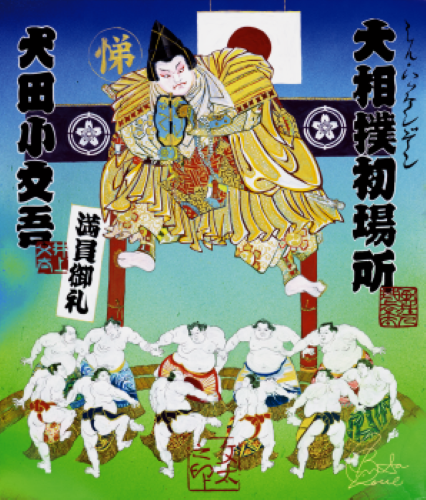
To mark the beginning of the new year, this issue’s cover features “Inuta Kobungo — The Grand Sumo Tournament,” a work by Gakyōjin Bunta Inoue.
新年の幕開けに合わせ、今月号の表紙は、画狂人・井上文太氏による作品「犬田小文吾・大相撲初場所」です。
What is depicted is a scene from the ring-entering ceremony of professional sumo.
描かれているのは、大相撲の土俵入りの場面です。
The rikishi (wrestlers) are lined up in a circular formation, and at the center stands Inuta Kobungo, a character from Nansō Satomi Hakkenden, serving as the gyōji.
力士たちが円を描くように並び、その中央には南総里見八犬伝に登場する犬田小文吾が行司として立っています。
On the rikishi’s ceremonial aprons are depicted auspicious motifs suitable for the New Year, such as pine, bamboo, plum, the rising sun, and Mount Fuji, expressing the entire dohyo as a festive space.
力士の化粧まわしには、松・竹・梅や日の出、富士山など、正月にふさわしい縁起物が描かれ、土俵全体が祝祭の空間として表現されています。
Inoue is also known for having designed the ceremonial apron worn by former ōzeki Baruto at the tournament where he achieved his first championship victory, and is an artist who deeply understands the spiritual nature of sumo.
井上氏は、かつて元大関・把瑠都が自身の初優勝を果たした場所で締めた化粧まわしを手がけたことでも知られ、相撲の精神性を深く理解するアーティストです。
From the fact that two pillars are depicted behind the dohyo, it can be seen that this work portrays sumo as it was before the September 1952 tournament.
土俵の後ろに二本の柱が描かれていることから、本作は1952年(昭和27年)9月場所以前の相撲を描いたものと分かります。
The origin of the circular dohyo lies in the ring formed by spectators who naturally gathered to watch sumo, and the suspended roof adopted after the removal of the pillars was a development to preserve a space where the dohyo could be seen from anywhere.
土俵が円形である原点は、相撲を見ようと自然に集まった見物人の人垣が円を成したことにあり、柱を廃したつり屋根も、どこからでも土俵が見える場を守るための発展でした。
The four tassels hanging from the suspended roof represent the deities that protect the seasons and the cardinal directions, indicating that the dohyo is a sacred space.
つり屋根に下がる四つの房は、四季と方位を守る神々を表し、土俵が神域であることを示しています。
Sumo is not a competition, but a Japanese ritual passed down to pacify the earth and to pray for abundant harvests and peace on such sacred ground.
相撲は競技ではなく、こうした神域で大地を鎮め、五穀豊穣と安寧を祈る日本の神事なのです。
This article is from the February 2026 issue of Hiragana Times.
この記事は、月刊誌『ひらがなタイムズ』2026年2月号より掲載しています。
Information From Hiragana Times


Topics in Japan
-
![Japan Has a Culture of Hara <br src=]() 日本には、肚の文化がある" />
Japan Has a Culture of Hara
日本には、肚の文化がある" />
Japan Has a Culture of Hara
日本には、肚の文化がある -
![Yanagita Kunio: A Life in Dialogue with the Depths of This Land <br src=]() 柳田國男:この国の肚と、対話し続けた生涯" />
Yanagita Kunio: A Life in Dialogue with the Depths of This Land
柳田國男:この国の肚と、対話し続けた生涯" />
Yanagita Kunio: A Life in Dialogue with the Depths of This Land
柳田國男:この国の肚と、対話し続けた生涯 -
![Japan: A Nation Built by Matsuri <br src=]() 「まつり」で作られた国家、日本" />
Japan: A Nation Built by Matsuri
「まつり」で作られた国家、日本" />
Japan: A Nation Built by Matsuri
「まつり」で作られた国家、日本 -
![Obon — A Summer Spent with Our Ancestors <br src=]() お盆 ― 先祖と過ごす夏のひととき" />
Obon — A Summer Spent with Our Ancestors
お盆 ― 先祖と過ごす夏のひととき" />
Obon — A Summer Spent with Our Ancestors
お盆 ― 先祖と過ごす夏のひととき -
![After the Festival — Already Too Late <br src=]() 後の祭り" />
After the Festival — Already Too Late
後の祭り" />
After the Festival — Already Too Late
後の祭り
 日本には、肚の文化がある" />
 柳田國男:この国の肚と、対話し続けた生涯" />
 「まつり」で作られた国家、日本" />
 お盆 ― 先祖と過ごす夏のひととき" />
 後の祭り" />

