
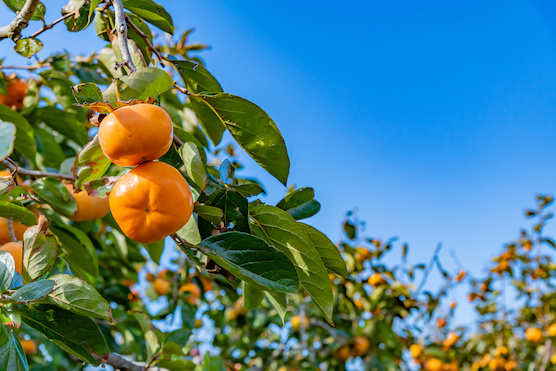
“Food of the Gods” – Kaki Reflecting the Autumn of Japan
[Japan Savvy – November 2025 Issue]
“Food of the Gods” – Kaki Reflecting the Autumn of Japan
「神の食べ物」 ― 柿が映す日本の秋
When we think of fruits that are essential to the autumn landscape, kaki (Japanese persimmons) come to mind.
秋の風景に欠かせない果物といえば、柿です。
Seeds have been found in ruins from the Jomon period (about 14,000 years ago), and kaki have been loved by the Japanese since ancient times.
縄文時代(約1万4千年前) の遺跡からも種が見つかり、古代から日本人に親しまれてきました。
Relatives of kaki are also found in Europe, and its scientific name, Diospyros, means “food of the gods.”
柿の仲間はヨーロッパにもあり、学名 Diospyros は「神の食物」を意味します。
The kaki tree not only bears highly nutritious fruit but has also been used for piano keys and luxury furniture.
柿の木は、滋養豊かな果実を実らせるだけでなく、ピアノの鍵盤や高級家具に使われてきました。
Its common name is persimmon. Its hard wood was even once used to make golf club heads.
一般的な呼び名は persimmon。その堅い木材は、かつてゴルフクラブのヘッドにも用いられました。
In the 19th century, during the Edo period, the Japanese persimmon was newly added to this “food of the gods” family.
19世紀の江戸時代になると、この「神の食物」の仲間に、日本の柿が新たに加わりました。
Its scientific name became Diospyros kaki. The Japanese word “kaki” was incorporated as it is into the genus name “food of the gods.”
学名は Diospyros kaki。属名の「神の食物」に日本語の「kaki」がそのまま組み込まれました。
Kaki is so rich in nutrients that there is a saying, ‘When kaki turn red, doctors turn pale.'”
「柿が赤くなれば医者は青くなる」と言われるほど栄養満点の柿。
Truly, it is the “food of the gods” that reflects the autumn of Japan.
まさに日本の秋を映す「神の食物」です。
 ”Warm Up ウォームアップ”
 ”Warm Up ウォームアップ”
kaki JapaNEEDS
Useful words
- 柿(かき)-Japanese persimmon
- 遺跡(いせき)-ruin
- 種(たね)-seed
- 食物 / 食べ物(しょくもつ / たべもの)-food
- 滋養 (じよう)-nourishment
- 豊か(ゆたか)-rich, abundant
- 果実(かじつ)-fruit
- 高級(こうきゅう)-luxury, high-class
- 家具(かぐ)-furniture
- 一般的(いっぱんてき)-general
- 堅い(かたい)-hard, firm
- 栄養満点(えいようまんてん)-nutritious
- 映す(うつす)-reflect
Ice Breaker Questions
Have you ever eaten a persimmon? What did it taste like?
柿を食べたことがありますか?どんな味でしたか?
Besides persimmon, what other kinds of wood do you know?
柿の他に、どんな種類の木材を知っていますか?
How much do fruits usually cost in your country?
あなたの国では、果物はどのぐらいの値段ですか?
When you think of foods that are full of nutrients, what comes to mind?
栄養満点の食べ物といえば、何が思いつきますか?
Do you ever feel the “season” through the foods you eat?
食べ物から「季節」を感じることはありますか?
”Work Up ワークアップ”
 ”Work Up ワークアップ”
kaki Discussion
Vanessa: Have you ever heard the saying “Momo kuri sannen kaki hachinen” (“Three years for peaches and chestnuts, eight for Japanese persimmons”)?
ヴァネッサ: 「桃栗三年柿八年」って聞いたことありますか?
Jose: Hmm, I know peaches, chestnuts, and kaki (Japanese persimmons) are all autumn foods, but…
ホセ:うーん、桃も栗も柿も秋が旬の食べ物だとは思うけど…。
Will: Oh! Maybe it means how many years it takes from planting the seed until the fruit grows?
ウィル:あ、もしかして、種を植えてから実ができるまでの年数を表してるんですか?
Mayumi: That’s right! Because it takes time for them to bear fruit, the phrase came to mean that “everything takes time before you see results.”
まゆみ:そうなんです!実るまで時間がかかることから、「何事も成果が出るまで時間が必要」という意味になったんですよ。
Vanessa: Kaki must be really familiar to Japanese people if there’s even a proverb about them.
ヴァネッサ:ことわざにまでなるくらい、柿は日本人にとって身近なんですね。
Mayumi: Yes, they’re often planted in gardens in Japan.
まゆみ:日本では、庭にもよく植えられていますね。
Jose: Speaking of that, I saw news about bears coming down from the mountains and eating kaki in people’s gardens.
ホセ:そういえば、熊が山から降りてきて、庭の柿を食べているニュースを見ました。
Will: There have been a lot of bear attacks recently.
ウィル:最近、熊による被害が多いですね。
Mayumi: Maybe it’s because there’s less food in the mountains.
まゆみ:山に食べ物が少なくなっているのかもしれません。
Will: Do you think deforestation is part of the problem?
ウィル:森林伐採が関係してるんでしょうか?
Vanessa: On top of that, solar panels are being installed all over mountain slopes in Japan, which has become a cause for concern.
ヴァネッサ:それに加えて、日本では山の斜面に太陽光パネルが敷き詰められ、問題視されています。
Jose: What if we planted lots of kaki trees in the mountains?
ホセ:山にたくさんの柿の木を植えるのはどうですか?
Mayumi: That’s a good idea! But remember, it takes eight years before kaki bears fruit.
まゆみ:いい考えですね!でも柿が実るまでには八年かかりますよ。
Will: At least peaches and chestnuts only take three!
ウィル:桃と栗なら三年ですね!
Vanessa: Then we’d need to think of other ways to coexist for at least three years.
ヴァネッサ: 少なくとも三年間は他の共生の方法も考えないといけませんね。
”Wrap Up ラップアップ”
 ”Wrap Up ラップアップ”
kaki Knowledge
Just as there is the saying “The sky is high and horses grow fat in autumn,” autumn is a season when the sky is clear and the harvest is plentiful.
「天高く馬肥ゆる秋」という言葉があるように、秋は空が澄み渡り、実りの季節です。
There is a famous haiku about kaki by Masaoka Shiki: “Eat a persimmon and the bell will toll at Horyuji”
柿に関する有名な俳句に、正岡子規が詠んだ「柿くへば 鐘が鳴るなり 法隆寺」があります。
October 26, the date on which Masaoka Shiki is said to have composed this haiku, is now recognized as “Kaki Day.”
正岡子規がこの句を詠んだとされる10月26日は、現在「柿の日」に認定されています。
Kaki is called Japan’s “national fruit” and has long been a part of people’s daily lives.
柿は日本の「国果」とも呼ばれ、古くから人々の暮らしに根付いてきました。
In the past, there were no sweet persimmons like we have today, so people would dry astringent persimmons to make hoshigaki (dried persimmons) and eat them.
昔は現在のような甘柿がなかったので、渋柿を干し柿にして食べていました。
Hoshigaki were an important preserved food for getting through the winter.
干し柿は冬を越すための大切な保存食でした。
The prefecture that produces the most kaki in Japan is Wakayama.
日本で一番柿の生産量が多い県は和歌山県です。
Kaki even appears in folktales. A famous one is “The Crab and the Monkey.” In this story, the monkey hogs the kaki that the crab had grown and injures the crab, but the crab’s children and their friends work together to take revenge on the monkey.
柿は昔話にも登場します。有名なのは「さるかに合戦」。かにが育てた柿をさるが独り占めしてかにを傷つけますが、かにの子どもたちと仲間たちが力を合わせて仕返しをするという物語です。
In recent years, bear attacks have been increasing. 2023 saw the highest number on record, and in 2025 they are continuing at the same level.
近年は、熊の被害が増えています。2023年は過去最多で、2025年も同じ水準で推移しています。
One reason bears are coming into human settlements is that, due to population decline, villages are returning to forest, making the boundary between the bears’ and humans’ living areas less distinct.
熊が人里に出てくる原因には、人口減少で集落が森に戻り、熊と人間の生活圏の境界があいまいになっていることも挙げられます。
This article is from the November 2025 issue of Hiragana Times.
この記事は、月刊誌『ひらがなタイムズ』2025年11月号より掲載しています。



Information From Hiragana Times


Topics in Japan
-
![Hiyashi Chuka — Now Serving <br src=]() 冷やし中華はじめました。" />
Hiyashi Chuka — Now Serving
冷やし中華はじめました。" />
Hiyashi Chuka — Now Serving
冷やし中華はじめました。 -
![Food, and the Shape of a Life <br src=]() 食が映す、生き方のかたち" />
Food, and the Shape of a Life
食が映す、生き方のかたち" />
Food, and the Shape of a Life
食が映す、生き方のかたち -
![Words Nourished by Food <br src=]() 食に育まれた言の葉" />
Words Nourished by Food
食に育まれた言の葉" />
Words Nourished by Food
食に育まれた言の葉 -
![The daughter who consulted an AI; the adults who stopped thinking <br src=]() AIに相談した娘、考えることを止めた大人たち" />
The daughter who consulted an AI; the adults who stopped thinking
AIに相談した娘、考えることを止めた大人たち" />
The daughter who consulted an AI; the adults who stopped thinking
AIに相談した娘、考えることを止めた大人たち -
![Where Did the Japanese Come From? ― A New Story DNA Has Begun to Tell <br src=]() 日本人はどこから来たのか ― DNAが語り始めた新しい物語" />
Where Did the Japanese Come From? ― A New Story DNA Has Begun to Tell
日本人はどこから来たのか ― DNAが語り始めた新しい物語" />
Where Did the Japanese Come From? ― A New Story DNA Has Begun to Tell
日本人はどこから来たのか ― DNAが語り始めた新しい物語
 冷やし中華はじめました。" />
 食が映す、生き方のかたち" />
 食に育まれた言の葉" />
 AIに相談した娘、考えることを止めた大人たち" />
 日本人はどこから来たのか ― DNAが語り始めた新しい物語" />

