
Yamato Takeru — The Prince Who Became a White Bird
ヤマトタケル ―― 白い鳥になった皇子
The True Face of Hyottokoひょっとこの素顔
NIHONGO DO® | Voice & Word Art – Hiragana Times December 2026 issue
Listen to the Audio:
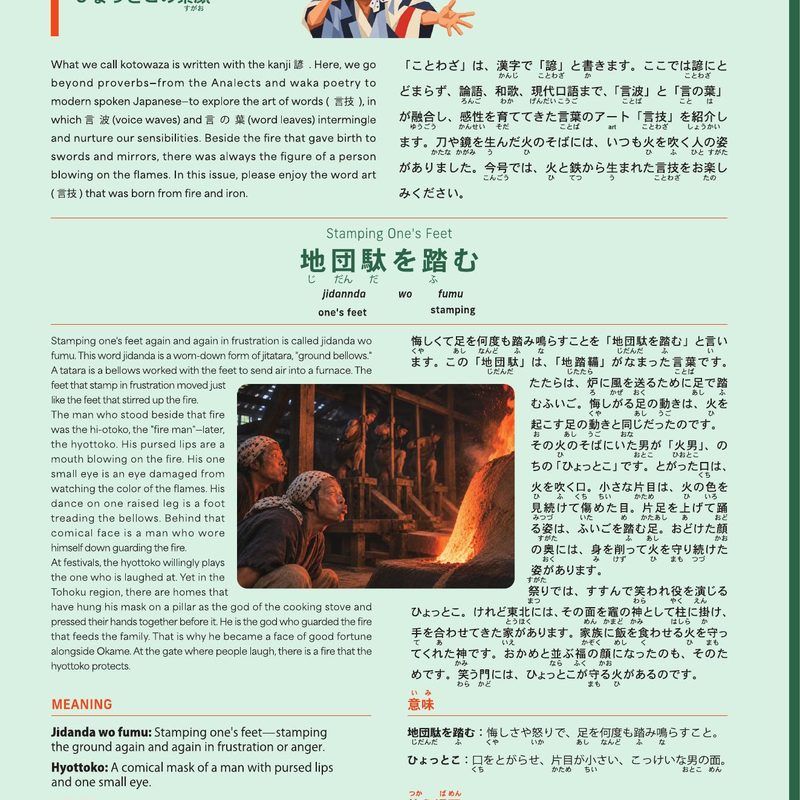
The True Face of Hyottoko
ひょっとこの素顔
What we call kotowaza is written with the kanji 諺. Here, we go beyond proverbs—from the Analects and waka poetry to modern spoken Japanese—to explore the art of words (言技), in which 言波 (voice waves) and 言の葉 (word leaves) intermingle and nurture our sensibilities. Beside the fire that gave birth to swords and mirrors, there was always the figure of a person blowing on the flames. In this issue, please enjoy the word art (言技) that was born from fire and iron.
「ことわざ」は、漢字で「諺」と書きます。ここでは諺にとどまらず、論語、和歌、現代口語まで、「言波」と「言の葉」が融合し、感性を育ててきた言葉のアート「言技」を紹介します。刀や鏡を生んだ火のそばには、いつも火を吹く人の姿がありました。今号では、火と鉄から生まれた言技をお楽しみください。
Stamping One's Feet
地団駄を踏む
Stamping one's feet again and again in frustration is called jidanda wo fumu. This word jidanda is a worn-down form of jitatara, "ground bellows." A tatara is a bellows worked with the feet to send air into a furnace. The feet that stamp in frustration moved just like the feet that stirred up the fire.
悔しくて足を何度も踏み鳴らすことを「地団駄を踏む」と言います。この「地団駄」は、「地踏鞴」がなまった言葉です。たたらは、炉に風を送るために足で踏むふいご。悔しがる足の動きは、火を起こす足の動きと同じだったのです。
Continue Reading in Hiragana Times
続きを読む — Hiragana Times 本誌へ
Digital Packages
Read and listen in your browser — available in bundles.
誌面と音声を、パッケージでご利用いただけます。
More From Hiragana Times

Join the Hiragana Times Discord Community — Free!
Connect with readers worldwide — free, open, and always welcoming.
世界の読者とつながる、無料のDiscordコミュニティへようこそ。

Online Japanese lessons, run by Hiragana Times.
One month free for Hiragana Times subscribers.
ひらがなタイムズ定期購読者は、1ヶ月無料でご受講いただけます。
Information From Hiragana Times


Topics in Japan
-
![Hiragana Times App Updated (iOS 8.18.1 / Android 8.19.04) <br src=]() ひらがなタイムズ アプリを更新しました" />
Hiragana Times App Updated (iOS 8.18.1 / Android 8.19.04)
ひらがなタイムズ アプリを更新しました -
![Shogi: The Culture That Turned Enemies into Treasure <br src=]() 将棋 — 敵を宝に変えた文化" />
Shogi: The Culture That Turned Enemies into Treasure
将棋 — 敵を宝に変えた文化 -
![The Story of “Wa” (倭 and 和) and “Yamato” (大和) <br src=]() 「倭」と「和」と「大和」の物語" />
The Story of “Wa” (倭 and 和) and “Yamato” (大和)
「倭」と「和」と「大和」の物語 -
![People Who Can’t Help Making Things <br src=]() 作らずにいられない人々" />
People Who Can’t Help Making Things
作らずにいられない人々 -
![Nobody Tells You <br src=]() でも、伝わってくる" />
Nobody Tells You
でも、伝わってくる
 ひらがなタイムズ アプリを更新しました" />
 将棋 — 敵を宝に変えた文化" />
 「倭」と「和」と「大和」の物語" />
 作らずにいられない人々" />
 でも、伝わってくる" />


