Yamato Takeru — The Prince Who Became a White Bird ヤマトタケル ―― 白い鳥になった皇子

Yamato Takeru — The Prince Who Became a White Birdヤマトタケル ―― 白い鳥になった皇子


IBUKI: The Breath of the People – Hiragana Times December 2026 issue

Listen to the Audio:

Yamato Takeru — The Prince Who Became a White Bird

ヤマトタケル ―― 白しろい鳥とりになった皇子みこ


Layers Upon Layers
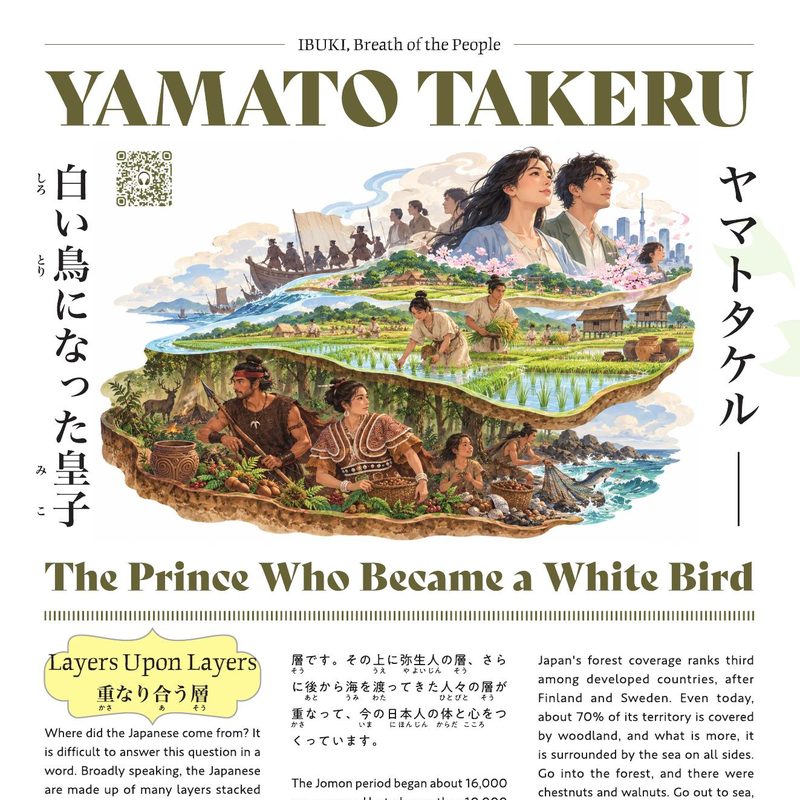
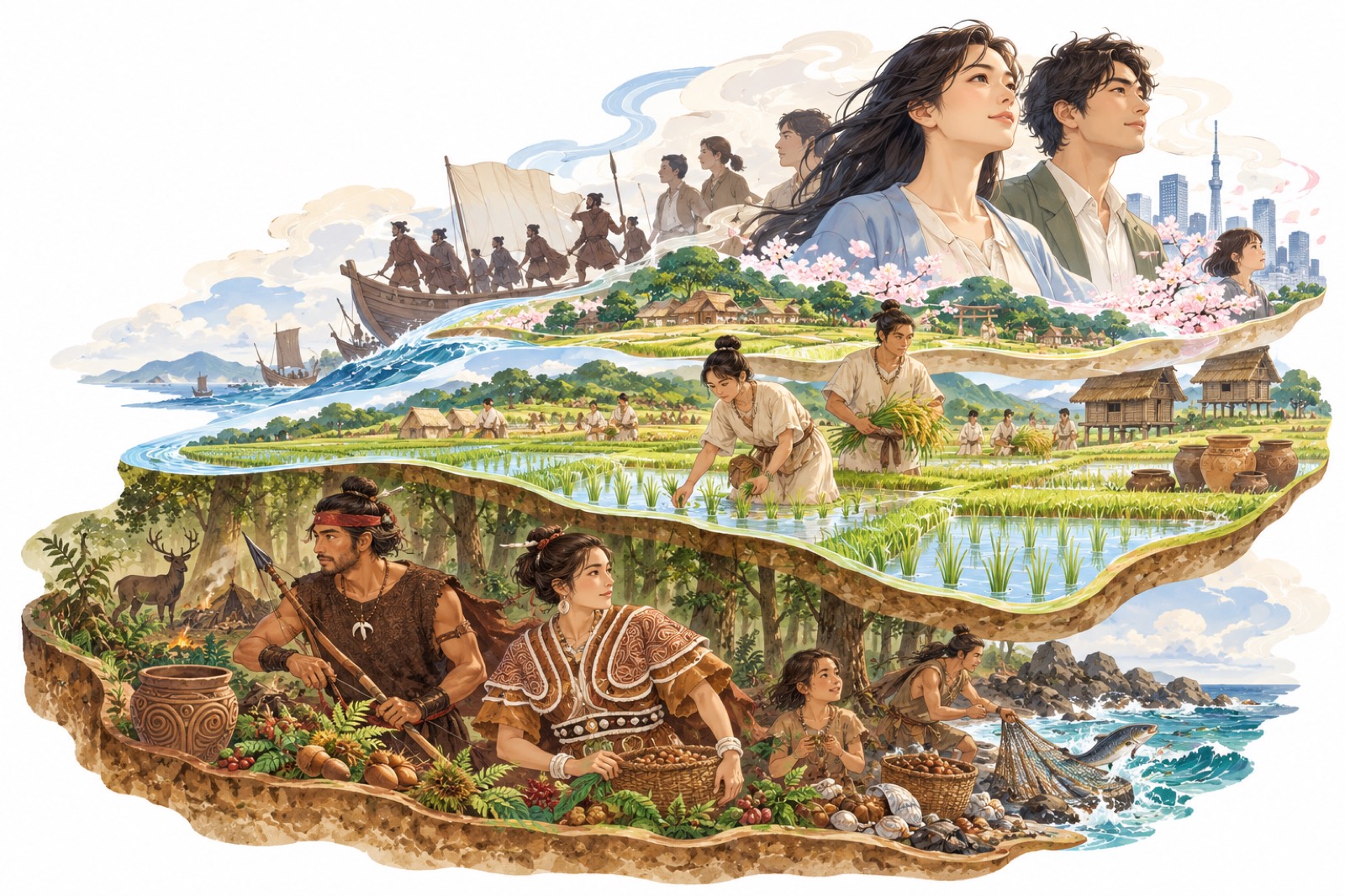
Where did the Japanese come from? It is difficult to answer this question in a word. Broadly speaking, the Japanese are made up of many layers stacked one on top of another. At the very bottom lies the layer of the Jomon people. On top of it lie the layer of the Yayoi people and then the layers of people who later came across the sea, and together they form the bodies and hearts of the Japanese today.
重なり合かさなりあう層そう
日本人にほんじんはどこから来きたのか。この問といに、ひと言ことで答こたえるのは難むずかしいことです。大おおまかに言いえば、日本人にほんじんは何なん枚まいもの層そうが重かさなってできています。いちばん下したにあるのが縄文人じょうもんじんの層そうです。その上うえに弥生人やよいじんの層そう、さらに後あとから海うみを渡わたってきた人々ひとびとの層そうが重かさなって、今いまの日本人にほんじんの体からだと心こころをつくっています。

Illustration of the layers of the Japanese people, from the Jomon hunters at the bottom to the Yayoi rice farmers and later arrivals from across the sea

Layers upon layers

The Jomon period began about 16,000 years ago and lasted more than 10,000 years, until about 3,000 years ago. Many tribes are thought to have lived on the Japanese archipelago at that time. Their lives centered on hunting, fishing, and gathering nuts.
縄文じょうもん時代じだいは約やく1万6千年前いちまんろくせんねんまえに始はじまり、約やく3千年前さんぜんねんまえまで、1万年以上いちまんねんいじょう続つづきました。当時とうじの日本列島にほんれっとうには、たくさんの部族ぶぞくが暮くらしていたと考かんがえられています。暮くらしの中心ちゅうしんは、狩かりと漁りょう、そして木の実このみ拾ひろいでした。

Japan’s forest coverage ranks third among developed countries, after Finland and Sweden. Even today, about 70% of its territory is covered by woodland, and what is more, it is surrounded by the sea on all sides. Go into the forest, and there were chestnuts and walnuts. Go out to sea, and there were fish. As long as people lived without going against nature, nature shared its food with them in abundance.
日本にほんの森林しんりんの割合わりあいは、先進せんしん国こくの中なかでフィンランド、スウェーデンに次ついで3番目さんばんめ。今いまも、国土こくどの約やく7割ななわりが森もりに覆おおわれ、しかも四方しほうを海うみに囲かこまれています。森もりに入いれば、クリやクルミ。海うみに出でれば、魚さかな。自然しぜんに逆さからわずに生いきていれば、自然しぜんはいくらでも食べ物たべものを分わけてくれました。

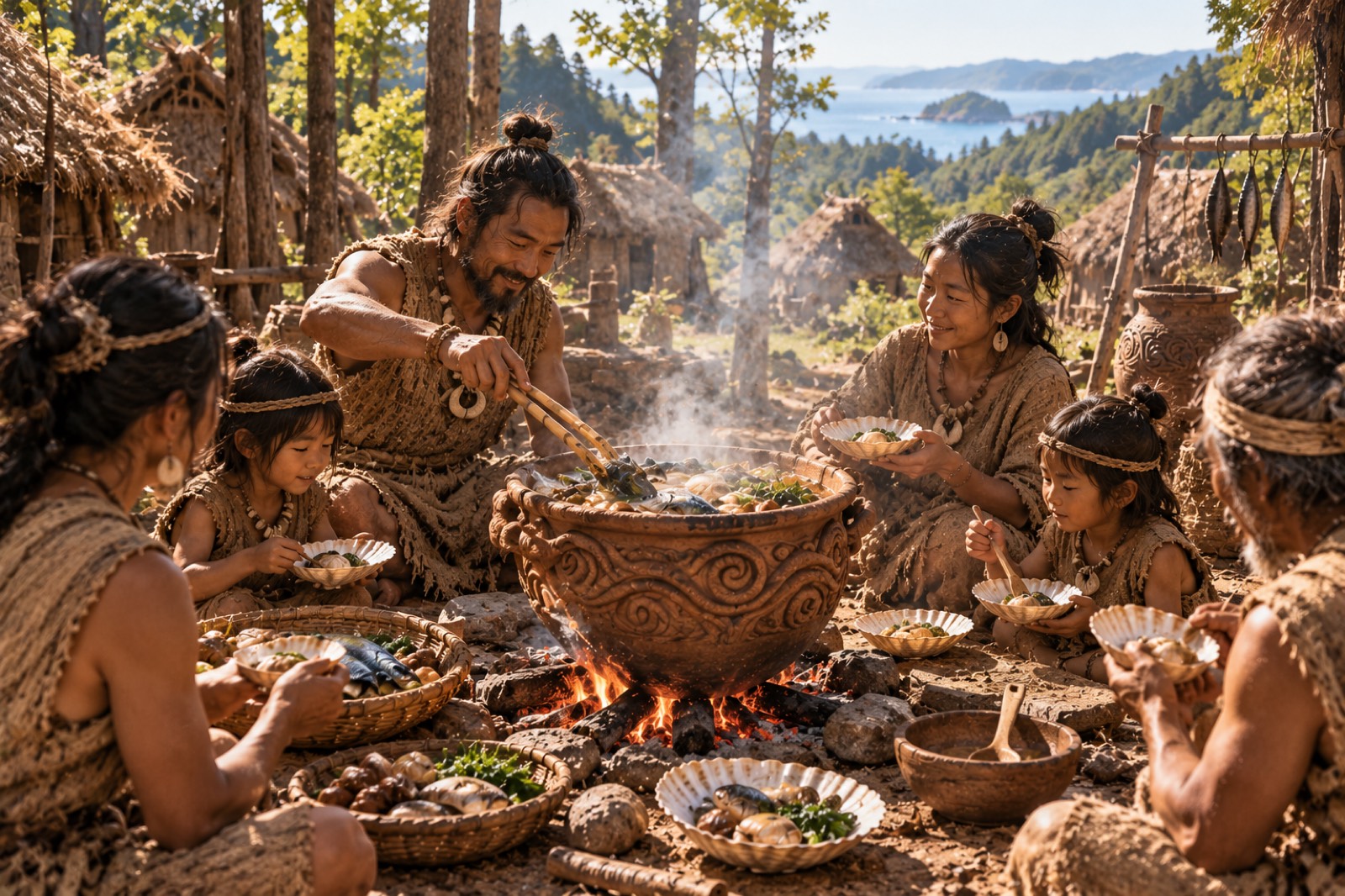
The Jomon people cooked these blessings in earthenware and ate them. Jomon pottery is among the oldest pottery in the world. When the scorched residue left inside is examined with modern science, traces of boiled fish and shellfish appear. In the center of their dwellings was a hearth. Families gathered around earthenware pots set over the fire. The Jomon people, it seems, loved hot-pot meals.
縄文人じょうもんじんは、その恵めぐみを土器どきで煮にて食たべていました。縄文じょうもん土器どきは、世界せかいで最もっとも古ふるい土器どきのひとつです。内側うちがわに残のこったおこげを今いまの科学かがくで調しらべると、魚さかなや貝かいを煮にた跡あとが出でてきます。住すまいの真ん中まんなかには炉ろがありました。火ひにかけた土器どきの鍋なべのまわりを家族かぞくが囲かこみます。縄文人じょうもんじんは、鍋なべが好すきだったようです。

Illustration of a Jomon family gathered around an earthenware pot cooking over a fire

A Jomon hot-pot meal

Some see the Jomon people as savages who did not even have chopsticks. But no one puts their bare hands into a boiling pot. When heated over a fire, bamboo bends into tongs. Shells used as plates have been found in shell mounds. Ladles and spoons carved from wood have also been discovered at archaeological sites.
縄文人じょうもんじんを、箸はしも持もたない野蛮やばんな人々ひとびとだったと見みる人ひともいます。けれど、煮にえたぎる鍋なべに素手すでを入いれる人ひとはいません。竹たけは火ひであぶると曲まがってトングになります。貝塚かいづかからは、お皿さらにした貝殻かいがらも出でています。遺跡いせきからは、木きを削けずったお玉たまやさじも見みつかっています。

If people have no trouble getting food, there is no need to fight over it. People lived wrapped in nature, entrusting themselves to it, never doubting that its blessings would last forever. Of the Jomon human remains, those believed to have died in conflict account for less than 2%. For more than 10,000 years, time flowed peacefully.
食たべることに困こまらなければ、奪い合うばいあう必要ひつようもありません。人々ひとびとは自然しぜんに包つつまれ、自然しぜんに身みをゆだね、その恵めぐみがずっと続つづくことを疑うたがわずに生いきていました。縄文じょうもんの人骨じんこつのうち、争あらそいで命いのちを落おとしたとみられるものは2%にも届とどきません。1万年以上いちまんねんいじょう、穏おだやかな時間じかんが流ながれていたのです。

Around the Source of Life
Peace, however, does not advance science. Ironically, today’s science has grown up in the midst of war. Many technologies, including the internet, were born from the military. War and science stand back to back. And many wars arise from the struggle over energy.
命いのちの源みなもとをめぐって
ただ、平和へいわは科学かがくを進すすめません。皮肉ひにくなことに、今いまの科学かがくは戦たたかいの中なかで育そだってきました。インターネットをはじめ、多おおくの技術ぎじゅつが軍事ぐんじから生うまれています。戦たたかいと科学かがくは背中合せなかあわせです。そして戦たたかいの多おおくは、エネルギーの奪い合うばいあいから起おこります。

Today, the energy people fight over is oil. In ancient times, that role was played by carbohydrates. Carbohydrates still move people’s brains and bodies today. They are the source of life, born from the sun’s mysterious work, “photosynthesis.” Oil, too, if traced back to its origins, is the remains of ancient algae and plankton. It is a remnant of photosynthesis.
奪い合うばいあうエネルギーは、今いまなら石油せきゆです。古代こだい、その役やくを担になっていたのは炭水化物たんすいかぶつでした。炭水化物たんすいかぶつは、今いまも人ひとの脳のうと体からだを動うごかしています。太陽たいようの神秘しんぴ的てきな営いとなみ「光合成こうごうせい」から生うまれる、命いのちの源みなもとです。石油せきゆも、もとをたどれば大昔おおむかしの藻もやプランクトンの亡なきがら。光合成こうごうせいの名残なごりです。

Carbohydrates changed their form to suit the climate of each land. In dry Europe, they became wheat; in the water-rich monsoon regions of East Asia, rice; in the highlands of Central and South America, corn; and on the humid tropical islands, taro. The carbohydrates of each land kept alive the people and animals living there.
炭水化物たんすいかぶつは、その土地とちの風土ふうどに合あわせて姿すがたを変かえました。乾かわいたヨーロッパでは麦むぎに、水みずの豊ゆたかな東アジアひがしあじあのモンスーン地域ちいきでは米こめに、中南米ちゅうなんべいの高地こうちではトウモロコシに、湿しめった熱帯ねったいの島々しまじまではタロイモに。それぞれの土地とちの炭水化物たんすいかぶつが、そこに生いきる人ひとと動物どうぶつを生いかしました。

The same is true when we eat meat and fish. Cattle and deer grow by eating the carbohydrates of the grasslands — tough grass that humans cannot digest. Fish grow by eating the carbohydrates of the sea, beyond human reach — algae and plankton. By receiving their flesh, humans are “outsourcing” carbohydrates to animals.
肉にくや魚さかなを食たべるときも同おなじです。牛うしや鹿しかは、人間にんげんには消化しょうかできない草原そうげんの炭水化物たんすいかぶつ、硬かたい草くさを食たべて育そだちます。魚さかなは、人ひとの手てが届とどかない海うみの中なかの炭水化物たんすいかぶつ、藻もやプランクトンを食たべて育そだちます。人間にんげんはその肉にくをいただくことで、炭水化物たんすいかぶつを動物どうぶつたちに「外注がいちゅう」しているのです。

Humankind, which had long received carbohydrates as gifts from nature through hunting and gathering, eventually found the means to produce this energy artificially. These were “paddy-field rice farming” and “livestock farming.”
狩かりや採集さいしゅうで、炭水化物たんすいかぶつを自然しぜんからの授さずかりものとしていただいてきた人類じんるいは、やがて、このエネルギーを人工じんこう的てきに作り出つくりだす術じゅつを見みつけます。「水田すいでん稲作いなさく」と「牧畜ぼくちく」です。

The Rice Paddies Begin to Shine
Paddy-field rice farming was born in the Yangtze River basin in China. Even before paddy-field farming arrived, rice itself was already on the archipelago as upland rice, okabo (rikuto). Traces of rice have been found in soil layers from the end of the Jomon period. But the skill of growing rice in water-filled paddies was something new. The technique crossed the sea, reached Kyushu, and spread across the Japanese archipelago. The people who came carrying rice — they were the Yayoi people. The layer of the Yayoi people slowly settled onto the layer of the Jomon people. Here and there across the archipelago, water-filled rice paddies began to shine.
田たんぼが光ひかり始はじめる
水田すいでん稲作いなさくは、中国ちゅうごくの長江ちょうこうの流域りゅういきで生うまれました。稲いねそのものは、水田すいでん稲作いなさくが伝つたわる前まえから、陸稲おかぼとして列島れっとうにありました。縄文じょうもんの終おわり頃ころの地層ちそうから、稲いねの跡あとが見みつかっています。けれど、水みずを張はった田たんぼで稲いねを育そだてる技わざは新あたらしいものでした。その技術ぎじゅつは海うみを渡わたって九州きゅうしゅうにたどり着つき、日本列島にほんれっとうに広ひろがっていきました。稲いねを携たずさえてやって来きた人々ひとびと。それが弥生人やよいじんです。縄文人じょうもんじんの層そうに、弥生人やよいじんの層そうがゆっくりと重かさなっていきます。列島れっとうのあちこちで、水みずを張はった田たんぼが光ひかり始はじめました。

At the center of it all was today’s Nara Basin. Surrounded by mountains on all four sides, this land was called “Yamato,” a place embraced by mountains. Or perhaps the people who lived there were called “people of the mountains” — yamato.
その中心ちゅうしんとなったのが、今いまの奈良盆地ならぼんちです。四方しほうを山やまに囲かこまれたこの土地とちは、「山処やまと」、山やまに抱いだかれた所ところと呼よばれました。もしくは、そこに住すむ人ひとたちのことを「山やまの人ひと」、やまとと呼よんだのかもしれません。

In the middle of the basin, there was once a lake. The wetlands left behind after the water receded were perfect for growing rice. Myths call the earthly world “Ashihara no Nakatsukuni.” A land of wetlands thick with reeds. The Nara Basin was exactly the land its name described. The people who grew powerful here later became the Yamato court.
盆地ぼんちの真ん中まんなかには、かつて湖みずうみがありました。水みずが引ひいた後あとに残のこった湿地しっちは、稲いねを育そだてるのにうってつけでした。神話しんわは地上ちじょうの世界せかいを「葦原中国あしはらのなかつくに」と呼よびます。葦あしの茂しげる湿地しっちの国くに。奈良盆地ならぼんちは、まさにその名なのとおりの土地とちでした。ここで力ちからをつけた人々ひとびとが、後のちの大和朝廷やまとちょうていです。

People Who Stayed in the Forest
In this way, paddy-field rice farming slowly changed the archipelago, with Yamato at its center. But not everyone welcomed it gladly. In every era, there are people who turn their backs on new things. People who won’t give up their flip phones even after smartphones have become the norm. People who live keeping computers at a distance. People who won’t eat foods with additives or genetically modified foods.
森もりに留とどまった人々ひとびと
こうして水田すいでん稲作いなさくは、大和やまとを中心ちゅうしんに列島れっとうをゆっくりと変かえていきました。けれど、誰だれもがそれを喜よろこんで受け入うけいれたわけではありません。新あたらしいものに背せを向むける人ひとは、いつの時代じだいにもいます。スマートフォンが当たり前あたりまえになっても、ガラケーを手放てばなさない人ひと。コンピューターを遠とおざけて暮くらす人ひと。添加てんか物ぶつや遺伝子いでんし組み換くみかえ食品しょくひんを絶対ぜったいに口くちにしない人ひと。

Paddy-field rice farming changes the shape of the land, changes the flow of rivers, and produces food by human hands. Humans changing the face of nature. Some people felt a dread in this, as if laying hands on something that must not be touched.
水田すいでん稲作いなさくは、土地とちの形かたちを変かえ、川かわの流ながれを変かえ、人ひとの手てで食べ物たべものを作り出つくりだします。自然しぜんの姿すがたを人ひとが変かえていく。そこに、触ふれてはならないものに手てをかけるようなおそれを感かんじた人々ひとびとがいました。

Such people stayed in the forest and kept on hunting. The Nihon Shoki describes them as having “small bodies and long limbs.” People who ran swiftly through the forest like spiders and lived in holes in the earth. Those who spread rice farming called them “Tsuchigumo” (earth spiders).
そうした人々ひとびとは森もりに留とどまり、狩かりを続つづけました。『日本書紀にほんしょき』は、彼かれらを「体からだは小ちいさく、手足てあしが長ながい」と描えがいています。森もりを蜘蛛くものようにすばやく駆かけ、土つちの穴あなに住すむ人々ひとびと。稲作いなさくを広ひろめる側がわは、彼かれらを「土蜘蛛つちぐも」と呼よびました。

Many of those who kept on hunting also remained in the Tohoku region. They were called “Emishi.” The character 夷 is made up of 大 (large) and 弓 (bow), depicting a person holding a bow. 蝦 means shrimp. It is also said that they wore long beards like those of shrimp.
狩かりを続つづけた人々ひとびとの多おおくは、東北とうほくにも残のこりました。彼かれらは「蝦夷えみし」と呼よばれました。「夷い」の字じは「大だい」と「弓ゆみ」から成なり、弓ゆみを手てにした人ひとの姿すがたを表あらわします。「蝦えび」はエビ。エビのように長ながいひげをたくわえていたからともいわれます。

In southern Kyushu, there were people called the “Kumaso.” The place names Kuma in present-day Kumamoto Prefecture and So in Kagoshima Prefecture are said to be the origin of this name. “Kuma” was originally 隈, a word meaning a secluded, faraway place. Japanese was originally sound. Kanji were placed on top of it later, so the characters can be misleading. The animal kuma (bear), too, is a creature that hides deep in the forest. The Kumano Kodo, likewise, is an ancient road that stretches deep into the mountains.
九州きゅうしゅうの南みなみには、「熊襲くまそ」と呼よばれる人々ひとびとがいました。今いまの熊本くまもと県けんの球磨くま、鹿児島かごしま県けんの曽於そおという土地とちの名なが、この呼び名よびなの元もとになったとされます。「くま」は、もともと「隈くま」、奥おくまった所ところを指さす言葉ことばです。日本語にほんごは、もとは音おとです。漢字かんじは後あとから乗のせられたものなので、字面じづらに惑まどわされます。動物どうぶつのクマも、森もりの奥おくに潜ひそむ生き物いきものです。熊野くまの古こ道みちもまた、山やまの奥おくへと延のびる古ふるい道みちです。

The Name Takeru
In the early 300s, the Yamato court entered the era of Emperor Keiko, its 12th emperor. Even the people who had kept on hunting gradually shifted to the “technology” of rice farming. Rice is energy that can be stored. With stores, many people could be fed, and the population grew rapidly.
タケルの名な
西暦せいれき300年代ねんだいの前半ぜんはん、大和朝廷やまとちょうていは12代目だいめの景行けいこう天皇てんのうの時代じだいを迎むかえます。狩かりを続つづけていた人々ひとびとも、少すこしずつ稲作いなさくという「テクノロジー」へと移うつっていきました。稲いねは、蓄たくわえられるエネルギーです。蓄たくわえがあれば多おおくの人ひとを養やしなうことができ、人ひとの数かずも一気いっきに増ふえていきました。

Land where rice fields were opened came to belong to someone. The idea of “owning” the harvested rice was also born. From then on, until the Meiji era, rice was paid as tax and served in practice as money. As rice spread, the capital grew wealthier, and the power of the Yamato court increased.
田たを拓ひらいた土地とちは、誰だれかのものになります。実みのった米こめを「持もつ」という考かんがえも生うまれました。米こめはこの後のち、明治めいじの時代じだいに至いたるまで税ぜいとして納おさめられ、事実上じじつじょうのお金かねの役目やくめも果はたしていきます。稲いねが広ひろがれば都みやこは豊ゆたかになり、大和朝廷やまとちょうていの力ちからも増ましていきました。

Even so, at that time the archipelago was home to many tribes and powerful clans that did not obey the court, including the Tsuchigumo, the Emishi, and the Kumaso. Having grown strong, the Yamato court at last set out to unite the land into one nation.
それでも当時とうじの列島れっとうには、土蜘蛛つちぐも、蝦夷えみし、熊襲くまそをはじめ、朝廷ちょうていに従したがわない部族ぶぞくや豪族ごうぞくが数多かずおおくいました。力ちからをつけた大和朝廷やまとちょうていは、いよいよ国くにをひとつにまとめようとします。

The emperor sent a prince out to lands far and wide. He was Prince Ousu, later Yamato Takeru (日本武尊 / 倭建命). Ousu was a fierce prince — fierce enough to tear off his elder brother’s limbs and kill him. Fearing his son’s ferocity, his father sent him to the Kumaso in southern Kyushu.
天皇てんのうは、一ひと人ひとの皇子みこを各地かくちへ送り込おくりこみます。小碓命おうすのみこと、後のちのヤマトタケル(日本武尊やまとたけるのみこと/倭建命やまとたけるのみこと)です。小碓命おうすのみことは荒々あらあらしい皇子みこでした。兄あにの手足てあしをもぎ取とって殺ころしてしまうほどです。父ちちは息子むすこの荒々あらあらしさを恐おそれ、九州きゅうしゅうの南みなみ、熊襲くまそのもとへと送り出おくりだしました。

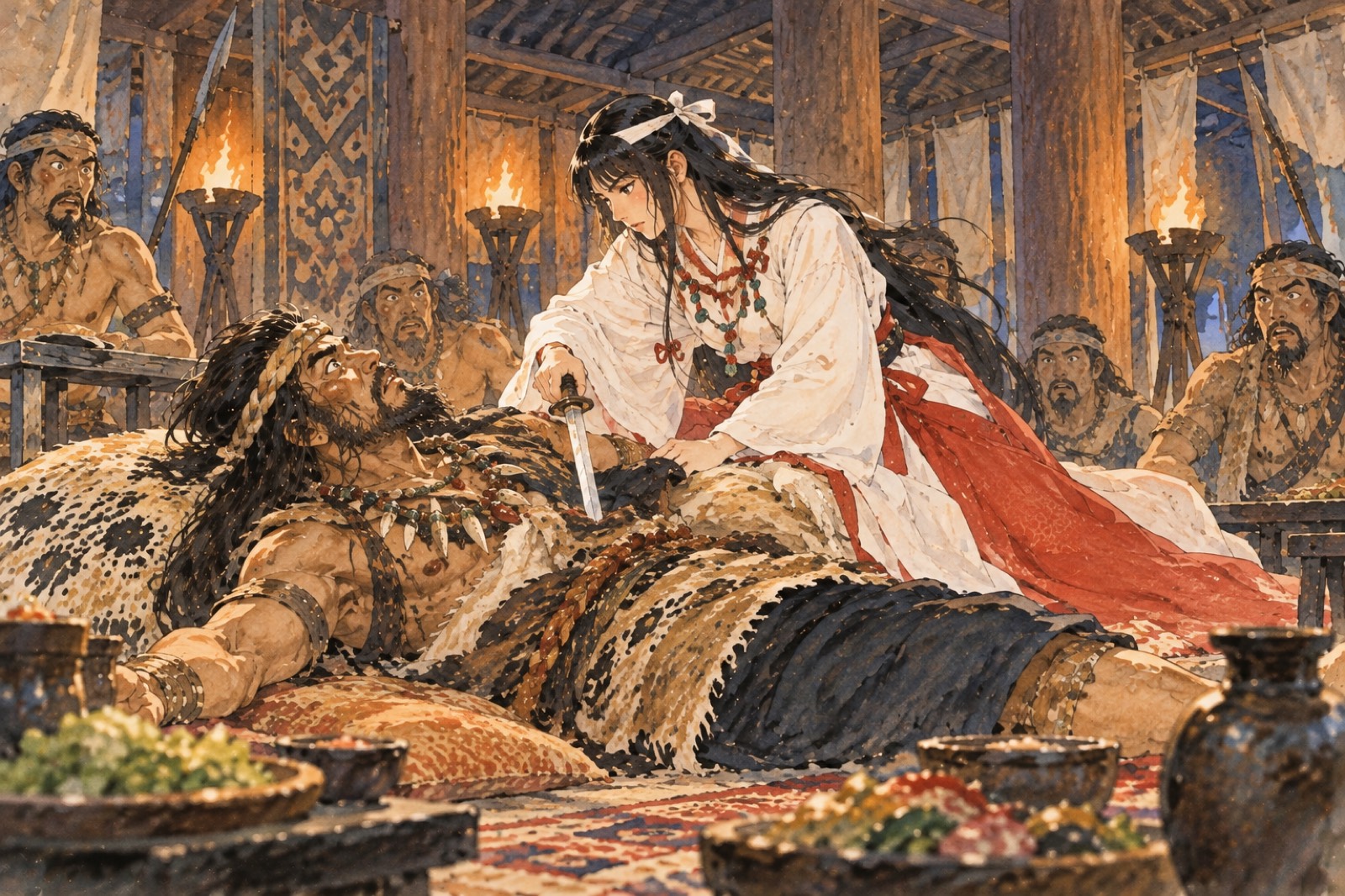
Disguised as a young girl, Ousu slipped into a Kumaso banquet and struck down their chief, Kumaso Takeru. Just before he breathed his last, Kumaso Takeru offered up his own name, “Takeru.” And so Ousu became Yamato Takeru.
小碓命おうすのみことは少女しょうじょの姿すがたに化ばけて熊襲くまその宴うたげに紛れ込まぎれこみ、首長しゅちょうの熊襲建くまそたけるを討うちます。息いき絶たえる間際まぎわ、熊襲建くまそたけるは自みずからの「タケル」の名なを差し出さしだしました。こうして小碓命おうすのみことは、ヤマトタケルとなります。

Illustration of Prince Ousu, disguised as a young girl, striking down Kumaso Takeru at a banquet

Ousu and Kumaso Takeru

Fields of Fire, a Raging Sea
Even after he returned to the capital, there was no time to rest. Next, his father ordered him to go to the Emishi in the east. Before setting out, he stopped at Ise, where he received a sword from his aunt, Yamatohime. It was Ame-no-Murakumo-no-Tsurugi.
火ひの野の、荒あれる海うみ
都みやこへ戻もどっても、休やすむ間まはありませんでした。父ちちは次つぎに、東ひがしの蝦夷えみしのもとへ行いけと命めいじます。旅立たびだつ前まえに伊勢いせへ立ち寄たちよると、叔母おばの倭比売やまとひめから一振ひとふりの剣つるぎを授さずかりました。天叢雲剣あめのむらくものつるぎです。

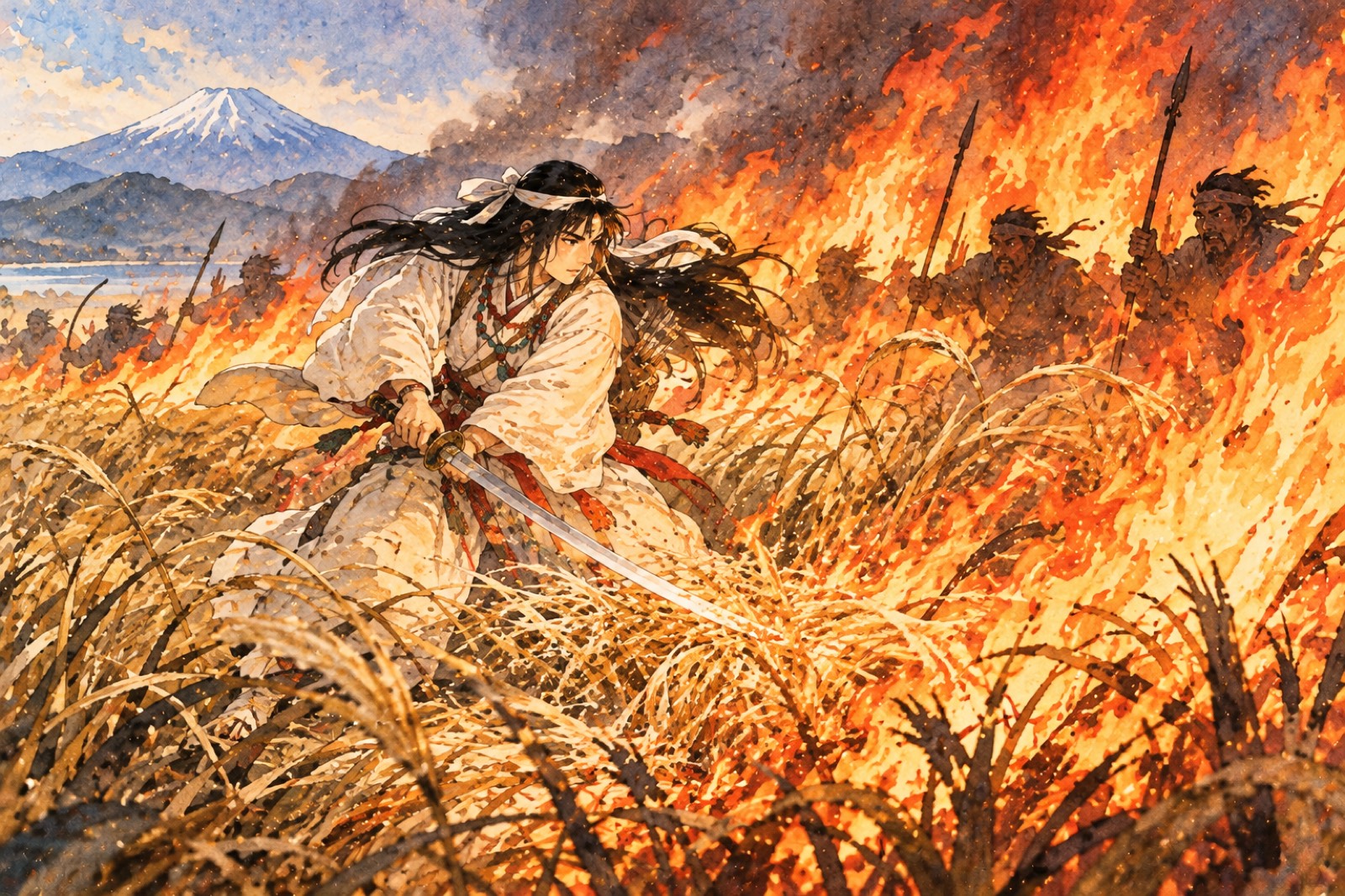
In the fields of Suruga, Yamato Takeru was attacked with fire by his enemies. He mowed down the grass with the sword, turned the fire back, and escaped danger. From then on, the sword was called Kusanagi-no-Tsurugi. Yaizu in Shizuoka Prefecture is said to have taken its name from the fields that were burned at that time.
駿河するがの野ので、ヤマトタケルは敵てきの火攻ひぜめに遭あいます。剣つるぎで草くさを薙ぎ払なぎはらい、火ひを返かえして難なんを逃のがれました。以来いらい、剣つるぎは草薙剣くさなぎのつるぎと呼よばれます。静岡しずおか県けんの焼津やいづは、このとき野のが焼やかれたことから付ついた名なとされます。

Illustration of Yamato Takeru mowing down the burning grass with his sword in the fields of Suruga

The fields of Suruga

As he tried to cross the mouth of Tokyo Bay by boat, the sea grew rough. His wife, Ototachibanahime, who had accompanied him on his journey, threw herself into the sea for her husband’s sake. The sea grew calm as if nothing had happened. It is said that seven days later, her comb washed up on the shore.
東京とうきょう湾わんの入り口いりぐちを船ふねで渡わたろうとしたとき、海うみが荒あれました。旅たびに連れ添つれそっていた妻つまの弟橘媛おとたちばなひめは、夫おっとのために自みずから海うみへ身みを投とうじます。海うみは嘘うそのように静しずまりました。7日後なのかご、浜辺はまべには媛ひめの櫛くしが流れ着ながれついたといいます。

Having reached Chiba on the opposite shore, Yamato Takeru, grieving the loss of his wife, could hardly bring himself to leave that place. “Kimi sarazu” (The lord does not leave). Kisarazu in Chiba Prefecture is said to have taken its name from these words. Sodegaura is said to have taken its name from the princess’s sleeve, which washed ashore after she threw herself into the sea.
対岸たいがんの千葉ちばにたどり着ついたヤマトタケルは、妻つまを失うしなった悲かなしみから、なかなかその地ちを離はなれられませんでした。「君きみ去さらず」。千葉ちば県けんの木更津きさらづは、この言葉ことばから付ついた名なと伝つたえられます。袖ケ浦そでがうらは、身みを投とうじた媛ひめの袖そでが流れ着ながれついたことから付ついた名なと伝つたえられます。

Toward Mahoroba
On his way back after subduing the eastern lands, Yamato Takeru stood on a mountain pass and, longing for the princess, lamented three times, “Azuma haya” (Oh, my wife). It is said that this is why the east came to be called “Azuma.”
まほろばへ
東国とうごくを平たいらげた帰り道かえりみち、峠とうげに立たったヤマトタケルは、媛ひめをしのんで「吾妻あづまはや(わが妻つまよ)」と三みたび嘆なげきました。東ひがしを「あずま」と呼よぶのは、ここからだといわれます。

After that, Yamato Takeru challenged the god of Mount Ibuki. But there, he fell ill. His legs felt heavy, as if bent threefold. Those murmured words became the origin of the name Mie Prefecture. Yamato Takeru breathed his last at Nobono, in what is now Kameyama City, Mie Prefecture.
その後ご、ヤマトタケルは伊吹いぶき山の神やまのかみに挑いどみます。けれど、そこで病やまいに倒たおれました。足あしは三重みえに折れ曲おれまがったように重おもい。そのつぶやきが、三重みえ県けんの名なの元もとになりました。ヤマトタケルは、今いまの三重みえ県けん亀山かめやま市し、能褒野のぼのの地ちで息いきを引き取ひきとります。

The myth of a prince who burned his life away for a nation that would one day become one. Yet Yaizu, Kisarazu, Sodegaura, Azuma, Mie — his footprints remain to this day as place names. Each has become a town, a stretch of land, a part of this nation’s soil, and lives on. Myths are not fairy tales. They are the very history of this nation.
やがてひとつになる国くにのために、命いのちを燃もやし尽つくした一ひと人ひとの皇子みこの神話しんわ。けれど、焼津やいづ、木更津きさらづ、袖ケ浦そでがうら、あずま、三重みえ。その足跡あしあとは、今いまも地名ちめいとして残のこっています。どれもがこの国くにの町まちとなり、土地とちとなり、国土こくどの一部いちぶとして生いき続つづけています。神話しんわは、おとぎ話ばなしではありません。この国くにの歴史れきしそのものです。

After Yamato Takeru breathed his last, a single white bird took flight from his tomb. The white bird flew on toward the distant sky of Yamato.
ヤマトタケルが息いきを引き取ひきとったあと、墓はかから一羽いちわの白しろい鳥とりが飛び立とびたちました。白しろい鳥とりは、遠とおい大和やまとの空そらをめざして飛とんでいきます。

Yamato wa / kuni no mahoroba / tatanazuku / aogaki / yamagomoreru / Yamato shi uruwashi
(Yamato is the finest place among all lands. Surrounded by mountains layered like green fences, Yamato is truly beautiful.)
大和やまとは 国くにのまほろば たたなづく 青垣あおがき 山隠やまごもれる 大和やまとしうるはし
(大和やまとは、国々くにぐにの中なかでいちばんすばらしい所ところ。重なり合かさなりあう青あおい垣根かきねのような山々やまやまに囲かこまれた大和やまとは、本当ほんとうに美うつくしい。)

This is the poem Yamato Takeru composed in his final moments.
ヤマトタケルが、最期さいごに詠よんだ歌うたです。

Continue Reading in Hiragana Times
続きを読む — Hiragana Times 本誌へ


Direct Subscription
Direct Subscription RECOMMENDED
Special Rate Up To 30% Off
直販ページからのお申込で最大30%OFF

Digital Packages
Read and listen in your browser — available in bundles.
誌面と音声を、パッケージでご利用いただけます。

Print Back Issues
Print Back Issues
Explore our archive of past editions.
過去の号を探す。

More From Hiragana Times

Hiragana Times Discord Community
Join the Hiragana Times Discord Community — Free!
Connect with readers worldwide — free, open, and always welcoming.
世界の読者とつながる、無料のDiscordコミュニティへようこそ。

nihongo.net
Online Japanese lessons, run by Hiragana Times.
One month free for Hiragana Times subscribers.
ひらがなタイムズ定期購読者は、1ヶ月無料でご受講いただけます。