
Obon — A Summer Spent with Our Ancestors
お盆 ― 先祖と過ごす夏のひとときWords the Festival Binds
祭が結ぶ言の葉
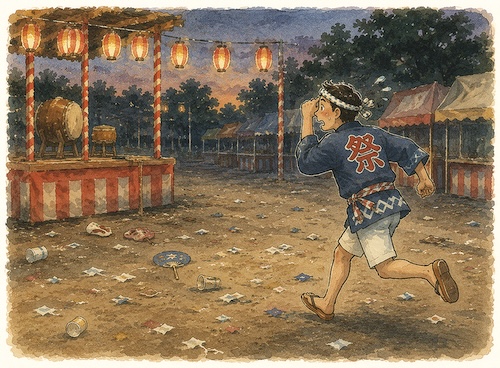
After the Festival — Already Too Late
後の祭り
Voice / Word Art – Hiragana Times August 2026 issue
Listen to the Audio:
What the Festival Leaves Behind
祭りが残す、生き方のかたち
What we call kotowaza is written 諺. Here we go beyond its original sense — to the Analects, waka poetry, and modern spoken Japanese — introducing the art of words (言技), where 言波 (voice waves) and 言の葉 (word leaves) intermingle and nurture our sensibilities. The Japanese have long marked the turning of the seasons, and the meeting of this world and the next, through their festivals. In this issue, please enjoy the word art (言技) born from Japan’s festival culture.
「ことわざ」は「諺」と書きます。ここでは諺にとどまらず、論語、和歌、現代口語まで、「言波」と「言の葉」が融合し感性を育ててきた言葉のアート(言技)を紹介します。日本人は古くから、祭りを通して季節の節目や、この世とあの世の出会いを刻んできました。今号では、日本の祭り文化から生まれた言技をお楽しみください。
After the Festival — Already Too Late|後の祭り
Ato no matsuri means missing the right moment — a regret that comes too late to change anything. Rush to the festival after it has ended, and the revelry is already gone.
「後の祭り」とは、時機を逃してしまい、今さら悔やんでも間に合わないことを指します。祭りが終わったあとに駆けつけても、賑わいはもうそこにはありません。
The phrase has several proposed origins. Some trace it to Kyoto’s Gion Festival, whose “after-festival” was quieter than the first; others to the emptiness of arriving the day after the celebration is done. And there is one more: that the matsuri for the dead — the rites of memorial — can never be offered in time once a person is already gone.
語源には諸説あります。祇園祭の後祭が前祭ほど華やかでなかったからとも、祭りの済んだ翌日では何も残っていないからとも言われます。そしてもう一つ――亡き人を悼む祭り、すなわち供養は、逝ってしまってからでは間に合わない、という説もあります。
Perhaps that is why Obon exists — so that our feelings for those who have passed never become entirely “too late.” Once a year, we light the welcoming fire and see the spirits off with the parting flame. The Japanese keep a season for welcoming back, once more, what we could not reach in time.
だからこそ、お盆があるのかもしれません。逝った人への想いが、すっかり「後の祭り」になってしまわないように。年に一度、迎え火を灯し、送り火で見送る。日本人は、間に合わなかったものを、もう一度迎え直す季節を持っているのです。
Ato no matsuri is usually a word of resignation. Yet turned over, it teaches how much it matters to do all we can, and to speak our hearts, while there is still time. To leave no regret behind — this, too, is a wisdom the festival has handed down.
「後の祭り」は、ふだんは諦めの言葉です。けれど裏を返せば、間に合ううちに手を尽くし、想いを伝えておくことの大切さを教えてくれます。悔いを残さないこと――それもまた、祭りが伝えてきた知恵なのです。
■ Meaning / 意味
Ato: after something has already passed.
後(あと): 物事が過ぎ去ったあと。
Matsuri: a rite honoring gods or spirits; by extension, the peak moment itself.
祭り(まつり): 神や霊をまつる行事。転じて、絶好の機会そのもの。
■ Usage / 使う場面
Kenta: They say the early-bird tickets are already gone.
ケンタ: 早割チケット、もう終わっちゃったって。
Misaki: What? I should have signed up yesterday…
ミサキ: えっ、昨日申し込んでおけばよかった…。
Kenta: Saying that now is ato no matsuri — the festival’s already over.
ケンタ: 今ごろ言っても後の祭りだよ。
Misaki: You’re right. Next time I’ll act right away.
ミサキ: そうだよね。次はすぐ動くよ。
Kenta: That’s the way. The trick is to leave no regret.
ケンタ: それがいちばん。悔いを残さないのがコツ。
Misaki: Enjoy the festival before it ends, huh.
ミサキ: 祭りは終わる前に楽しまなきゃ、だね。
Online Japanese Language Courses
Learn Japanese The Fun Way!
🎁 1 Month FREE for Hiragana Times Subscribers
ひらがなタイムズ定期購読者は1ヶ月無料でご受講いただけます
Start Learning →

Information From Hiragana Times


Topics in Japan
-
![Japanese Minka—Homes Alive with Nature <br src=]() 自然の中で生きている日本民家" />
Japanese Minka—Homes Alive with Nature
自然の中で生きている日本民家" />
Japanese Minka—Homes Alive with Nature
自然の中で生きている日本民家 -
![The Man Who Chose Harmony in an Age of Blood | Prince Shōtoku <br src=]() 血の時代に、和を選んだ人 | 聖徳太子" />
The Man Who Chose Harmony in an Age of Blood | Prince Shōtoku
血の時代に、和を選んだ人 | 聖徳太子" />
The Man Who Chose Harmony in an Age of Blood | Prince Shōtoku
血の時代に、和を選んだ人 | 聖徳太子 -
![The Fish That Leads the Way into Autumn <br src=]() 秋の先頭を泳ぐ魚" />
The Fish That Leads the Way into Autumn
秋の先頭を泳ぐ魚" />
The Fish That Leads the Way into Autumn
秋の先頭を泳ぐ魚 -
![The House Has Ears, Eyes—and a Mouth <br src=]() 耳と目と口を持つ家" />
The House Has Ears, Eyes—and a Mouth
耳と目と口を持つ家" />
The House Has Ears, Eyes—and a Mouth
耳と目と口を持つ家 -
![Words the Home Holds <br src=]() 家がつつむ言の葉" />
Words the Home Holds
家がつつむ言の葉" />
Words the Home Holds
家がつつむ言の葉
 自然の中で生きている日本民家" />
 血の時代に、和を選んだ人 | 聖徳太子" />
 秋の先頭を泳ぐ魚" />
 耳と目と口を持つ家" />
 家がつつむ言の葉" />

