-
[From February Issue 2013]
Public Interest Incorporated Foundation, National Foster Parent Association, Vice Chairman,
KINOUCHI HiromichiIn Japan there are some 40,000 children who are unable to live together with their families. This happens for a variety of reasons; sometimes because it would be inappropriate for them to live in an abusive environment. Many of those children live in care homes or nurseries. Only 10% live with foster families.
While UN guidelines recommend foster care for children who’ve been taken into care, it’s not yet very common in Japan. The government has just begun efforts to help support foster parents and is aiming to increase the percentage of children in foster care to 30% within the next ten years or so.
There are four kinds of foster parent in Japan: “child rearing foster parents” take care of children who, for whatever reason, can’t live with their parents; “specialist foster parents” take care of children who have been abused, or are mentally or physically handicapped; “parents hoping to adopt” who are aiming to adopt a child but haven’t yet done so; and “relations who are foster parents” – grandparents, uncles, aunts, and so forth. With the exception of relations who are foster parents, one becomes a foster parent with the approval of the governor of the prefecture. To become a “child rearing foster parent” or a “specialist foster parent,” training is obligatory.
In Japan, foster care isn’t very common yet, but why isn’t institutional care good enough? One reason is that life in care homes is centered around group activities. That makes it hard for children to develop individuality and to learn about family life and social rules, which they need to know about to become responsible members of society. Also, it’s hard to develop an emotional relationship with individual caregivers, attachments which children need.
So why is it that, in Japan, institutional care is so well established and has continued for so long at the expense of foster care? Some people point out that the public is generally unaware of the need for volunteers, but I think one of the reasons is the lack of government support for children who need care. Compared to institutional care homes, foster families require a lot of support from the system, but this support is sadly lacking.
As institutional care is the norm in Japan, we are hosting an IFCO (International Foster Care Organization) World Conference in Osaka in September this year in order to promote foster care. It’s an opportunity to discover what can be done to promote foster care and with this in mind, experts from around the world will be invited to participate.
The year before last, about 280 children lost both parents in the Great East Japan Earthquake. Most of them are living with relatives. They are being cared for by relying on the institution of “relations who are foster parents,” but some relatives are reluctant to register as foster parents as they themselves are struggling to get by.
After the Great Earthquake at the IFCO World Conference in Canada, we talked about the Japanese custom of making senbazuru (a thousand paper cranes) for disaster victims. Following this, Wanslea, an Australian foster care association sent 5,000 of these cranes together with messages of support to the National Foster Parent Association. And we sent these on to the people in the areas affected by the disaster; this made them very happy.
[2013年2月号掲載記事]
公益財団法人全国里親会
副会長 木ノ内博道さん日本には、家族と一緒に暮らすことのできない子どもが4万人ほどいます。虐待により家庭で暮らすことが適切でないなど、さまざまな事情があります。その多くは児童養護施設や乳児院で暮らしています。里親家庭で暮らす子どもは全体の1割にすぎません。
国連の指針では保護された子どもについても家庭養護をすすめていますが、日本ではなかなか進まないのが現状です。政府は10数年後に家庭養護を3割に増やす目標を立て、里親支援にも力を入れ始めています。
日本の里親制度には4種類あります。親の事情などで親と暮らせない子どもを預かる「養育里親」、虐待を受けたり、心身に障害があったりする子どもを養育する「専門里親」、養子縁組の目的で子どもを委託されたがまだ養子縁組に至っていない「養子縁組希望里親」、祖父母、おじ、おばなどが子どもの養育を行う「親族里親」です。「親族里親」以外の里親は都道府県知事の認定を受けて里親になることができますが、「養育里親」「専門里親」には一定の研修が義務づけられています。
日本では家庭養護がなかなか進みませんが、なぜ施設養護ではいけないのでしょうか。理由の一つは、施設では決まった日課を団体生活で行っていることです。このため自主性が育たず、社会人として自立していくための家庭モデルや社会のルールが学びにくいといわれています。また、子どもにとって必要な特定の養育者との愛着関係を築くことが難しいこともあります。
なぜ日本では家庭養護が広がらずに施設養護が長い間続けられてきたのでしょうか。国民のボランティアに対する意識の低さを指摘する人もいますが、私は保護を必要とする子どもへの行政の支援の立ち遅れがその一つだと思います。家庭養護は施設養護に比べてきめ細かな支援が必要ですが、その体制が十分ではありません。
施設養護の多い日本ですが、家庭養護を進めようと、今年の9月に大阪でIFCO(国際フォスターケア機構)世界大会の開催を進めています。世界中の関係者に集まってもらい、家庭養護の推進のための課題などを学んでいく機会にしたいと思っています。
一昨年の東日本大震災では280人ほどの子どもが両親を失いました。その多くは親族のもとで暮らしています。親族里親の制度を利用して養育されていますが、なかには親族自身の生活の見通しが立たずに、里親登録をためらっている人もいます。
大震災の発生後にカナダで行われたIFCO世界大会で、日本ではお見舞いに千羽鶴を折る習慣があることを話しました。すると後日、オーストラリアの里親支援機構ウオンズリの人たちから5千羽の折り鶴とメッセージが全国里親会に届けられました。そして被災地の里親に届けられ、たいへん喜ばれました。
-

[From February Issue 2013]
KAMIYA Toru
This artist custom-makes flutes from mass produced straws and in doing so, has created a sensation on TV with his performances. KAMIYA Toru, a resident of Takarazuka, Hyogo Prefecture, dreamed of becoming a recorder player while studying in the science department at Kyoto University, and, after graduating, threw himself into both performing and teaching the instrument.
At a training camp for the college of music he taught at, one of his students crushed the tip of a straw and accidentally made a sound. Kamiya recalls having a go at playing it himself but felt that, even though it was a wind instrument, when it came to producing a sound, he himself was only a beginner. He continues, “I was curious to see what kind of tones I could produce if I practiced.”
First he managed to play a scale by making finger holes in the straw. Then by trial and error he developed a range of flutes. For instance, to play low notes he needed a long straw, which he bent so his fingers could reach over the holes. With no one to play with, he struggled to create harmonies, but has now developed a flute on which he can play a solo quartet.
He has often appeared on television and performed at concerts overseas. In the US, he played the Japanese children’s song “Mushi no Koe” (Singing of Insects) on a flute shaped like a grasshopper. “After a few seconds, the tone becomes high-pitched like that of a grasshopper, before returning to normal. People were surprised by this unexpected change. I use different flutes depending on the song I play. I only played short pieces, things like children’s songs. My playing is also fun to watch, as some flutes have moving parts. I got the same response from the audiences abroad as I had had in Japan.” The flute for the song “Shabon-dama” (soap bubbles) is made in such a way that real soap bubbles emerge while he’s playing it.
During the Great Hanshin Earthquake his apartment block was completely destroyed. “I was at a loss, but my children said, ‘you’ll be all right with your straw flutes.’ It’s funny because there’s that phrase ‘to grasp at straws,’ and by rebuilding my life with straws, I had to do exactly the same. Because of my experience as a disaster victim, coupled with my desire to give people pleasure, I continue to give free concerts in the areas affected by the Great East Japan Earthquake.
“I think I’ve succeeded at improving my straw flutes because I’ve done other things in my life, so I’ve had all kinds of experiences and abilities to draw on. Since I have no predecessors, I’ve created a trail for others myself. It’s lonely and exhilarating at the same time. I’m happy that, wherever I go to play, people smile and enjoy themselves. I want to go on giving concerts and creating flutes that make audiences happy,” Kamiya says with a bright smile.
Text: KAWARATANI Tokiko
[2013年2月号掲載記事]
神谷徹さん
市販されているストローを笛に加工して演奏し、テレビ出演や公演で話題を呼んでいるアーティストがいます。兵庫県宝塚市に住む神谷徹さんは、京都大学理学部在学中からリコーダー奏者への道を志し、卒業後は演奏家と指導者として活躍していました。
指導している音楽大学での合宿で、一人の学生が何げなくストローの先をつぶして音を出しました。神谷さんも吹いてみたところ、これはストローで作った管楽器だが、自分ではまだ初心者レベルの音しか出せないと感じたと話します。「では、訓練すればどんな音色になるのだろうと、好奇心がわいてきました」と神谷さんは続けます。
まず、指で押さえる穴を開けて音階が出せるようになりました。低音を出すための長い笛では、曲がるストローを使って指が穴に届くようにするなど、すべて一人で工夫しながら笛を開発してきました。共演者がいないので合奏はできませんが、なんとかハーモニーを奏でたいと苦心して、今では一人で四重奏が演奏できる楽器まで生まれました。
海外でのテレビ出演や、公演もたびたびあります。アメリカ公演では、日本の童謡「虫の声」を、バッタの形をした笛で演奏しました。「何秒か吹くと、曲の途中で本当に虫が鳴くような高い音色に変わり、またもとの音色に戻ります。その意外性にとても驚かれました。演奏する曲ごとに専用の笛を使います。童謡などの短い曲ばかりで、演奏しながら動くしかけもあるので、見ても楽しく、反応は日本と変わらない印象でしたね」と神谷さん。「しゃぼん玉」という曲では、演奏中に実際にしゃぼん玉が出る仕組みになっています。
阪神大震災のときには、住んでいたマンションが全壊しました。「途方に暮れましたが、子ども達から『お父さんにはストロー笛があるから大丈夫だね』と言われたんです。『わらにもすがる』ということわざがありますが、ストロー(日本語では「わら」)の楽器で生活を再建するとはことわざ通りでおもしろいなと感じました」。自身が被災した経験と、公演を楽しんでもらいたいという気持ちから、東日本大震災で被災した地域でのコンサートを、無料で引き受ける活動を続けています。
「寄り道をしてきたから得られた、様々な経験や能力を活かしてストロー笛を発展させた気がします。先人がいないので、自分が歩いたところが道になります。孤独でもあり、清々しくもあります。どこへ行って演奏しても、人が笑って楽しんでくれるのが嬉しいですね。これからもお客さんに喜んでもらえる笛の開発とコンサートを続けていきたいです」神谷さんは、晴れやかな笑顔で話します。
文:瓦谷登貴子
-

[From February Issue 2013]
ONE PIECE
This manga tells the story of its main character Luffy, who sets off on an incredible adventure in search of One Piece (a great treasure) in order to become king of the pirates. The series of comics first came out in 1997 and has continued up until today. It’s been a huge hit with the total number of copies printed domestically exceeding 280 million, the highest number ever. The translated version is also popular abroad and is sold in over 30 countries.
The story takes place during the Great Pirate Era. The dying words of Gold Roger, the former king of the pirates, were: “My treasure? Why, it’s right where I left it… It’s yours if you can find it.” This pronouncement drove people out to sea in search of his fortune. Luffy is a young boy living in a port village, he wants to join the pirate Red Haired Shanks, but is turned away because he is “just a brat.”
When Luffy accidentally eats a “gum gum fruit” which Shanks had stolen from an enemy pirate ship, he becomes a rubber human being, but the downside of this new ability is that he will be unable to swim for the rest of his life. Before long Luffy turns 17 and sets off on a grand adventure to find treasure and to fulfill his promise to meet up with Shanks again after he has become a great pirate.
As he continues his adventure, one by one he acquires travelling companions. Currently, a crew led by Luffy includes Roronoa Zoro who wants to be the greatest swordsman in the world, Nami, a genius navigator, Usopp, an expert sniper who is good at cheering up his mates, Sanji, a cook whose fighting technique is delivering killer kicks, Chopper, a reindeer and ship’s doctor, Robin the beautiful archeologist, Franky a shipwright who made himself into a cyborg, and Brook, the skeleton who is both a swordsman and a musician.
It’s not only Luffy’s companions that make this story interesting, there are also many other unique characters portrayed in the manga, including members of rival pirate gangs, the World Government, and the marines who chase Luffy. Additionally, the attention to detail in this vividly imagined universe makes these characters even more attractive. These elements give depth to the otherwise monotonous and repetitive story development of defeating each new enemy that stands in their way as they push on with the adventure.
The themes running throughout the story are passion for adventure and friendship between companions. The characters literally bleed, sweat, cry, even snivel, and crumble to pieces at times. However, they always get back on their feet again and regain the determination to search for their dreams and protect their friends. There has been a long tradition of this kind of passionate determination in the history of shounen manga (boy’s comics).
The animated version for TV first aired in 1999 and is still in production to this day, there are also ten movie versions too. In 2012 for the 15th anniversary of One Piece, a new movie was released and an exhibition was held. One Piece novels and games are also sold and many companies have produced One Piece merchandise. One Piece has transcended the bounds of manga to become a phenomenon in itself.
Text: HATTA Emiko
[2013年2月号掲載記事]
ワンピース
海賊王を目指す主人公ルフィが、ワンピース(ひとつなぎの大秘宝)を追い求める大冒険が描かれます。1997年に連載が始まり現在も続いています。累計発行部数が国内最高となる2億8千万部を突破している大ヒットまんがです。翻訳版は30ヵ国以上で販売されており、海外でも人気の高い作品です。
物語の舞台は大海賊時代。かつての海賊王ゴールド・ロジャーの死に際の言葉「おれの財宝か? 欲しけりゃくれてやるぜ。探してみろ。この世のすべてをそこに置いてきた」という言葉が、人々を海へと駆り立てました。ある港村に住む少年ルフィは、赤髪のシャンクスが率いる海賊団に加わりたいと思いますが、「ガキだから」と断られてしまいます。
シャンクスが敵船から奪った「ゴムゴムの実」を偶然に食べてしまったことで、ルフィは一生泳げなくなる代わりに、全身ゴム人間になるという能力を身に付けました。やがて17歳になったルフィは、立派な海賊になって再会するというシャンクスとの約束を果たすため、財宝を求めて大いなる冒険の旅へと出発するのです。
旅の途中で、仲間が一人また一人と増えていきます。現在ルフィが率いる一味は、世界一の大剣豪を目指すロロノア・ゾロ、天才航海士のナミ、狙撃の名人でムードメーカーのウソップ、蹴りが必殺技の料理人サンジ、トナカイで船医のチョッパー、美しき考古学者ロビン、自らを改造してサイボーグとなった船大工のフランキー、音楽家でがいこつ剣士のブルックです。
仲間だけでなく、敵対する海賊やルフィを追う世界政府、海軍など、次々に登場する個性豊かなキャラクターも、おもしろさの一つです。そして彼らをより魅力的に見せているのが、壮大な世界観と細かな設定です。冒険を進めるごとに、新たに立ちふさがる敵を倒していくという、くり返しで単調になりがちな物語の展開に深みを与えています。
全体を通して貫かれるテーマは、冒険への情熱と仲間との友情です。登場人物たちは文字通り血と汗と涙を、ときには鼻水も流し、かっこ悪いほどぼろぼろになります。しかし何度でも立ち上がり、夢を追い求め、仲間を守ろうと力をつくします。この熱さこそが、少年まんがの長い歴史の中で受け継がれてきた王道です。
1999年に開始したテレビアニメは現在も放映中で、映画はすでに10作品が制作されています。2012年には連載15周年を記念した映画最新作が公開され、展覧会も開催されました。小説やゲームも発売されており、多くの企業とのコラボレーション商品も販売されています。ワンピースは、まんがの枠を超えた大きな一つのジャンルになっています。
文:服田恵美子
-
[From January Issue 2013]
Approximately 80% of Japan is mountainous. Because of its high rainfall, it has abundant moisture and greenery. For this reason, in many places in Japan you can see vegetation growing by the edge of waterways or covering the sides of mountains. And this scenery changes according to the season. This is because there is a clear distinction between the four seasons in Japan. Preferring untouched nature (undeveloped natural beauty), Japanese feel a strong attachment to the bounty of nature and the changes in season.
This preference is reflected in Japanese gardens too. In traditional Japanese gardens, objects, such as winding brooks or stones, are used without altering their natural form. Trees are also pruned in a way that makes use of their natural shape. The unique characteristics of the Japanese garden become clear when compared to the ruler straight flower beds and streams you find in Europe and the Middle East and the manufactured stones favored in China.
“In the Japanese gardens that were created by daimyou (feudal lords) in the Edo period (17~19th centuries), we see a characteristic similar to landscape paintings,” says EBINA Makoto of the Cultural Assets Garden Section, Tokyo Metropolitan Park Association. “For example, a small mound is made to resemble the shape of Mount Fuji, or the garden is a miniaturized reproduction of a sorely missed native landscape.”
“Japanese gardens are designed so that the scenery changes when you look at it from a different perspective,” says Ebina. In this way a slope resembles a mountain path when you ascend it, or standing close to a pond gives you the feeling that you’re standing on the sea shore. “Flowers and trees are planted with the characteristics of the changes in season in mind, so that in spring there are fresh green leaves, and in autumn the leaves show up in beautiful reds and yellows. These gardens are a condensed version of nature,” says Ebina.
“Another characteristic trait of the Japanese garden is incorporating the topography and trees that were originally there in the garden design. For example, a waterfall is created where the land suddenly drops in height, or if the sea is nearby, seawater is pumped into the garden to create a pond, allowing visitors to enjoy the changes in water levels. When the tide goes out, a sandy beach that had been hidden is revealed,” Ebina says, explaining the special features of a Japanese garden.
Japanese gardens may resemble untouched nature, but they are very difficult to maintain. “Trees in gardens designed to display beautiful scenery through the foliage, must be constantly pruned to prevent the foliage from getting too thick. In recent years, global warming has had an effect on certain trees, which now grow too vigorously, and flowers which bloomed in the old days, no longer bloom in season,” says Ebina. “Japanese gardens have to be maintained by highly skilled craftsmen. I think we must pass on these skills to future generations.”
A traditional art form called “bonseki” is a way of creating miniaturized depictions of landscapes with sand and stone on a tray. This is a tradition that goes back several hundred years and there are a variety of different schools, but the basics of the Hosokawa style, which was founded by the 16th Century daimyou HOSOKAWA Tadaoki, uses natural stones and white sand on a black tray to suggest scenery.
The Hosokawa style uses a stone to represent mountains and white sand to represent a sandy beach, the flow of water, or trees. The sand is placed on the tray with a small spoon and then patterns are created using bird feathers. Once complete they may be kept for a while, but generally they are tidied away by removing the stones and pouring the sand back into a box.
“Originally bonseki was an art form connected with tea ceremony. It was prepared to decorate the tokonoma (alcove in a Japanese room) in honor of one of the guests at the ceremony, bearing in mind that person’s taste and the current season. So once the ceremony was over, the bonseki was cleared away,” says KOMEJI Setsuko, chairman of the Tokyo Kuyoukai, Hosokawa School of Bonseki. “When I am creating the tray, I can forget other things and concentrate on the art. All idle thoughts fade away and I can free myself from all thoughts and desires.”
“Originally I liked suibokuga (India ink painting) and the rock gardens of Kyoto,” says Komeji. “I feel that bonseki, which represents miniaturized landscapes with sand, has an affinity with suibokuga. Using sand to represent water and stones for mountains is also similar to karesansui (traditional Japanese rock gardens). Because these representations strip away unnecessary elements, it conversely allows the viewer to give free reign to their imaginations. It gives you the feeling that you are actually there in the landscape.”
“The appreciation of rocks is a cultural tradition that originally came from China, but the Japanese have adapted this to suit their own tastes,” relates Komeji. “Bonseki is associated with various forms of Japanese culture. We still recreate the same picture that is said to have been created by SEN no Rikyu and when we look at the textbooks from the past several hundred years, we can sense the influence of art and kimono that were popular in the day. These days artists of the Hosokawa School increasingly produce realistic landscapes.”
Another hobby is suiseki, which is a way of appreciating nature in a stone. For example, spotting a similarity to Mount Fuji in a stone and displaying it for the appreciation of others. “Suiseki is a hobby in which the viewer can give free range to his imagination. One can imagine oneself climbing a mountain, recall a kanshi (Chinese poem) or waka (Japanese poem) about a mountain, and imagine the scene,” says WATANABE Hiroki, the chairman of Nikkei Suisekikai.
Records of the hobby of suiseki date as far back as the 14th century. The Chinese cultural tradition of appreciating beautifully colored stones was adapted to Japanese tastes so that stones with a subdued wabi-sabi beauty, and stones closer to their natural state were preferred. Currently, there are more than 400 suiseki enthusiast associations in various parts of Japan, and a specialist monthly magazine, titled “Aiseki” (Love Stones), about stones. “There are people who pay money for several-hundred-year-old stones, but I like to go to rivers and beaches to gather stones that appeal to me,” says Watanabe.
“When I look at a stone, I see a natural landscape in it: mountains in the higher parts and plains in the flat parts. When I place an ornament of a person riding a horse near it, it creates the image of a traveler going through an old mountain side. On the other hand, when I place a boat beside it, the image the stone conjures up changes into a sea shore. Because there are so many perspectives, I never tire of it,” says Watanabe, explaining the charms of suiseki.
“The hobby we call suiseki has a deep connection with the sensibility of the Japanese which is well attuned to the topography of Japan with its numerous mountains and forests and the changes in season,” says Watanabe. Urbanization is advancing in modern day Japan, but the Japanese feeling of love toward nature does not seem to change.
Tokyo Metropolitan park Association
Tokyo Kuyoukai, Hosokawa School of BonsekiText: SAZAKI Ryo
[2013年1月号掲載記事]
日本は国土の約80%が山地です。また雨が多いため、水や緑も豊富です。そのため日本では多くの場所で、植物の茂った山や水辺の風景を見ることができます。そしてそれらの風景は季節ごとに変化します。日本は四季の区別がはっきりしているからです。このような事情から日本人は豊かな自然やその四季の変化に親しんでいるので、手つかずの自然(開発が行われていない自然)を好みます。
このような好みは、日本庭園によく表れています。伝統的な日本庭園では曲がった小川や加工していない石など、自然な形のものがよく使われるのです。木ももともとの自然の形をいかすように手入れされます。ヨーロッパや中東に多いまっすぐな花壇や小川、中国で好まれる人工的な形の石などと比べると、日本庭園の特徴は明らか
です。「江戸時代(17~19世紀)に大名(地方の支配者である有力な侍)によって造られた庭園には、風景画のような特徴が見られます」と、東京都公園協会文化財庭園課の海老名誠さんは言います。「例えば富士山のような形の小山を造ったり、なつかしいふるさとの優れた景色を縮小して再現していたりします」。
「日本庭園は見る位置によって風景が変わるように設計されています」と海老名さん。坂を上るときは山道を行くような印象を受けるように、池の近くでは美しい海岸に立っているような感じがするように、というぐあいです。「草花も、春には新緑、秋には紅葉など四季の特色を出すように植えられています。自然を凝縮した庭なんですよ」。
「もともとの地形や木などをいかして庭を造ろうとするのも日本庭園の特徴です。例えば高低差がある場合にはそれを利用して滝を造ったり、海が近い場合は海水を引き込んで池を造り、水位の変化を楽しんだりします。潮が引くと、それまで水に隠れていた砂浜が現れたりするんですよ」と海老名さんは日本庭園の見どころを説明します。
自然のままに見える日本庭園ですが、管理はとても大変です。「木を透かして美しい風景が見えるようにと意図されている庭では、木をいつも手入れして茂り過ぎないようにしなければいけません。近年は温暖化によって特定の木がむやみに伸びたり、昔咲いていた花がその時季に咲かなくなったりということも起きています」と海老名さん。「日本庭園は職人の高い技術によって保たれています。そのような技は今後も引き継いでいかなければと思いますね」。
自然の風景を盆の上に砂や石を使って表現する「盆石」という伝統的な芸術もあります。数百年の伝統とさまざまな流派がありますが、細川流は16世紀の大名、細川忠興が始めた流派で、黒い盆の上に自然の石と白い砂で風景を表すのが基本です。
細川流では石で山を表し、白い砂で砂浜や水の流れ、木々などを表現します。小さなさじ(スプーン)で砂を置き、鳥の羽根などで模様をつけていきます。完成した後は、しばらく保存することもありますが、たいていは石を外し砂を箱に戻して片づけます。
「盆石はもともと茶道と関係があった芸術です。いらっしゃるお客様一人だけのために、その方の好みや季節を考えて用意し、床の間に飾ったのです。ですから終わった後は片づけてしまいます」と細川流盆石東京九曜会会長の古明地節子さんは言います。「打っているときは他のことは何もかも忘れて集中できます。一切の雑念が消えて心が無になります」。
「私はもともと、水墨画や京都の石庭が好きだったんです」と古明地さん。「ですから砂の濃淡で風景を表す盆石に、水墨画と同じものを感じました。砂で水を、石で山を表すのは石庭の枯山水とも共通していました。むだをそぎ落とした表現なので、逆に見る側は自由にイメージをふくらませることができます。その風景に入り込んでその中に立っているような気分を味わえます」。
「石を愛でるのは中国から伝わってきた文化ですが、日本人はそれらを日本人好みの文化に変化させました」と古明地さんは話します。「盆石は日本のいろいろな文化と関わっています。千利休が考えたといわれる景を今でも打ったりしますし、過去数百年のお手本を見ているとその時代にはやった絵や着物の影響が感じられます。現在の細川流では写実的な景が増えてきているんですよ」。
石そのものに自然を感じて観賞する「水石」という趣味もあります。例えば山形の石を富士山に見立てて飾ったり眺めて楽しんだりするのです。「水石は、見る人が自由に感じることのできる趣味です。山の形の石を見ながら、その山に登っていく自分を想像してもいいですし、山を詠んだ漢詩や和歌を思い出してその風景を思い描くこともできます」と日経水石会会長の渡辺浩氣さんは言います。
水石も14世紀頃の記録に残っている歴史のある趣味です。色の美しい石を愛でる中国の文化が日本人の好みに合わせて変わり、わび・さびを感じさせる地味な石、自然のままの石が愛されるようになったものです。現在、日本各地に400を越える愛好家の団体があり、月刊誌「愛石」など石の専門誌もあります。「数百年前から伝わる名石をお金を払って買い集める人もいますが、私は川や海へ行って自分がいいと思う石を採集するのが好きです」と渡辺さん。
「石を見ていると、高い部分は山、平たい部分は平野というように自然の風景が見えてきます。馬に乗った人の置物を添えてみると、昔の山里を旅人が行くようなイメージになります。一方、舟の置物を添えると、石は一転して海岸のように見えてきます。いろいろな見方を試せるのであきません」と渡辺さんは水石の魅力を語ります。
「水石という趣味は山や森の多い日本の風土や、季節の変化に敏感な日本人の感性と深く関わっていると思います」と渡辺さん。近年の日本は都市化が進んでいますが、日本人の自然を愛する気持ちは変わっていないようです。
文:砂崎良
-
[From January Issue 2013]
Many people sing songs at “karaoke” with close friends or family. Part of Japanese culture, karaoke has been exported to other countries just as it is. The “kara” in the Japanese word karaoke means “empty” and the second part “oke,” is short for “o-kesutora” (orchestra). Originally the word karaoke referred only to the karaoke equipment itself, but now it also stands for a facility at which you can sing.
Originally karaoke booths contained thick books from which to select songs, but now a karaoke-on-demand machine together with remote control is standard. A wide repertoire of songs can be stored on a karaoke-on-demand machine, so songs come not only in Japanese, but in many other languages including, English, French, Spanish, Portuguese, Chinese, and Korean.
However, in recent years, the numbers of people going to karaoke has begun to decline. According to All-Japan Karaoke Industrialist Association (Tokyo) – an organization that operates karaoke booths – the total number of karaoke goers in Japan during 2011 was 46.4 million. If you compare this with 1994, when karaoke was at the height of its popularity, this is a 20% decrease. The increase in the number of vacant karaoke booths during weekday afternoons is becoming a serious concern.
To counter this trend, some companies are increasingly offering karaoke booths to rent for other purposes than singing. For example, during this year’s summer holidays, SHIDAX CORPORATIONs “party rooms” were used as classrooms for the Shidax Chofu Kokuryo Club. In collaboration with Gakken E-mirai Co., Ltd., they hosted hour-long science and dietary education lessons for 30 children (of elementary school age and younger) and their parents.
YAMASHITA Koji, their PR representative says, “Through our collaboration with Gakken, we hoped to make links between our other business ventures, such as food and public service businesses. We hope to continue this course not only during the summer holidays, but during other major holidays, too.” It was well-received by guardians who commented that, “At first, the children were attracted to the idea of making sweets and snacks, but they also enjoyed the science experiments as well.”
Adores Inc. has karaoke machines in Akihabara, Tokyo that come with a device named “Sound Effecter” that allows you to plug in a guitar and play music. PR representative, FUJITA Masayuki says, “This is popular with people who come to use our rooms as a music studio. Currently the majority of users are young men in their teens and twenties, but we might have a different demographic of users from now on,” he says, hopefully. They also do guitar rentals.
Fujita emphasizes that the role of karaoke booths has evolved, “They’re no longer just a place to sing, they’ve become spaces for a variety of different uses and goals.” Recently, there has been an increase in the numbers of people who use these rooms on their own to practice a song they intend to sing at a wedding, or to study for an exam. This change reflects a trend towards trying to prevent booths becoming “kara,” or empty.
SHIDAX CORPORATION
Adores, Inc.Text: ITO Koichi
[2013年1月号掲載記事]
親しい友だちや家族と一緒に「カラオケ」で歌を歌ったことのある人は多いでしょう。カラオケという日本語は、海外でもそのまま通じる、日本文化の一つです。カラオケは、何もないことを表す「空」と楽器演奏の「オーケストラ」とを組み合わせた和製英語です。もともとは装置そのものの名前でしたが、今では歌う施設も指しています。
以前のカラオケルームには必ず、曲目を選ぶための分厚い本が置かれていましたが、今はリモコンで操作する通信カラオケが主流になっています。通信カラオケはたくさんの曲目を保存できるので、日本語ばかりでなく、英語やフランス語、スペイン語、ポルトガル語、中国語、韓国語など、世界中の曲目を歌えるようになりました。
しかし、ここ数年、カラオケを利用する人は少なくなりつつあります。カラオケルームなどを運営する「全国カラオケ事業者協会」(東京)によると、2011年にカラオケを利用した人は全国で4,640万人でした。最も盛んだった1994年に比べて20%以上も減っています。特に、利用者の少ない昼間の平日に空き部屋が増えていることが問題になっています。
そこで、減り続ける利用者を食い止めるため、歌以外の目的のためにカラオケの部屋を使う取り組みに力を入れる運営会社が増えています。例えば、シダックス株式会社は今年の夏休みに、東京・シダックス調布国領クラブのパーティールームを教室として利用。株式会社学研教育みらいと共同で、小学校低学年以下の子どもと、その保護者30人を対象に、食育と科学の授業を1時間ずつ行いました。
広報担当の山下浩志さんは、「学研様との連携を、弊社が展開するフードサービスや公共サービスなど、グループの他の事業につなげたいです。また、この講座は夏休みだけでなく、長い休み期間の企画として、これからも続けていきたいですね」と話しています。保護者からは「子どもは最初、おやつ作りに興味を持っていましたが、科学実験も楽しんでいました」と好評でした。
アドアーズは東京・秋葉原店にギターをつなげば音が出る装置「サウンドエフェクター」を備えています。広報担当の藤田雅之さんは「楽器を演奏するためのスタジオ代わりに利用されるお客様に喜ばれています。現在は10~20代の若い男性が中心ですが、今後は幅広い世代にも利用されるのではないでしょうか」と期待します。ギターの貸し出しもしています。
藤田さんは「歌うだけの場所ではなく、さまざまな目的や用途に応えられる空間になっています」とカラオケルームの役割が変わってきたことを強調。最近は、結婚式などで披露する歌の練習や試験勉強のために一人で利用する人も増えてきました。こうした動きは、カラオケルームが「空」にならないようにするための変化といえます。
文:伊藤公一
-
[From January Issue 2013]
Miyazaki Prefecture is located in the southeastern part of the Kyushu region. With its mild climate, Miyazaki was a mecca once for honeymooning couples. Now it’s a mecca for surfers and from spring to autumn a number of surfing competitions are held in the prefecture. There are even people who move there just to go surfing. Miyazaki is also known for being the location of training camps for professional baseball and soccer teams and there are tours that show visitors round these camps.
Palm trees, such as the Phoenix and Washington Palms, are the symbol of Miyazaki. Washington Palms can often be seen lining the road and grow to about 25 meters tall. Able to withstand strong winds, these trees rarely break, but withered leaves are regularly removed by crews using cranes so that they will not fall and harm pedestrians.
To enjoy a day out in Miyazaki, it’s a good idea to go on a sightseeing bus tour. On Saturdays, Sundays and national holidays, a tour, titled “Nichinan-kaigan Coast and Obi, Kyushu’s little Kyoto,” runs along the shore, stopping at places of interest. Although there is no English-speaking guide on board, you can still enjoy the tour by obtaining a pamphlet written in English, Chinese or Korean in advance.
Washington Palms / Aoshima Shrine
The first place the bus stops at is Aoshima. Although it’s a small island of about 1.5 kilometers in circumference, there are 27 kinds of subtropical plants growing there. The island is surrounded by undulating rocks called “the Demon’s Washboard.” Having been eroded by the waves for a long time, only hard layers of sandstone that resemble a pile of planks have been left behind. When the tide is out, you can often find small crabs and shellfish moving about on the Demon’s Washboard. What looks like a sandy beach is actually made up of seashells.
It is said that the “Kojiki” (Records of Ancient Matters) is Japan’s oldest history book, and that about two thirds of the places featured in the book are in Miyazaki Prefecture. In the Kojiki, Aoshima Shrine on Aoshima Island is the place where the love story between Yamasachihiko and Princess Toyotama takes place, and thus is a shrine to the god of marriage.
About a ten-minute drive from Aoshima is Horikiri-toge Pass. Nearby is Phoenix, a rest stop which sells local specialty products, including soft-serve ice cream with such special local flavors as ashitaba (a herb of the parsley family), mango, lobster and hyuuganatsu (a citrus fruit similar to a tangerine). There you can enjoy views of the Pacific Ocean stretching out endlessly before you and the Nichinan Phoenix Road, which has been chosen as one of the 100 best roads in Japan.
Udo Jingu Shrine / Garden at Obi
Continuing on your journey you come to Udo-jingu Shrine, which enshrines Ugaya Fukiaezuno Mikoto. This is where Prince Toyotama gave birth to Ugaya Fukiaezuno Mikoto. The main shrine is inside a cave. When you visit, you must try your hand at undama-nage (throwing a lucky ball). Aiming for the kame ishi (turtle stone) throw the undama – a ceramic ball about two centimeters in diameter – with your left hand if you are a man and with your right hand if you are a woman. It costs 100 yen for five balls. It is said that if a ball goes into a hole in the stone, your wish will come true. Undama balls are made by hand by local elementary and middle school students.
The last stop is Obi. This is called “Kyushu’s little Kyoto,” characterized by streets of old stone walled houses where samurai used to live. You can tour the residence and garden of the ITO family, who served under Shogun TOYOTOMI Hideyoshi. Visitors really ought to try eating obi-ten and atsuyaki-tamago. Obi-ten is deep-fried fish paste, and atsuyaki-tamago (a thick omelet) is as soft and fluffy as a custard pudding.
The bus mainly runs along Nichinan-kaigan Coast, allowing you to enjoy views of the sea. At the high of its popularity, in the 1960s and 1970s 370,000 pairs of newlyweds visited Miyazaki’s coast annually. Ninety-five buses ran along the route per day. All this started in 1960, when SHIMAZU Takako, the fifth daughter of Emperor Showa, went to Miyazaki on her honeymoon. Two years later, the then crown prince and crown princess, who had just got married, also visited Miyazaki, feeding the trend.
Sunmesse Nichinan / Heiwadai Park
Other unique tourist spots include Sunmesse Nichinan and Heiwadai Park. You can see moai statues from Easter Island at Sunmesse Nichinan, the only place in the world where the statues were allowed to be replicated by the Chilean government. It also houses an animal farm, and “the Bell that Gives Thanks to the Earth,” the first structure to be built with funds donated by top officials from religious organizations from around the world, including Christian and Buddhist sects.
Heiwadai Park is a relaxing place for the citizens of Miyazaki and its symbol is a 37-meter-high tower. In a plaza within the park is a stone platform, if you stand on top of it and clap your hands, the sound echoes against the tower. The starting point of the second leg of the torch relay for the Tokyo Olympics 1964 was in Heiwadai Park and the torch used then still remains there. Next to the park is Haniwa-en Garden, where you can enjoy looking at the expressions on the faces of haniwa (ancient clay figures).
Miyazaki is famous for its mangoes and hyuuganatsu, and there are also a number of sweets made using these fruits. Famous local dishes include hiyajiru, nikumaki-onigiri (rice balls wrapped with slices of meat), chicken nanban (fried chicken with vinegar and tartar sauce), miyazaki-jitokko (a local variety of chicken) and Miyazaki beef. These days, many sweet shops produce cheese manjuu (buns stuffed with cheese instead of bean paste), which are popular as souvenirs.
It takes one hour and 40 minutes to fly from Haneda Airport in Tokyo to Miyazaki Airport. On the rooftop of Miyazaki Airport, there is a plane on display which you can actually climb inside, which was used for training purposes by the Civil Aviation College. This plane was able to avoid being damaged by the tsunami on the day of the Great East Japan Earthquake, as it was flying over Sendai for training.
Miyazaki City Tourisum Association
Nichinan City
Miyazaki Kotsu Co., Ltd.[2013年1月号掲載記事]
宮崎県は九州地方の南東部に位置しています。気候は温暖で、かつては新婚旅行のメッカといわれました。今はサーファーのメッカといわれ、春から秋にかけて多くの大会が行われます。サーフィンを目的に移住する人もいます。プロ野球やサッカーチームのキャンプ地としても知られ、それらをまわるツアーもあります。
宮崎はフェニックスやワシントニアパームなどヤシ科の木がシンボルです。街路樹によく見られるワシントニアパームは25メートルほどに成長します。風には強く、折れることはありませんが、枯れた葉が落ちて下にいる人がけがをしないよう、クレーン車による葉を落とす作業が定期的に行われます。
宮崎での一日を楽しむには、定期観光バスがおすすめです。毎週土・日曜日と祝日には、海岸に沿って名所をまわる「日南海岸と九州の小京都・飫肥」が運行しています。英語でのガイドサービスはありませんが、事前に英語、中国語、韓国語のパンフレットがもらえるので十分楽しめます。
バスが最初に訪れるのは青島です。周囲約1.5キロメートルの小さな島ですが、ここには27種類の亜熱帯植物が生えています。島の周りは波状岩に囲まれており、「鬼の洗濯板」といわれています。長い間に波に洗われ、固い砂岩層だけが板のように積み重なって見えるようになりました。潮の満ち状態によりますが、鬼の洗濯板では小さなカニや貝が動き回っているのがよく見られます。また、砂浜に見えるのは砂ではなく貝がらです。
「古事記」は日本最古の歴史書といわれていますが、古事記に登場する場所のおよそ3分の2が宮崎県といわれています。青島内にある青島神社は古事記に登場する山幸彦と豊玉姫の恋物語が伝えられていて、縁結びの神社です。
青島から10分ほど走ったところには堀切峠があります。すぐ近くには道の駅フェニックスがあり、アシタバ味、マンゴー味、エビ味、日向夏(みかんの一種)味のソフトクリームをはじめ地元の特産品が販売されています。どこまでも続く太平洋と、日本の道100選にも選ばれている日南フェニックスロードの景色が楽しめます。
続いて鵜葺草葺不合命をまつる鵜戸神宮へ。ここは豊玉姫が鵜葺草葺不合命を出産したところです。本殿は洞くつの中にあります。ここを訪れたら試してみたいのは運玉投げです。素焼きでできた直径2センチほどの運玉(5個で100円)を「亀石」めがけて、男性は左手で、女性は右手で投げます。亀石に空いているくぼみのなかに入れば願いごとがかなうといわれています。運玉は地元の小・中学生による手作りです。
最後に立ち寄るのは飫肥です。ここは九州の小京都と呼ばれ、武家屋敷の古い石垣の街並みが特徴です。豊臣秀吉に仕えた伊東家の屋敷や庭園などが見学できます。ここで食べてみたいのは「おび天」と「厚焼きたまご」です。おび天は魚のすり身を揚げたもの、厚焼きたまごはプリンのような食感です。
バスは主に日南海岸沿いを走るので海の景色が楽しめます。1960年代から1970年代には一番多いときで、この海岸に年間37万組の新婚カップルが訪れました。一日にバス95台が動いたといわれています。1960年、昭和天皇の第五皇女である島津貴子さんの新婚旅行先が宮崎だったことがきっかけです。その2年後には結婚したばかりの皇太子ご夫妻(当時)がやはり宮崎を訪れ、さらにブームを呼びました。
この他ユニークな観光地として、サンメッセ日南や平和台公園があります。サンメッセ日南では、世界でここだけ、チリ政府によって複製が許されたイースター島のモアイ像を見ることができます。世界ではじめて、キリスト教や仏教など世界の宗教団体のトップの人たちからの出資によって建てられた「地球感謝の鐘」や、牧場もあります。
宮崎市民のいこいの場でもある平和台公園のシンボルは、高さ37メートルの塔です。広場中央にはふみ石があり、この上に立って手を打つと、塔に音がはね返って響きます。1964年に開催された東京オリンピックで、国内聖火リレー第2コースの起点となったのが平和台公園で、そのときに使われた聖火台が残っています。公園の隣には「はにわ園」があり、さまざまな表情のはにわ(古代の素焼き人形)が楽しめます。
宮崎ではマンゴーや日向夏が特産品で、これらを使ったお菓子もたくさんあります。ご当地グルメとしては、冷や汁、肉巻きおにぎり、チキン南蛮(あげた鶏肉にタルタルソースをかけたもの)、宮崎地頭鶏、宮崎牛など。最近ではチーズまんじゅうが多くの菓子店で作られており、お土産として人気です。
羽田空港(東京)から宮崎空港まで飛行機で1時間40分です。宮崎空港の屋上には航空大学校の訓練に使われた飛行機が展示されていて、実際に乗ってみることができます。この飛行機は東日本大震災の日、仙台上空を訓練中で、津波の被害を免れることができました。
-
[From January Issue 2013]
Japanese songs come in many different genres. One type is a genre deeply rooted in the Japanese way of life; simple lyrical songs such as “Sakura Sakura” (Cherry Blossom) or “Koujou no Tsuki” (Moon Over a Ruined Castle), and regional folk songs. For these songs traditional Japanese musical instruments such as the koto (Japanese harp), shamisen (a string instrument similar to the guitar) and shakuhachi (flute) are often used. Another genre is enka, a unique kind of Japanese music, which uses “kobushi” (an accentuated or fluctuating note) to emphasize parts of the song.
Many enka songs take the theme of thwarted love. The late MISORA Hibari was one of the most notable enka singers, who, since she was a little girl, reigned as one of the genre’s most popular singers. The late KOGA Masao was a famous enka song writer who created hit after hit with his melancholy melodies. The 50s and 60s were a golden era for enka, but, with the rapidly growing economy, new genres, such as “mood” romantic ballads appeared on the scene.
In addition “group sounds” bands like the Tigers and Tempters appeared and became popular. At the start of the 70s, new folk singers and groups such as YOSHIDA Takuro, INOUE Yousui and ARAI Yumi (present-day MATSUTOYA Yumi) appeared one after another. Songs in which singers expressed their feelings directly were called “new music.”
In the 80s, charismatic singer OZAKI Yutaka’s cries from the heart resonated with young people and drew a lot of attention. After that many different kinds of artists appeared and the term “J-Pop” began to be used. In 1991, SMAP, a band from Johnny’s talent agency – an agency that has created many handsome idol groups – debuted and became popular instantly.
In November 2012, the JASRAC (Japanese Society for Rights of Authors, Composers and Publishers) announced the top 100 songs from the past 30 years, based on royalties generated from karaoke and other means of distribution. At number one was SMAP’s “Sekai ni Hitotsu Dake no Hana” (The One and Only Flower in the World). The reason it was so successful was that the song’s message – that you don’t have to become number one and that each of us is the one and only flower of its kind in the world – struck a chord with many people.
Other Music Scenes
AKB48 is trending right now. Many female idol groups have been manufactured in the past. In the 70s Pink Lady was hugely popular, in the 80s it was Onyanko Club and Morning Musume, who debuted in 1998, is also well-known.
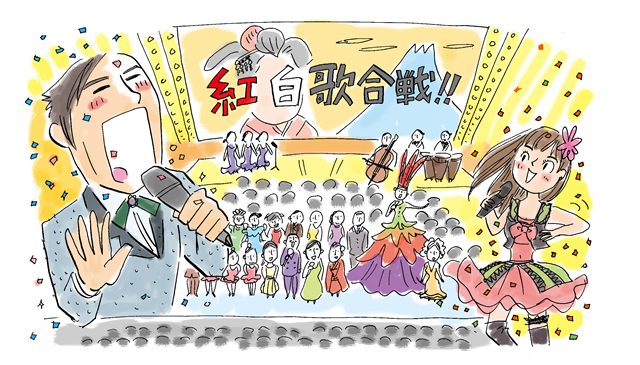
There is a TV program that many people watch on New Year’s Eve, namely NHK’s Kouhaku Utagassen (Annual Singing Contest), which has been going since 1953. Male and female singers, or group singers, divided into red and white teams of 25 compete. Teams are selected according to a variety of surveys. Japan’s top singers, from idol group AKB48 to enka king KITAJIMA Saburo – 2012 marked his 49th appearance on the show – perform on the night.
Of course, many foreign songs come to Japan. What’s called “yougaku” (western music) has also been popular since the era of Elvis PRESLEY and the Beatles. Recently, in addition to western singers, Korean singers are also becoming popular.
[2013年1月号掲載記事]
日本の歌のジャンルには、いろいろあります。一つは、「さくらさくら」「荒城の月」などの抒情歌や、各地で生まれた素朴な民謡など日本の生活に根付いた分野です。これらの曲には琴や三味線、尺八などの日本の伝統楽器がよく使われます。他には、歌の強調部分に「こぶし」と呼ばれるアクセントをつける日本独特の、演歌があります。
演歌の多くは、ままならない恋をテーマにしています。美空ひばりは演歌の代表的な歌手で、少女時代からトップとして君臨しました。古賀正男は、哀愁を帯びた数々のヒット曲を作った有名な演歌作曲家でした。1950年代から60年代は、演歌の黄金時代でしたが、高度成長にともないムード歌謡(ロマンチックバラード)など新しいタイプの歌も登場しています。
さらに、タイガースやテンプターズなどの「グループサウンド」が台頭し、人気となります。70年代に入ると、吉田拓郎、井上陽水、荒井由実(現・松任谷由実)などフォークシンガーやグループが次々に現れます。自分の感情を素直に表現するこれらの歌は、「ニューミュージック」と呼ばれました。
80年代には、心の叫びを歌い若者の共感を呼んだカリスマ的なシンガー尾崎豊が注目されます。その後、さまざまなスタイルのアーティストが登場し、「Jポップ」という言葉が使われるようになりました。1991年には美形の男性アイドルグループを次々に誕生させるジャニーズ事務所からSMAPがデビューし、またたく間に人気となりました。
2012年11月に日本音楽著作権協会(JASRAC)は、過去30年間のカラオケなどで発生した著作権使用料の上位100曲を発表しました。その1位はSMAPの「世界に一つだけの花」でした。ナンバーワンにならなくともいい、一人ひとりが世界に一つしかない花というこの歌は、多くの人の共感を得て歌い継がれています。
その他の音楽シーン
現在、AKB48が話題となっていますが、女性アイドルグループは過去にもたくさん生まれました。70年代にブームを巻き起こしたピンクレディー、80年代のおニャン子クラブ、1998年にデビューしたモーニング娘。がよく知られています。
大晦日の夜に多くの国民が見るテレビ番組があります。それは、1953年から毎年開催されているNHK紅白歌合戦です。さまざまな調査から選ばれた男女それぞれ25組の歌手が、紅組(女性)と白組(男性)に分かれて競い合います。AKB48のようなアイドルグループから2012年で出場49回となる演歌の大御所、北島三郎まで日本のトップシンガーが出場します。
日本でも、もちろん外国の歌がたくさん入ってきます。エルビス・プレスリー、ビートルズの時代から、いわゆる「洋楽」は日本でも人気があります。最近は、欧米に限らず韓国の歌手なども日本で人気になっています。
-
[From January Issue 2013]
Katsuobushi, also called dried bonito, is a smoked fermented fillet of skipjack tuna. An essential ingredient in Japanese cuisine, shaved dried katsuobushi is one of the main ingredients in dashi, a broth that forms the base of many soups, including miso.
First the head of the fish is removed and the flesh is deboned. The fatty belly area is also removed. The fillets are then put in a basket and simmered for an hour to an hour and a half. Bones from the ribs are then removed and the fish is smoked. This action is repeated many times and the process can take up to a month.
The last step of the process is to cover the fillets with mold and let them dry. The fermentation stage in the process is essential for breaking down the long molecules of the natural fat in the bonito into shorter ones, and this creates the so-called umami flavor. Artisan katsuobushi makers repeat the fermentation stage multiple times until all of the fat has been converted. A katsuoboshi master knows when this has occurred from the softness of the surface of the whole katsuobushi, as well as from the sound it makes when struck.
A katsuobushi block has the appearance of very hard, dry wood and is less than 20% of its original weight, containing only 18 ~ 20% water. Production takes from three to six months. In spite of its external dull brown color, once broken, the katsuobushi block is a beautiful ruby red inside. When sold in thin shavings it has a soft color somewhere between pink and light brown.
Katsuobushi is mostly found shaved into very thin pieces and is mainly used for making dashi stock. However it does come in other shapes and sizes: thicker shavings with a richer flavor can be used for salad or as a substitute for smoked ham in a variety of different dishes. You can also buy whole katsuobushi blocks and shave it yourself for a fresher taste. Thin katsuobushi shavings are often used as a topping for dishes such as okonomiyaki or cold tofu. When used on hot dishes it is also called “dancing fish flakes,” because the flakes move in the steam.
Before shaved katsuobushi was sold in strong plastic bags, every household had a special bowl for katsuobushi and it was often the job of the children in the house to shave the katsuobushi before meals. Elderly people associate the sound of katsuobushi being shaved with pleasant childhood memories.
The katsuo fish itself has been consumed in Japan ever since the Jomon period (12,000 ~ 4,000 years ago) but dried bonito was not consumed until later and its appearance and taste have evolved over the years to become the product you can find in stores nowadays.
Katsuobushi is very low in calories but contains lots of protein, thus making it very good for the health. It is considered to be a diet food and useful for fighting stress. Interestingly, outside of Japan it is also widely sold as a gourmet treat for cats.
Text: Nicolas SOERGEL
[2013年1月号掲載記事]
干しカツオともいわれるカツオ節は、カツオの切り身をくんせいにし、発酵させたものです。カツオ節は味噌汁などスープの基本となるだしで、日本食には欠かせない重要な食材です。
まず、カツオの頭を落とし、解体し、骨を取り除きます。脂の多い腹部あたりも切り取ります。切り身をかごに入れ、1時間から1時間半とろ火で煮ます。あばら骨を取り除いた後にいぶします。この工程は何度も行われ1ヵ月ほどかかります。
最後の工程は、切り身を鋳型にいれて乾燥させます。この発酵の過程が、カツオの自然の脂肪を分解させるための重要なポイントです。そしてそれが、いわゆるうまみとなるのです。熟知したカツオ節メーカーは、すべての脂肪がなくなるまで、この発酵過程を何度も繰り返します。カツオ節職人は、それがいつなのかは、カツオ節の表面のやわらかさや、たたいた音でわかります。
カツオ節は、見た目はとても固い乾いた木のようで、重さは元の20%以下となり、水分も18~20%までおとします。生産には3~6ヵ月かかります。外側は渋い茶色ですが、削ると中身はきれいなルビーレッドです。薄く削って売られるときには、ピンクと薄茶色のやわらかい色になります。
カツオ節は普通、とても薄く削られた形で売られ、主にだしをとるために使われます。しかし、他の形やサイズのものもあります。半生タイプに加工され厚く削られた風味のあるものは、サラダやくんせいハムの代わりとしていろいろな料理に使われます。カツオ節一本をまるごと買い、自分で削って新鮮な味を作ることもできます。薄く削ったカツオ節は、お好み焼きや冷奴などの料理に、トッピングとしてよく使われます。削られたカツオ節は熱い料理に使われると蒸気で揺れ動くので、「踊るフイッシュ・フレーク」とも呼ばれています。
厚めの丈夫なプラスチックの袋に入った削られたカツオ節が店で売り出される前には、どの家庭でも削り器があり、食事前にカツオ節を削るのは子どもたちの仕事でした。熟年者は、カツオ節の削る音を聞くと、なつかしい子ども時代の思い出と重なります。
日本では、カツオ自体は縄文時代(紀元前12,000~4,000年前)以来食べられてきました。しかし、干したカツオはそれ以降からで、長い間に形や味が進化して、現在の製品にたどりつきました。
カツオ節は、カロリーがとても少ないですが、プロテインを多く含むので健康にとてもよいです。また、ダイエット食で、ストレスを押える助けにもなります。面白いことに、日本以外では猫のぜいたくな食べ物として広く売られています。
文:ニコラ・ゾェルゲル
-
[From January Issue 2013]
KAWAKAMI Jinichi
Since way back, ninja have appeared in novels, movies, comics and games. Using their ninjitsu skills, ninja fight enemies and save their masters who employed them. Similar to a famous brand, the ninja is known, not only in Japan, but also abroad. What isn’t known though is whether such people really existed, and if they did, what kind of activities they were involved in.
In Japan, Iga City, Mie Prefecture and Koka City, Shiga Prefecture are famous as ninja hangouts. In order to do research into the history and culture of ninjutsu, KAWAKAMI Jinichi, honorary director at the Iga-ryu Ninja Museum in Iga City, became a specially appointed professor of the Science of Ninjutsu at Mie University last December. Kawakami says, “Since I was a child, I’ve been practicing the same training routines as ninja.”
When he was around six, Kawakami encountered ISHIDA Masazo, teaching Koka-ryu ninjutsu in his neighborhood. Taking an interest in ninjutsu, he learned a variety of martial arts techniques used by ninja, including how to throw shuriken (throwing stars), a weapon commonly believed to have been used by ninja. He also learned to walk without making any sound, to use wild grass as medicine, to sneak into enemy territory, and to set traps. And at the age of 18, he succeeded Ishida and began to hand down the Koka-ryu ninjutsu tradition and teach martial arts to young pupils as a master himself.
Called “the last ninja” by those got to know him through his ninja activities, Kawakami speaks at various seminars. It was because of a lecture he gave at a symposium hosted by Mie University last year that Kawakami became a specially appointed professor. At the university, he is studying documents related to ninjustu. He is planning to publish his research results in the future.
Running and jumping about in the mountains, fighting with ninjitsu, and so on; in novels and movies, ninja are depicted as being similar to spies. Kawakami, however, sees ninja as people who have knowledge about information gathering, psychology, medicine and sociology, as well as survival skills. Therefore, when he gets injured or catches a cold, Kawakami cures himself with medicine made from wild grasses.
“When I was training to become a ninja, I practiced reading other people’s emotions, and this was useful when making business deals and for establishing important relationships,” Kawakami recalls. Because of this, he says, “At the university, I want to teach students not only about the skills that ninja possess, but also their way of thinking, their spirit and historical background.”
Kawakami is trying to portray ninja not as fictional characters but as masters of survival skills that can be applied to modern life. And in order to disseminate this idea, he is working as a museum director and a university professor. Kawakami’s science of ninjutsu, might help people from abroad with an interest in Japanese culture, history and thought processes, to know Japan more deeply.
Text: ITO Koichi
[2013年1月号掲載記事]
川上仁一さん
忍者は昔から小説や映画、まんが、ゲームなどの題材として登場します。忍者は忍術を使って敵と戦ったり、雇い主である主人を助けたりします。日本国内はもちろん、海外でも「ニンジャ」という一種のブランドとして知られています。しかし、そういう人たちが本当にいたのか、いたのならどのような活動をしていたのかはあまり知られていません。
日本では三重県伊賀市と滋賀県甲賀市が忍者の里として有名です。このうち、伊賀市にある伊賀流忍者博物館の名誉館長、川上仁一さんは昨年12月、忍術の歴史や文化などを研究するため、三重大学で忍術学を研究する特任教授になりました。川上さんは自分のことを「小さいころから、忍者が行った修行を積んだ者です」と言います。
川上さんは6歳頃のとき、家の近所で甲賀流忍術を伝えていた石田正蔵さんに出会いました。忍術に興味を持った川上さんは、一般に、忍者が使ったとされる武器である手裏剣や様々な武術などを学びました。また、音を立てずに歩く方法、薬の代わりに野草を使う方法、敵地への潜入、謀略の技なども身に付けました。そして、18歳のときに石田さんのあとを継いで甲賀流忍術を伝承し、武術では後輩を指導する師範になりました。
川上さんは忍者の活動を通じて知り合った人々から「最後の忍者」と呼ばれており、さまざまな講演会などで話をしています。川上さんが三重大学の特任教授になったのも、三重大学が昨年開いたシンポジウムで講演をしたことがきっかけとなりました。大学では忍術に関する資料の研究などをしています。将来はその成果をまとめていく考えです。
小説や映画などで忍者は、野山を駆け巡り、飛んだり跳ねたり、忍術をかけたりするスパイのように描かれています。しかし、川上さんは忍者を、情報収集や心理学、薬学、社会学の知識を備えたサバイバルの技術を持った人のことと考えています。ですから、川上さんはけがをしたり風邪をひいたりしたときも自分で野草を薬にして治します。
また、川上さんは「忍者の修行をしていたときに、相手の気持ちを上手に読む訓練をしたので、仕事で駆け引きをしたり、大事な関係を築いたりするときに役立ちました」と振り返ります。このため「大学では、忍者の持つ技術的なことばかりでなく、忍者の考え方や精神、歴史的な背景なども学生に教えていきたいです」と話しています。
川上さんは、忍者を架空の存在ではなく、現代にも応用できるサバイバル技術の伝え手としてとらえようとしています。そして、その考え方を広めるために博物館の館長や大学の教授を務めています。川上さんの教える忍術学は、日本の文化や歴史、考え方などに興味を持つ外国人にとっても、日本をより深く知る手助けになるかもしれません。
文:伊藤公一
-
[From January Issue 2013]
Garasu no Kamen (Glass Mask)
First serialized in 1975 and still going today, “Garasu no Kamen” (Glass Mask) is a popular shoujo manga (girl’s comic). Its fast paced story of rivalry and love made the manga a huge hit. It has been adapted into a TV drama, a TV anime and a play. Since it’s been going for such a long time, the manga can be read to get an insight into changes in Japanese society.
Heroine KITAJIMA Maya is an elementary school student. Barely able to keep up with her studies, she lives in poverty with her mother. Maya has a talent for storytelling. One day, by chance, the famous actress TSUKIKAGE Chigusa passes by while Maya is telling a story to some children in the park. Tsukikage is captivated and Maya is drawn into the world of the theater.
Maya has a genius for performing on stage. Chigusa decides that someday Maya will play the lead role in the masterpiece “Kurenai Tennyo” (The Crimson Maiden of Heaven) and trains her hard for the role. The other actors feel that Chigusa is giving Maya special treatment and begin to play tricks on her while on stage. But with talent and hard work, Maya overcomes these difficulties and soon becomes a famous actress.
Maya has a very talented rival in HIMEKAWA Ayumi. Beautiful and intelligent, Ayumi has been raised by a wealthy family and has had an excellent education. She is well connected because both her parents are in the entertainment business. Though everyone believes that Ayumi is the best choice for the lead role in “Kurenai Tennyo,” Maya battles with her own insecurities and tries to land the part. Gradually her dream becomes a reality.
Maya also has an enemy. He is HAYAMI Masumi, the president of a talent agency. Masumi believes that “productions are products,” and, as a business rival, tries to hinder Chigusa and Maya. Secretly though he is charmed by Maya’s acting and sends her flowers and money anonymously. Not knowing the true situation, Maya detests Masumi, but when she find out about his kind side, she becomes bewildered. Soon the two fall in love.
“Garasu no Kamen” became a huge hit with young girls. Not only because it tells the story of a normal girl becoming a star, but also because of the flamboyant costumes and makeup stirred up dreams in little girls of becoming beautiful actresses themselves. Love between enemies and confessions of love by a childhood friend are typical romantic storylines used in shoujo manga. On the other hand, sports manga and shounen manga (boy’s comics) fans were also attracted to this series because the heroine confronts various rivals and, after giving it her best shot, wins out in the end.
Today there is a hotel which has rooms and a food menu themed around the main characters, and, in addition, Masumi tweets on Twitter. There is also a project underway in which readers can vote on their favorite lines from the manga to be printed onto a set of karuta (playing cards) that is due to go on sale. Since this manga series has been going for such a long time, developments within Japan over the past few decades can be seen: the black home phones of yesteryear have been replaced with smartphones and the poverty stricken households that used to be depicted are no longer seen.
Text: SAZAKI Ryo
[2013年1月号掲載記事]
ガラスの仮面
「ガラスの仮面」は、1975年に連載が始まり今も続いている人気の少女まんがです。ライバルとの対決や敵対する人との恋などドラマチックな事件を次々に、しかしテンポよく描いて大ヒットしました。テレビドラマ化されたり、テレビアニメや舞台作品になったりもしています。長い間続いているため、日本の社会の変化を読みとることもできます。
主人公の北島マヤは落ちこぼれぎみの小学生で、母親と二人、貧しい暮らしをしていました。彼女の特技は、人にお話を聞かせるのがうまいこと。ある日公園で、子どもたちにお話をしてあげていたマヤは、たまたま通りかかった名女優、月影千草の目を引き、演劇の世界へ進むこととなります。
マヤは舞台役者として天才的な才能を持っていました。月影はいつかマヤに名作「紅天女」の主役を演じさせようと考え、厳しく特訓して育てます。周囲の役者たちはマヤが月影にひいきされていると考え、本番の舞台で嫌がらせをするようになりました。しかしマヤは才能と、人並み以上の努力で困難を乗り越え、有名な女優になります。
マヤには強力なライバル、姫川亜弓がいます。亜弓は美しくて頭がよく、裕福な家庭で教養豊かに育てられています。両親が芸能関係だという強いコネもあります。紅天女の主役にふさわしいのは亜弓だと誰もが考える中、マヤはコンプレックスと闘いながら紅天女役を目指します。そして少しずつ夢に近づいていきます。
マヤには敵もいます。芸能プロダクション社長の速水真澄です。「演劇は商品だ」と言う速水は、商売敵である月影やマヤの活動をじゃましますが、内心ではマヤの演技に引かれていて匿名で花やお金を贈っていました。事情を知らないマヤは速水を憎みますが、そのやさしさを知ってとまどいます。そしてふたりは次第に愛し合うようになります。
「ガラスの仮面」は少女たちの間で大ヒットしました。平凡な女の子がスターになるだけでなく、役者として華麗な衣装を着たりメークで美人になったりするのが、夢とあこがれをかきたてたからです。敵との恋や幼なじみからの告白なども、少女マンガの王道を行くロマンスでした。一方、スポーツまんがや少年まんがのファンたちも、さまざまなライバルと対決し努力によって勝ちあがっていくという物語に引かれました。
現在では、主要キャラクターのイメージに合わせた部屋やメニューを用意しているホテルがあったり、速水の名前で配信されているツイッターがあったりします。まんがに出てくる有名なせりふを読者による投票で選びかるたにして発売する、という動きもあります。長い間連載されているまんがであるため、初期は黒電話だったのが今はスマートフォンを使っている、昔よく描かれていた貧しい家庭が今は見られなくなったなど、日本のこの数十年の発展もわかる作品です。
文:砂崎良