-
[From March Issue 2013]
For the past several years there’s been a “marathon boom” in Japan. The Tokyo Marathon was first held in 2007 and every year there are so many people applying to enter, that only one in nine are able to participate. Similar events are held all over the country, but the kind of marathon that’s really been attracting attention are “unique marathons.” Unique marathons include a “sweets marathon,” where runners are given cakes and other desserts along the route, instead of water, and a “konkatsu marathon” where runners search for a spouse.
In Minami-uonuma, Niigata Prefecture, there is the “Minami-uonuma Gourmet Marathon.” Popular since it began in 2010, this year’s event will be held on June 9. One interesting feature of this event is that every participant is rewarded with an all-you-can-eat meal of Koshihikari-brand rice produced in Minami-uonuma. Producing a brand of rice that’s well-known throughout Japan, this idea could only have come from Minami-uonuma.
At the main meeting area, a “gourmet village” is set up, where dishes that go well with rice are served up. After crossing the finish line, each participant is given a bowl of cooked rice and with that in hand, are able to sample local dishes. “We started with the intention of promoting our wonderful local food. Food such as edible wild plants and pork,” says IGUCHI Noriko, secretary of the Minami-uonuma Gourmet Marathon.
Using the marathon as a promotional tool has been a big success, and participants have commented, “I run as fast as I can in anticipation of the delicious meal.” Just a 13 minute’ walk from Urasa Station on the Joetsu shinkansen, access to the site is easy and the number of applicants is increasing every year.
Another popular marathon is the “Fuji Marathon Race,” which involves running up Mt. Fuji. At an altitude of 3,776 meters, Mt. Fuji is the highest mountain in Japan. Since it is difficult to even walk up the mountain, this race to the top is really punishing. There are two routes: the 21-kilometer “Summit Competition” and the 15-kilometer “5th Station Competition.” Beginners can only participate in the “5th Station Competition.”
This event has a long history, with the first competition being held in 1948. This year’s event will be held on July 26 and marks the 66th time the event has been held. Since 2013 is the year that Mt. Fuji is due to be listed as a World Heritage Site, people in Fujiyoshida City, Yamanashi Prefecture, where the event takes place, are getting really fired up about it. A festival on the day before the event will be held at 10 a.m. in Fujihokuroku Park. There, lectures will be given by famous runners and running seminars will be held. Many stalls selling delicious B-class (inexpensive but satisfying) food will also be set up.
Runners of all different ages, from those in their teens to those in their 70s, take part and you can see both parents and children cheering each other on to reach the finish line. “It is an extremely tough and tiring race, but when you finally reach the top and take in the view below, you will be deeply moved,” says TAKAYAMA Kurato, secretary of the executive committee of the Fuji Mountain Race.
YANAGIOKA Hideo, a resident of Tokyo, who has been running marathons for 30 years says, “The Fuji Mountain Race gives me a greater sense of accomplishment than races over flat terrain. ‘Unique marathons’ give you something extra to enjoy in addition to the pleasure of running.”
Minami-uonuma Gourmet Marathon
Fuji Mountain RaceText: MUKAI Natsuko
[2013年3月号掲載記事]
数年前から、日本では「マラソンブーム」です。2007年に始まった東京マラソンには、毎年多くの参加希望者が集まり、その倍率は9倍です。その他各地でも大会が開催されていますが、最近話題なのが「ユニークマラソン」です。水の代わりにケーキなどのデザートを補給しながら走る「スイーツマラソン」や、出会いを求めて走る「婚活マラソン」などがあります。
新潟県南魚沼市で行われるのが、「南魚沼グルメマラソン」です。2010年の開催以来人気で、今年は6月9日に開催が予定されています。この大会のおもしろいところは、参加賞が、南魚沼産コシヒカリ食べ放題であることです。全国的に有名な米の産地である南魚沼ならではのアイディアです。
メイン会場には「グルメ村」があり、そこではご飯に合うおかずを提供しています。ゴール後、参加者はご飯の入ったお茶碗を片手に、地元の料理を食べることができます。「山菜や豚肉など、地元の素晴らしい食材をアピールする場をつくりたいという思いから始めました」と事務局の井口典子さんは話します。
マラソンを利用したアピールは大成功で、参加者からは「おいしい料理を楽しみに、一生懸命走ります」という感想がたくさん寄せられています。また、大会会場は上越新幹線浦佐駅から徒歩13分とアクセスもよいため、参加希望者が年々増えています。
一方で、富士山を駆けあがる「富士登山競走」も人気があります。富士山の標高は3,776メートルで、日本一高い山です。歩いて登るのも難しいので、頂上目指して走るこの大会はとても厳しいものです。コースはスタート地点から山頂まで21キロの「山頂コース」と、スタート地点から五合目まで15キロの「五合目コース」の2種類があります。初心者は五合目コースしか選ぶことができません。
大会の歴史は古く、1948年に第1回が開催されました。66回目を迎える今年は、7月26日の開催予定です。2013年度は富士山の世界文化遺産登録実現の年にあたるため、大会主催地の山梨県富士吉田市はとても盛り上がっています。大会前日の午前10時から富士北麓公園では前夜祭が開催されます。当日は有名ランナーの講演会やランニング講座が行われ、会場にはB級グルメ(安くておいしい料理)店がたくさん出店する予定です。
参加者の年齢層は10~70代と広く、親子ではげましあいながら走りきる姿も見られます。実行委員会事務局の高山倉人さんは、「非常に厳しく苦しいレースですが、山頂まで登りきり、下界を一望したときには、心の底から感動します」と話します。
東京都内に住むマラソン歴30年の柳岡秀男さんは、「富士登山競走は平地を走るマラソンよりも達成感があります。ユニークマラソンには走る喜びと、それとは別に特別な楽しみがありますね」と話します。
文:向井奈津子
-
[From March Issue 2013]
During spring and autumn, many wedding ceremonies are held in Japan. Though the number of practicing Japanese Christians is thought to be around 1% – that’s including Catholics and Protestants – nearly 70% of Japanese weddings are held in a chapel. By contrast, almost all funerals are Buddhist. On the other hand, events like shichigosan, which celebrates the growth of children, are held at Shinto shrines. In Japan, religions are able to coexist without any friction between them.
Shinto has been the religion of Japan since ancient times. Sensing a mysterious power residing in things like rocks, waterfalls, rivers and mountains, Japanese worshiped natural objects, animals and humans as gods. Shinto shrines are symbolic places. In Japan many gods coexist. In this way, Buddhism has been accepted since the sixth century. For their first visit of the year, people may go to pray at either a shrine or a temple.
Since Japan is polytheistic, Japanese are tolerant of foreign religions. Because of this they have incorporated western religious events and ceremonies, like Christmas and Halloween, into their lives. For most Japanese they are merely fun events.
However, besides funerals, events and ceremonies connected with Buddhism are regarded as old-fashioned, and these days Japanese distance themselves from them. Japanese know Christ’s birthday, but hardly anybody knows Buddha’s. However, in recent years, Asian countries have taken center stage and because of this, religious events originating from these countries that are perceived as being “cool,” may be adopted.
The Japanese pagan attitude to religion can be seen as tolerant, but on the other hand, it may be seen as impious or even indifferent. From the standpoint of fiercely religious countries, the Japanese might appear to be heathens. However, due to this attitude, Japan hasn’t been involved in any religious disputes, and because religion is not an integral part of everyday life, it’s a peaceful country.
The Other Side of Religion
Zen, which can be a religion or philosophy, has greatly influenced Japanese culture and bushido (the samurai code). Leading to enlightenment, zazen (meditation) training is well known, but few people fully understand it. Its central message to “Accept reality as it is” might be more easily understood through the Beatles’ song “Let it Be” or Doris DAY’s “Que Sera Sera.”
In Japan there are no religious political parties, but a party supported by a religious group exists. New Komeito, a political party that has formed a coalition cabinet with ABE Shinzo’s Liberal Democratic Party was founded by Soka Gakkai, a religious Buddhist group. Candidates of newly formed religious groups occasionally run for office in national elections, but almost all fail.
In 1995, many people were victims of the sarin gas attack on the Tokyo metropolitan subway. This was carried out by cult religious group Aum Shinrikyo. Though all the suspects were arrested, having divided into splinter groups, Aum still survives under different names. As a result, many Japanese are suspicious of new religions.
[2013年3月号掲載記事]
日本の春と秋には結婚式が多く行われます。日本人のキリスト教信者は、カトリック、プロテスタントを合わせても1%ほどとみられていますが、日本人の結婚式の7割近くがチャペル式で行われています。一方、葬式となると、ほとんどが仏教式で行います。また、子どもの成長を祝う七五三などの行事は神道の神社で行われます。日本では宗教が争いなく共存しています。
日本の古くからの宗教は神道です。日本人は、不思議な力を感じる巨大な岩や滝、川、山などの自然、動物、人間などを神とあがめてきました。その象徴的な場所が神社です。日本では、たくさんの神が共存しています。仏教はこのような風土の中で6世紀に受け入れられました。初詣では神社で、あるいは、仏教のお寺にお参りすることもあります。
日本は多神教ですので日本人は外国の宗教に関しても寛大です。そのため、日本人はこれまでクリスマスやハロウィーンなど、西洋の宗教行事や儀式を生活に取り入れてきましたが、ほとんどの日本人にとって、それらは楽しいイベントにすぎません。
これに対して、葬式は別として、仏教に由来した行事や儀式は古くさいものとして、近年、日本人は遠ざけてきました。日本人はキリストの誕生日を知っていますが、釈迦の誕生日を知っている人はほとんどいません。しかし、近年はアジア諸国の台頭で、これらの国の宗教に由来する行事も「クールな」イベントとして近い将来、受け入れられる可能性もあります。
日本人の宗教観については異教に対して寛大といえますが、見方を変えれば、信仰心がない、あるいは無関心ともいえます。世界の信仰の厚い国民の目には、日本人は不謹慎と映るかもしれません。しかし、そのおかげで日本には宗教に関わる争いがなく、日常生活に宗教を必要としていない平和な国ともいえます。
宗教の他の側面
宗教の一つとも哲学ともいえる禅は、日本の文化や武士道に大きな影響を与えました。悟りを開く座禅の修行はよく知られていますが、その本質を理解する人はあまりいません。「あるがままを受け入れる」という禅の中心的な考えは、ビートルズの「レット・イット・ビー」やドリス・ディが歌った「ケ・セラ・セラ」と通じるといえば、わかりやすいかもしれません。
日本には宗教政党はありませんが、宗教を母体にした政党はあります。安倍晋三総理の自民党と連立内閣を組む公明党は、仏教系の宗教団体、創価学会を母体としています。新興宗教団体が国政選挙に出馬することもあります。しかし候補者のほとんどが落選しています。
1995年に東京で地下鉄サリン事件が起き、多くの人が犠牲になりました。この事件は新興宗教集団のオウム真理教の仕業でした。容疑者は全員逮捕されましたが、オウムは名前を変えて今も存続しています。そのため、新興宗教をうさんくさく思う人は少なくありません。
-
[From March Issue 2013]
There are many unique districts in Tokyo, each with its own special features: for luxury shopping, there’s Ginza, for young women’s fashion, there’s Shibuya and for anime and electrical goods there’s Akihabara. Shinjuku is “a town for everybody that has just about anything.”
With six railways running through it, Shinjuku Station is a major terminal. In just one day 3.46 million passengers pass through this station, the largest amount in the world, a fact that has been recognized in the Guinness Book of Records. Shinjuku Station has six adjoining department and specialty stores: Lumine 1, Lumine 2, Luminesto, Keio, Odakyu and Odakyu Halc.
These stores have their own special features. On the seventh floor of Lumine 2 is “Lumine the Yoshimoto,” a comedy theater. Run by Yoshimoto Creative Agency, many comedians from its stable perform at daily shows.

Omoide Yokocho
To the north of Odayku department store is Omoide Yokocho, an area with a nostalgic feel. The narrow alleyways of Omoide Yokocho are lined with tiny eateries, the majority of which are yakitoriya (restaurants that serve grilled chicken on a skewer). Walking down these streets, the smoke and smell of yakitori is enticing. The spot is crowded with office workers, couples and tourists in the evening, and is also popular among non-Japanese.
The west exit of the station is a bus terminal. Limousine buses depart from here to Narita and Haneda airports. Night busses to local cities are popular among young people as it’s possible to travel cheaply, while sleeping. Behind the bus terminal are electronic discount stores, such as Yodobashi Camera, and the beyond that is a business district filled with skyscrapers.
One of these skyscrapers is Tokyo Metropolitan Office; its viewing platform is a popular sightseeing spot, visited by approximately 1,800,000 tourists a year. From there which you can view the whole of Tokyo, including Tokyo Skytree, Tokyo Tower and Mt. Fuji. Volunteer guides give humorous explanations about the view in English, Chinese and Korean. On the first floor is Tokyo Tourist Information Center, where leaflets with sightseeing information and PCs are available.
From the south exit of the JR station, you can see Takashimaya department store. Inside the department store you can find Tokyu Hands, a large DIY store. A few minutes’ walk from the department store is Shinjuku Gyoen, an oasis for city dwellers. It has an elegant traditional Japanese garden and in spring is a well-known spot for cherry blossom viewing.
At the east exit, Studio Alta is used as a meeting spot and Shinjuku Dori, the main shopping street, runs away from here towards the east. On this street is the large bookstore, Kinokuniya, and Bicqlo (a store which is a collaboration between Big Camera and Uniqlo), further down is Marui department store and Isetan department store. In this vicinity there are a variety of different restaurants.

Bicqlo / Isetan department sore
Leaving by the east entrance and heading north you soon come to Yasukuni Dori. Beneath this street is “Subnade,” a huge underground shopping mall. Crossing Yasukuni Dori, you will come to Kabukicho, Japan’s largest entertainment district. It’s packed with recreational facilities and restaurants, including movie theatres, pachinko parlors (much loved by Japanese) and game arcades.
Kabukicho is also an adult entertainment area. There are many adult entertainment establishments and adult video shops. Among these are host clubs where male hosts entertain rich women and off-duty hostesses. Pictures of handsome hosts are displayed in front of these clubs. In recent years a cleanup campaign has been carried out by the Metropolitan Government and an association of local small businesses, so harassment of tourists has practically died out. The northern part of Kabukicho is the love hotel (special hotels for couples) district.
Shinjuku Goldengai is in the east next to Kabukicho. Its old fashioned narrow alleys are packed with tiny bars. Though each bar fits only about ten around its counter, customers can enjoy a conversation with the mama (female proprietor) and other customers. Many customers are involved in the media or cultural arts, be they people in the movie or theatre business, novelists, writers or journalists. You may even come across some famous people.
Kabukicho / Manga bookstore
Next door to Goldengai is the scarlet-colored Hanazono Shrine. Its peaceful grounds are encircled by trees. Stalls are set up in its grounds on festive occasions. About five minutes’ walk from Hanazono Shrine to the east is Shinjuku-nichome, an area packed with gay bars. Many gay celebrities who appear on TV started out here.
As you can see, Shinjuku is rich in variety. For this reason, it’s much loved by people, because men and women of all ages can visit without feeling out of place. In a survey of foreign tourists, Shinjuku was chosen as the town that most lived up to people’s expectations.
[2013年3月号掲載記事]
東京には、高級ショッピングは銀座、若い女性のファッションは渋谷、アニメと電気製品では秋葉原というように、独自の特色を持つ街がたくさんあります。新宿は、「何でもあるみんなの街」です。
新宿駅は6つの鉄道が乗り入れる巨大なビッグターミナルです。一日の乗降客は346万人で、ギネスブックにも世界一と認定されています。新宿駅にはルミネ1、ルミネ2、ルミネエスト、京王、小田急、小田急ハルクの6つの百貨店・専門店が隣接しています。
これらの店はそれぞれの特色を持っています。ルミネ2の7階にはお笑い専門劇場「ルミネtheよしもと」があります。多くのお笑い芸人が所属するよしもとクリエイティブ・エージェンシーが運営している劇場で、毎日公演を行っています。
小田急デパートの北側には、レトロな雰囲気の「思い出横町」があります。細い路地には、焼鳥屋を中心とした屋台風の小さな食堂が並んでいます。この通りを歩くと、焼鳥を焼く煙とにおいが食欲をさそいます。夕方からは仕事帰りのサラリーマン、カップル、さらには観光客などで混み合います。外国人にも人気のあるスポットです。
駅の西口はバスターミナルになっています。ここから成田空港や羽田空港へのリムジンバスも発着しています。また、地方都市への深夜便は寝ている間に安く行けることから若者に人気です。バスターミナルの先にはヨドバシカメラなどの家電量販店があり、その先は高層ビルが立ち並ぶビジネス街です。
高層ビルの一つに都庁があり、東京が一望できる展望台は人気の観光スポットで、年間約180万人が訪れます。ここからは東京スカイツリー®、東京タワー、富士山も見えます。ボランティアガイドがユーモアをまじえながら英語、中国語、韓国語で案内してくれます。1階には東京観光情報センターがあり、外国語で書かれた観光案内のパンフレットや観光情報を自由に検索できるパソコンがあります。
JR南口からは髙島屋百貨店が見えます。ここには大きなDIY店の東急ハンズもあります。そこから徒歩数分で都民の憩いの場所である新宿御苑へ行けます。日本庭園は風情があり、春は桜の名所としてもよく知られています。
東口には待ち合わせ場所として利用されるスタジオアルタがあります。そこから東へのびる新宿通りはメインショッピングストリートです。大型書店の紀伊國屋、ビックカメラとユニクロがコラボしてできたビックロ、その先にはマルイや伊勢丹百貨店があります。この周辺にはさまざまなレストランもあります。
東口を出て北へ進むと、すぐに靖国通りに着きます。この通りの地下には巨大な地下ショッピング街、サブナードがあります。靖国通りを渡ると、日本一の歓楽街の歌舞伎町があります。ここには、映画館をはじめ、日本人が大好きなパチンコやゲームセンターなどの娯楽施設や飲食店などが密集しています。
歌舞伎町は風俗の街でもあり、風俗店やアダルトビデオ店がたくさんあります。その中にお金持ちの女性やホステスを相手にしたホストクラブもあります。店の前には、イケメンホストの写真がずらりと貼られています。近年は東京都と地元商店組合が浄化キャンペーンを行ったため、観光客とのトラブルはほとんどなくなりました。歌舞伎町の北側はラブホテル(カップル専用のホテル)街です。
新宿歌舞伎町の東に接して、新宿ゴールデン街があります。ここには狭い路地に古き良き時代の小さなバーが密集しています。バーには10人ほど座れるカウンターがあるだけで、ママ(女性のオーナー)や他のお客との会話を楽しみます。ここに来るお客には、映画や演劇、作家、ジャーナリストなど、メディアや文化的なビジネスに携わる関係者がたくさんいます。有名人との思わぬ出会いもあります。
ゴールデン街の隣には、朱色の花園神社があります。境内は木々に囲まれています。縁日には境内に屋台がたくさん並びます。花園神社から徒歩で東へ5分ほどで、ゲイバーが集まる新宿二丁目へ行けます。テレビに出演する有名なゲイタレントがここからたくさん生まれました。
このように、新宿はバラエティーに富んでいます。そのため、男女、年齢に関係なく集える街として多くの人に愛されています。外国人旅行者のアンケートでも、新宿は東京で一番満足した街に選ばれています。
-
[From March Issue 2013]
Origami Artist SHINGU Fumiaki
As an origami artist I’ve been asked by the government to promote the art of origami to the world by doing things like setting up a website that shows people how to make origami. Because it uses few natural resources, origami is eco-friendly. An outstanding example of “cool Japan” culture, it’s a pastime that both children and adults can enjoy.
Sometimes I’m asked to give lectures by universities overseas that specialize in the arts, but I’ve also started work on a big origami commission that I received from a Japanese person living in Europe. He said to me, “Though I brought a book on origami with me from Japan, it hasn’t captured the interest of children here. Could you please introduce me to origami that can capture the imaginations of European children.” With this in mind I made, “Origami for Christmas” and “Origami for Halloween.”
In western countries origami is regarded as a kind of paper craft. Origami is translated into English as paper folding, butrecently the word “origami” is more generally used.
The method of manufacturing paper was invented in China and brought to Japan in the early 7th century. Before long, manufacturing methods and materials used in Japan changed, producing durable, beautiful washi of excellent quality. Appreciated by the samurai classes, the use of washi spread, spawning a unique Japanese “paper culture.” In the early days, it was used for special envelopes that contained gifts of money; to express one’s hospitality. It was also used in daily life to create things like “shouji ” (sliding paper doors) and “fusuma” (sliding paper screens).
“Yuugi origami,” or the art of folding paper into things like cranes or helmets, and “unit origami ” constructing threedimensional out of identically shaped pieces of paper –popular in Europe – were invented in the Edo period (17~19 century). In the Meiji period the government invited the world famous German educator, Friedrich Wilhelm August FROEBEL, to Japan. He utilized origami in his child education program. This is how origami began to be taught in kindergarten.
In recent years, people in Hindu and Islamic societies have taken an interest in origami and I sometimes receive mail from them. They say that because it has no religious affiliations, origami can be easily accepted into their culture. It seems that my work will continue.
[2013年3月号掲載記事]
折り紙創作作家 新宮文明さん
私は創作作家として、国からの要請もあり、作品の作り方をインターネットに設けるなど、折り紙文化を世界に広めています。折り紙は大量の資源を使わず、自然と共存し、子どもから大人まで楽しめる娯楽で、「クールジャパン」の代表的なコンテンツの一つです。
今では海外の美術系の大学からときどき、講演の依頼が舞い込みますが、私が本格的に折り紙の創作を始めたのは、ヨーロッパに住んでいる日本人からリクエストがあったからです。「日本から折り紙の本を持って行きましたが、子どもたちが関心を持ってくれません。ヨーロッパの子どもたちが興味を持つ作品を紹介したい」ということでした。そこで、「クリスマスの折り紙」や「ハロウィンの折り紙」などをつくりました。
折り紙は、欧米でいうペーパークラフトの一部です。英語で、ペーパーホールディングともいいますが、最近はおりがみが一般的になってきました。
中国で発明された紙は、7世紀の初め頃、その製法が日本に伝えられました。まもなくして日本で製法や材料を変え、丈夫で美しく良質な和紙が誕生しました。和紙は武家社会に受け入れられてから急激に普及し、日本独特の紙文化が生まれました。初期はご祝儀袋などのような、おもてなしの心を表すものとして、また、障子やふすまなどの生活必需品にも使つかわれました。
江戸時代(17 – 19世紀)に入るとツルやかぶとなど、具体的な物の形に折る「遊戯折り紙」や、ヨーロッパで人気がある、特徴ある形に折ったものを組み合わせて立体的に作る「ユニット折り紙」が考案されました。明治時代に入ると政府から招かれたドイツの世界的な教育学者のフリードリヒ・W・A・フレーベルが、幼児教育のプログラムの一環として、折り紙を採用しました。これが幼稚園で折り紙を教える始まりです。
近年は、ヒンズー教やイスラム教社会でも関心が持たれ、ときどきメールが入ります。折り紙は宗教感がなく、受け入れやすいということでした。まだまだ、私の仕事は続きそうです。
-
[From March Issue 2013]
WelSelf Inc.
“An illustrator will draw a portrait of you.” “A parliamentary aide will recommend you a suitable gift.” “A professional author will write a novel for you with you as the main character.” “Coconala,” a website where you can make use of these kinds of services for 500 yen, has been gaining attention.
Coconala is a site where knowledge, skills and experience can be bought. The site was launched in July 2012 and has acquired 33,000 users in about six months. At the time of writing more than 3,700 unique services were up for grabs.
At 7:3, the proportion of male users far exceeds female users, and the largest age group is 25 to 35 year olds. Business orientated services to improve skills, such as advice on starting up a business, are popular with men. For women, services that give personal advice, such as fortune telling, are popular. Portrait drawing and illustration services are popular with both men and women.
Calico, an illustrator who offers a portrait drawing service on Coconala, says, “I was working for a company as an ad designer, but I quit because they were not sympathetic about childrearing issues. While thinking of continuing to draw portraits at home, I discovered Coconala where you could offer your services for 500 yen. I made my portrait drawing services available in order to brush up my skills and to reach a wider audience.”
MINAMI Akiyuki, a representative of WelSelf Inc., the company that runs Coconala, says he would like the site to be a place for “business” rather than for making pocket money. “Business has its origins in bartering. Bartering is exchanging what one has for what another person has in order to improve each other’s life. Everyone has some unique kind of experience, knowledge or skills. By offering these skills, people can help some one somewhere in society.”
Minami says, “If you are aware that you have a skill to offer to someone in society, your view of society will change. If there’s a system through which you can offer your skills, even if it’s just for 500 yen, what’s going on in society is no longer somebody else’s business, it gives you a deeper sense of involvement. Through taking action yourself you get a sense that this is a place where you can make a difference to society and by doing so you feel less isolated and get a sense of wellbeing. We run Coconala in this spirit.”
Coconala is now thinking of diversifying their services by setting up a varied pricing system and making the system easier to use via a smartphone.
Text: TSUCHIYA Emi
[2013年3月号掲載記事]
株式会社ウェルセルフ
「イラストレーターがあなたの似顔絵を描きます」「議員秘書がおすすめの手土産を教えます」「プロのライターがあなたを主人公にした小説を書きます」。こんなサービスをすべて500円で利用できるウェブサイト、「ココナラ」が注目を集めています。
ココナラは、知識、スキル、経験を売買できるサイトです。2012年7月にスタートし、サービス開始後約6ヵ月で33,000人のユーザーを獲得しました。今では常に3,700件以上のユニークなサービスが出品されています。
ユーザーの男女比は7:3で、男性のほうが多く、最もよく利用する年齢層は25-35歳です。男性には起業するうえでのアドバイスなどをしてもらえるビジネス・スキルアップ系、女性には占いなどのパーソナルな悩み相談などのサービスが人気です。また、男女ともに人気があるサービスは、似顔絵やイラスト作成です。
ココナラで似顔絵を描くサービスを出品しているイラストレーターのCalico さんは、「会社で広告デザイナーをしていましたが職場が育児に理解がないため退職しました。自宅で似顔絵サービスを続けようと思っていたときに500円でサービスを出品できるココナラを知り、自分のスキルアップのためと、似顔絵サービスをもっと多くの人に身近に感じてもらいたいという気持ちから、出品を始めました」と言います。
ココナラを運営する株式会社ウェルセルフの代表、南章行さんは単なるおこづかい稼ぎのサイトではなく、「商い」ができる場にしたいと話します。「商いの原点は物々交換です。物々交換とは、自分が持っているものと相手が持っているものを、お互いの生活を良くするために交換するということです。どんな人でも、何らかの特殊な経験、知識、スキルを持っています。そしてそれを提供することによって、社会のどこかで助けられる人がいます」。
「自分が社会の誰かに提供できるサービスがあるという意識を持つと、社会を見る目線が変わります。たった500円でも自分のサービスを提供するシステムがあると、世の中のことが他人事ではなくなり、自分に深く関わりがあるものとしてとらえられるようになるのです。自分が動くことによって、世の中の何かを変えることができる場所だと感じられると閉塞感がなくなり、幸福感を持てるようになるのではないか。ココナラは、そんな思いで運営しています」と、南さんは話します。
ココナラは現在、サービス内容に応じた多様な価格設定や、スマートフォンでより手軽に利用できるシステムを考えています。
文:土屋えみ
-
[From March Issue 2013]
Hidamari no Ki (Tree in the Sun)
TEZUKA Osamu, the author of this work, is hailed as “the God of comics” in Japan and is also credited with being the founder of modern manga. A doctor of medicine himself, Tezuka made own great-grandfather, Doctor TEZUKA Ryoan (later named Ryosen), the hero of this story. The story is set in the Bakumatsu era, during the closing days of the Tokugawa shogunate.
Born the son of a “ranpoui,” or doctor of western medicine, Ryoan is quite fond of women and enjoys going to the “yuukaku” red light district. Born into a samurai family, IBUYA Manjiro on the other hand is a serious man, who detests womanizing and flattery. At first, the two men do not get along, occasionally even coming to blows, but gradually become friends. The title “Hidamari no Ki” (Tree in the Sun) is how FUJITA Toko, the feudal retainer of Mito, describes the structure of the Tokugawa shogunate to Ibuya, “It appears to be a splendid tree but, its insides, eaten up by insects, are rotten.”
When told by Fujita to “prop up the huge tree of the Tokugawa Shogunate,” Ibuya feels he has found his purpose in life. In recognition of his role in helping people evacuate during a major earthquake, Ibuya was appointed as bodyguard to Townsend HARRIS, the USA’s first consul general in Japan. Through this relationship, a friendship developed between Ibuya and Harris’ assistant, Henry HEUSKEN. However problems arise because this young American can’t control his sexual desires, causing embarrassment to Ibuya and Harris.
Meanwhile, Ryoan leaves Edo for Osaka in order to study western medicine at “Tekijuku” a school run by OGATA Koan. However, unable to resist the urge to check out to Osaka’s red light district, he goes there before going to Tekijuku. There he sees a prostitute suffering from stomach pains and has the idea to carry out abdominal surgery, which he has never attempted before. However, in the end, he cannot save the prostitute. Ryoan decides to dissect the body of the prostitute determined to see the internal organs for himself.
Ryoan seeks permission to dissect the corpse from an Osaka government official. But the official refuses saying, “What foolishness!” However, in actual fact, he has been secretly granting exclusive permission for dissections, to the pupils of Tekijuku. When Ryoan is allowed to watch, he realizes the extent of his ignorance about the human body. Meanwhile, in Edo, Ryoan’s father and his colleagues are attempting to get permission from the shogunate to construct a western medical facility that will carry out vaccinations. However, their lives are in danger due to political pressure from doctors of Chinese medicine, who hold a grudge against them.
Though Ryoan doesn’t break his habit of going to the red light district, he is also a diligent student. When he hears that Ibuya is a bodyguard to the USA’s consul general, he coerces Ibuya into introducing him to Heusken, so he can ask Heusken to translate English medical books into Japanese.
This work has many different themes, including: friendship between men regardless of character, social standing or nationality; Japanese passionately fighting against prejudice against western medicine; the state of the Tokugawa shogunate at that time; duels to the death between swordsmen; love affairs between men and women; and the behaviour of prostitutes and customers in red light districts.
Text: MATSUMOTO Seiya
[2013年3月号掲載記事]
陽だまりの樹
作者である手塚治虫は、日本では「まんがの神様」と呼ばれており、現在のまんがの基礎を築いたといわれています。医学博士でもある手塚が、自分の曽祖父である手塚良庵(後の「良仙」)を主人公として、幕末(徳川幕府が政権をとっていた江戸時代の末期)を舞台にした物語を描いたのがこの作品です。
蘭方医(西洋医学の医者)の家に生まれた良庵は女好きで、遊郭(遊女といわれる売春婦が集まる地域)が大好きな男。一方、武士の家に生まれた伊武谷万二郎はまじめで、女遊びやおせじが大嫌いな男。最初は殴り合いのけんかをするほど仲が悪かった二人の主人公は、次第に友情を結びます。タイトルの「陽だまりの樹」は、水戸藩士の藤田東湖が伊武谷に語った徳川幕府の姿で、「見た目は立派な大樹だが、中身は虫に食われて腐っている」という意味です。
藤田に「枯れかかった徳川幕府という大樹の最後の支柱になれ」と言われた伊武谷は、自分の人生の目的を見つけたと感じます。大地震で人々を避難させた功績が認められた伊武谷は、日本初のアメリカ総領事であるタウンゼント・ハリスの警護役に任命されます。彼はその縁で、ハリスの付き人であるヘンリー・ヒュースケンと友情を結びます。しかし、このアメリカ人の青年は、自分の性欲を制御できずに問題を起こし、伊武谷やハリスを困らせます。
一方の良庵は、江戸を出て大阪へ留学します。緒方洪庵が主催する「適塾」で西洋医学を学ぶためです。しかし、大阪の遊郭にも行ってみたいという誘惑に勝てず、適塾へ行く前に遊郭へ出かけます。そこで、遊女が腹痛で苦しむのを見た良庵は、やったことがない開腹手術を考えます。しかし結局、彼女を助けることはできませんでした。良庵は勉強のために、その遊女の死体を解剖して、内臓を自分の目で見ようと決心します。
良庵から解剖の許可を求められた大阪の役人は「何をアホな!」と断ります。しかし実は、ひそかに、適塾の門下生にだけは許可していました。その現場に立ち会えた良庵は、人体について何も知らないことを思い知ります。一方、江戸では、良庵の父らが、西洋医学であるワクチンの施設を建てる許可を、幕府から得ようとしていました。しかし、彼らを快く思わない漢方医(東洋医学の医者)たちに政治的な圧力をかけられ、命の危険さえ覚悟する日々でした。
すぐに遊郭へ行きたくなる良庵ですが、必死になって勉強する場面もあります。伊武谷がアメリカ総領事の警護をしていると知った良庵が、彼に強引に頼んでヒュースケンと会い、英語の医学書の翻訳をしてもらう話も描かれています。
この作品には読みどころがたくさんあります。性格、立場、国籍などの違いを越えて結ばれた男たちの友情、西洋医学への偏見と闘った日本人たちの情熱、当時の徳川幕府の内情、生きるか死ぬかの剣士たちの勝負、男女の恋愛模様、遊郭での遊女や客の振る舞いなどです。
文:松本誠也
-
[From February Issue 2013]
The best way to learn a language is to live in the country where it’s spoken. In Japan, most learners go to a Japanese language school. Japan has many such schools. And there are a lot of learning materials.
The Kichijoji Language School in Musashino City, Tokyo, has four terms a year. It has about 100 students, though this depends on the time of year. Courses are run for eight different levels. In addition to these, there are also private lessons and preparation courses for the Japanese Language Proficiency Test.
“The goal of the Kichijoji Language School is to get you to be able to produce the language that you’ve studied,” says principal TSUCHIYA Iwao. “Teaching only to read or only to write isn’t effective. So we put emphasis on conversation practice where students use what they’ve learned at each level. Living in Japan, they hear honorific language used in everyday conversations. Since it’s hard for them to use such language, they practice it until they can.”
One good thing about Japanese language schools is that the students can learn about Japanese culture and make friends through school events. The Kichijoji Language School offers excursions for those who wish to participate. Excursions are to well-known spots or places where they can learn Japanese history, places like Kamakura or Mt. Takao. Events like yearend parties or summer evening festivals, commonly held at Japanese companies or schools, are also organized. “Sometimes students organize their own trips and invite along classmates,” says Tsuchiya.
At the Kichijoji Language School, about 20% of graduates go on to higher education institutions in Japan. “Some go to Japanese college or vocational school while others continue their studies in their own countries. We had a student who came to Japan to work after working as a cartoon animator in his country.”
Evergreen Language School
The Evergreen Language School is in Meguro Ward, Tokyo. In addition to running courses for those wishing to enter higher education, the school runs standard courses, two or three days a week courses and private lessons. Though it varies over the course of the year, the total number of students is currently about 20. The school takes part in events held in shopping arcades, holds speech contests and organizes cultural exchanges with private high schools.
“It’s been 25 years since we founded our Japanese language school and during that time, people from 70 countries have studied with us,” says principal NAITO Sachiko. “Currently we only have a few students because we haven’t been recruiting overseas at study abroad centers.” The Evergreen Language School was founded in 1949 as an English conversation school. “We give lessons that are tailored to suit our students’ needs. In terms of Japanese lessons, five years ago the ambassador to Senegal studied with us every day for a year and a half and after this, ties between Japan and Senegal were strengthened,” says Naito.
“We had a case in which a German who had come to Japan to start a headhunting business was transferred to our school from the Japanese language department of a famous private university. After graduation, some students stay in Japan to go on to higher education, to work, or to start a business. I’m glad they are active in so many areas.”
Academy of Language Arts
“Since we have students of so many different nationalities, I’ve often noticed a difference in each student’s background and general knowledge,” says KUROKAWA Hikaru who is an administrator for the Academy of Language Arts (Shinjuku Ward, Tokyo). The school has about 100 students and average class sizes of about 12.
“We offer Japanese language classes that focus on improving communication skills in conversation, in conjunction with using a textbook we have lots of discussions, debates and pair work. I’m happiest when I see students making progress who didn’t speak a word before,” says Kurokawa.
The advantage of studying Japanese in Japan is of course that you have more opportunities to engage in conversations in Japanese. When you go out, most people on the street are speaking Japanese. Most station names are written in kanji, but they are often also written in hiragana and the roman alphabet. You can practice reading those names.
Watching TV is another effective way to learn. Advanced learners can pick up common Japanese expressions as well as words that have recently entered the language. Advanced learners can also learn about what’s happening in Japan and study the Japanese way of thinking. Beginners are ought to watching news shows with sign language. As they are aimed at people with hearing difficulties, the announcers speak slowly and the subtitles are accompanied by hiragana text. It’s possible to learn Japanese conversation while at the same time enjoying dramas and animations.
For those who like to sing, karaoke is another good way to learn. The lyrics are shown on screen. So you don’t fall behind, the letters of the lyrics change color to indicate which part you should be singing. It’s important to choose slow tunes as most new hit songs have many words to pronounce in quick succession and are hard to sing.
Working full time or part time is also a good way to learn. With your Japanese colleagues, you not only talk about work but also chat, so your vocabulary grows. At work, you are obliged to use honorific language which many foreigners tend to avoid. It is good practice. However, you need to be careful because, depending on the type of visa you have, the occupation you can have and hours you can work may be restricted.
Japanese textbook section at a bookstore / Manga section
協力:紀伊國屋書店新宿本店Large bookstores often have a section containing textbooks for learning Japanese in which books for all levels are sold. Those bookstores also stock useful learning materials, such as cards for memorizing kanji. If you go to the children’s book section, you’ll find many easy, useful books such as illustrated dictionaries and picture books.
Manga are also excellent materials for study. Most manga are covered in plastic film, so you can’t see the contents before buying. Some popular ones, however, come with samples that show what kind of manga it is. Manga cafes stock a wide range of comic books for you to browse. There it’s possible to choose a title based on whether the kanji has hiragana readings and on the kind of language used.
Kichijoji Language School
Evergreen Language School
Academy of Language Arts
Shinjuku Main Store, KinokuniyaText: SAZAKI Ryo
[2013年2月号掲載記事]
東京都武蔵野市にある吉祥寺外国語学校では、1年に4学期があります。時期によって変わりますが、生徒数は100人くらいです。レベルは8段階に分けられています。そのほか、日本語能力試験対策コースや個人レッスンなどもあります。
「勉強したことは話せるようにするのが吉祥寺外国語学校の目標です」と校長の土屋巌さんは話します。「読めればいい、書ければいいという教育ではいけないと思っています。ですから各レベルで、習ったことを使った会話練習に力を入れています。日本で暮らしていると日常会話でも敬語が出てきます。生徒はなかなか敬語が使えないので、使えるようになるまで練習します」。
学校の行事を通じて日本の文化を学んだり友だちを増やしたりできるのも、日本語学校の強みです。吉祥寺外国語学校では希望者を集めて遠足に行きます。行き先は鎌倉や高尾山など、日本の歴史を学べるところやよく知られている場所です。忘年会や納涼祭りなど、日本の会社や学校がよく開催するイベントも行います。「生徒が自発的に企画して、クラスメートたちを誘って旅行に行くこともあります」と土屋さんは言います。
吉祥寺外国語学校では、約20%の生徒が日本で進学します。「日本の大学や専門学校へ進む生徒もいますし、自分の国へ帰って進学する生徒もいます。もともと自分の国でアニメーターとして働いていて、日本で働くために来たという生徒もいました」。
エヴァグリーンランゲージスクールは東京都目黒区にあります。進学のためのコースがあり、その他に一般コースや、週に2~3回通うコース、個人レッスンなどもあります。生徒数は時期によって異なりますが、今は合計20人くらいです。商店街のイベントへの参加やスピーチコンテスト、私立高校との交流会なども行っています。
「日本語学校を始めてから25年になりますが、その間70ヵ国の方々がうちで学びました」と校長の内藤幸子さんは話します。「現在は海外の留学センターで学生を集めることをしていないので生徒数が少ないのです」。エヴァグリーンランゲージスクールは1949年に英会話学校として創立されました。「生徒の要望に合わせて授業を行ってきました。日本語に関しては、今から5年前にセネガル大使が1年半くらい毎日勉強し、その後日本とセネガルとの交流を盛んにされました」と内藤さんは言います。
「ヘッドハンティングのビジネスを始めるために来日したドイツからの学生が、有名私立大学日本語学科から転校してきた例もあります。卒業後は日本での進学、就職、起業する方もいます。皆さん多彩な方面で活躍しているのがうれしいです」。
「さまざまな国籍の生徒さんがいますので、学生それぞれのバックグラウンドや常識の違いを感じることが多いです」と話すのはアカデミー・オブ・ランゲージ・アーツ(東京都新宿区)の事務スタッフ、黒川ひかるさんです。学生数は約100名で、授業は平均12名で行います。
「会話によるコミュニケーション能力を高める日本語教育を提供していますので、教科書を使いながら、ディスカッションやディベート、ペアワークなどを多く取り入れています。全然話せなかった学生が上達していく姿を見るのは一番うれしいです」と黒川さんは話します。
日本で日本語を勉強することのメリットは、やはり日本語にふれる機会が増えることです。外へ出れば街行く人たちの多くが日本語を話しています。駅名はたいてい漢字で書かれていますが、ひらがなやローマ字でも書いてあることが多いので、読む練習になります。
テレビを見ることも効果的な学習方法です。上級者にとっては、日本人がよく使う表現や今はやっていることばなどの勉強になりますし、日本で起きていることや日本人の考え方などを勉強することもできます。初心者は手話ニュースがお勧めです。手話ニュースは耳が不自由な人のためのニュース番組なので、アナウンサーはゆっくり話しますし、字幕にはふりがながついています。ドラマやアニメは、楽しみながら会話を学べます。
歌が好きな人は、カラオケもいい学習手段です。字幕が表示されますし、歌うべきところの文字は色が変わるので、メロディーと歌詞がずれることもありません。流行歌は早口で歌わなければいけない曲が多くて難しいので、ゆっくりした歌を選ぶのがポイントです。
仕事やアルバイトをするのもいい方法です。日本人の同僚とは仕事の話だけでなく、おしゃべりもするので語彙が豊かになります。多くの外国人が避けてしまう敬語も、仕事の場では話さなくてはならないので、いい訓練になります。ただし、ビザによって働ける職種や時間が違うので気をつけなければいけません。
また、大きな書店にはたいてい日本語の教科書コーナーがあって、さまざまなレベルの学習者向けの本が売られています。教科書以外にも、漢字を覚えるためのカードなど便利な教材が販売されています。また、子どもの本の売り場に行くと、イラストをたくさん使った辞書や絵本など、やさしくて役に立つ本があります。
まんがもいい教材です。まんがにはビニールが掛けられていて買う前に中が見られないことが多いのですが、人気のあるまんがには、どんなまんがなのかわかるサンプルが添えてあることがあります。また、まんが喫茶に行くと多くのまんがが置いてあるので見比べることができます。漢字にふりがながついているか、会話の内容が自分にとって役に立つか、選ぶことができます。
吉祥寺外国語学校
エヴァグリーンランゲージスクール
アカデミー・オブ・ランゲージ・アーツ
紀伊國屋書店新宿本店文:砂崎良
-
[From February Issue 2013]
“Escape games” are popular now. They begin with you suddenly finding yourself locked up in a room. To escape within the time limit you have to decipher codes and find special items.
SCRAP Co., Ltd., the company behind “Real Escaping Game” has organized dozens of similar games within Japan and overseas. Participants go into a locked room full of clues. Though some people participate alone, it’s also possible for couples, groups of friends and other kinds of teams to play. Some teams are made up of family members from three generations, including grandparents, parents and children.
You can participate if you understand kanji taught in the upper grade of elementary school and possess general knowledge. You can also enjoy the game with others if you can understand a normal Japanese conversation. The most important ability is to be able to think creatively and to cooperate with your teammates.
Able to solve this difficult game that has an overall success rate of only 10%, NISHIMOTO Yukihiko recalls the excitement he felt during game play, “It is probably impossible for a single person to collect all the clues and solve the puzzle. I found myself cooperating with people who were in the same team, who I’d just met that day.”
“Real Escaping Game is like a club activity for adults,” says KATO Takao, representative of SCRAP Co., Ltd. Adults rarely get the chance to cooperate with teammates, or to celebrate their joy by punching the air when they reach their goal.
Recently, some companies use the game to encourage communication between coworkers as part of their employee training program. This is because many employees in large companies might only know each other by sight and not have actually spoken. The Real Escaping Game is becoming the most effective tool to break down the walls between them.
The Escape Game began life as a popular game for PCs around ten years ago. Later, with the rising popularity of smartphones, it became known as a game that can be enjoyed easily, anytime, anywhere, and now many escape game apps are being made.
“DOOORS,” which became the number one “free app/game app” in 25 countries is a simple escape game in which you have to continue solving puzzles in order to open the door and escape from the room you are locked in. Since all the clues are either pictorial or symbolic, language is not necessary, and this means that the game can be enjoyed by people from any country.
Game developer NONOYAMA Koji of 58 Works, has developed popular games singlehandedly. He says, “I’ve created other kinds of games than escape games, but 90% of my ratings and feedback are about escape games, so I feel these are the ones that really resonate with people.” Though 40% of registered players come from Japan, the rest are from other countries.
Text: TSUCHIYA Emi
[2013年2月号掲載記事]
「脱出ゲーム」が人気です。突然ある部屋の中に閉じ込められるという設定で始まります。脱出するには制限時間内に部屋の中の暗号を解き、アイテムを見つけなければなりません。
「リアル脱出ゲーム」を主催している株式会社SCRAPは、今までに数十本のリアル脱出ゲーム公演を国内外で開催してきました。ヒントが散りばめられた密室へ入場してゲームに参加します。一人で参加する人もいればカップル、友人同士、グループと様々です。祖父母、両親、子どもの三世代で参加する家族もいます。
小学校高学年程度の漢字理解力と一般知識があれば参加可能で、通常会話レベルの日本語が理解できれば楽しめます。大切なのはひらめきと、一緒に参加した人たちとのコミュニケーションです。
脱出成功率が10%前後という難関ゲームをクリアすることに成功した参加者の西本幸彦さんは、「制限時間内にヒントをすべて集めて謎を解くのは、一人ではほぼ無理だと思います。その日初めて顔を合わせた同じグループの人たちと、知らないうちに協力しあっていました」とゲーム中の興奮を振り返ります。
「リアル脱出ゲームは大人の部活のようなものです」と株式会社SCRAP代表の加藤隆生さんは話します。仲間と協力しあい、目的に成功したときはガッツポーズをして喜びあう体験は、大人になるとほとんどないからです。
最近ではコミュニケーションを図るためのゲームとして、会社の社員研修に利用する企業もあります。大きな会社だと、顔見知りだけど話したことのない社員が多くなりがちです。いろいろな人と密なコミュニケーションがとれるリアル脱出ゲームは、そんな社員間の壁を取り払うのに最適のツールとなりつつあります。
もともと脱出ゲームは10年ほど前からパソコンゲームとして流行しはじめました。その後、スマートフォンが普及したことで、いつでもどこでも手軽に遊べるゲームとして広く知られるようになり、数多くの脱出ゲームアプリが作られています。
世界25ヵ国のスマートフォンの「無料アプリ/ゲームランキング」で1位を獲得した「DOOORS」は、閉じ込められた部屋から脱出するために謎を解いてひたすらドアを開けていくことを目的とするシンプルな脱出ゲームです。ヒントはすべてイラストやキャラクターで与えられるため、言語が不要で、どの国の人でも楽しめます。
開発者である58Worksの野々山鉱二さんは人気ゲームをすべて一人で開発しています。「脱出ゲーム以外のゲームも制作していますが、評価や感想は9割が脱出ゲームに関するもので、反響の大きさを実感します」と話します。プレイヤー在籍国の割合は40%が日本、残りが海外です。
文:土屋えみ
-
[From February Issue 2013]
ABE Shinzo’s cabinet was formed after last year’s December election. Japan faces a number of difficulties that need to be resolved and Prime Minister Abe’s abilities will be evaluated depending on how well he deals with them. One problem is that of nuclear power. Should Japan continue to use it? Should Japan abolish it? Public opinion is deeply divided. One view is that nuclear power stations that have been deemed safe should be switched back on for the sake of economic growth and cost effectiveness. The other side believes that human life should be given priority and that the accident at Fukushima proved without a shadow of a doubt that there are no absolute guarantees for the safety of nuclear power stations.
Pensions have also become a big problem. National pension payments by the working generation go towards paying the pensions of the elderly, but because of the declining birthrate and aging population, the existing pension system is heading for collapse. In short, the number of people receiving a pension is increasing, while the number of those making payments is decreasing. These days more and more young people are not paying, because there is a possibility that they will not be able to receive a pension in the future.
Japan owes approximately 1,000 trillion yen in debts. The largest amount in the world by far. Because of this the former regime decided to raise consumer tax in 2014 in order to pay for social welfare. However, the stagnation of Japan’s economy is continuing. Many people oppose this and say that if consumption tax goes up, the economy will slump even further which would have a knock on effect, causing corporate tax to decrease.
As the trend towards globalization continues, Japanese manufacturers have moved overseas in search of cheap labor and new markets. Because of this, within Japan fewer permanent staff are being employed, while the number of temporary and part time workers is increasing. Wages for workers have not increased so their purchasing power has decreased meaning that businesses cannot make enough profit. The government is planning to increase tax revenues in line with to economic growth, but there is strong opposition to this policy.
Another problem is diplomatic. People are closely watching how the government deals with territorial disputes between China, Korea and Russia. The ruling Liberal Democratic Party wants to strengthen military power, which would mean revising the constitution to make this possible. Other people are objecting to this move, stating that a hard-line stance would worsen relations with these nations. Meanwhile the debate continues over whether free trade agreements, like the TPP (Trans-Pacific Partnership), are in the national interest.
Invisible Problems
Now people are keeping a close eye on whether politicians keep their election pledges. Out of the many problems that need dealing with, citizens particularly want to see a decrease in the number of politicians, a wage cut for politicians, as well as a decrease in the number of public servants and a cut in their wasteful spending.
People’s trust in the media, which often treats politics as some form of entertainment, is declining. There has been criticism of the opinion polls that they carry out immediately after a cabinet member has made a blunder; these give the impression that the approval rating for the cabinet has declined. Some say that this is one of the reasons that Japanese prime ministers are replaced after serving about one year in office.
Some people say that the problem lies with voters who are either overly influenced by the media, or don’t bother voting at all because they believe that nothing will change no matter who the prime minister is. There is a saying that “the level of a nation’s politics is equivalent to the level of the people themselves.” Critics point out that this saying is applicable to Japan.
[2013年2月号掲載記事]
昨年12月の総選挙後に安倍晋三内閣が誕生しました。日本にはさまざまな解決すべき問題があり、安倍総理の手腕が問われます。一つは原発問題です。存続するのか、廃止するのか、国民の意見はほぼ二分されています。経済成長やコスト面で安全が確認された原発は再開すべきという意見と、福島の事故が証明したように原発には絶対安全はなく、生命が優先されるべきとの意見です。
年金も大きな問題となっています。労働世代の年金保険料が高齢者の給付金になりますが、少子高齢化が進みそのシステムが崩れつつあります。つまり、年金をもらう人が増え、支払う人が減っていくのです。現在、支払っている若者が将来年金をもらえない可能性があることから、納付しない若者が増えています。
日本はおよそ1,000兆円の借入金があります。これは世界で飛び抜けて多い額です。そのため、前政権は消費税を2014年に上げ、社会保障にあてる決定をしました。しかし、日本の景気の低迷は続いています。消費税を上げればさらに景気は落ち込み、結局は法人税などが減る懸念があり、その実施には多くの人が反対しています。
グローバル化が進み日本の製造業は、安い労働力および新たな市場を求めて海外へ進出しました。それにより日本国内での正社員の雇用が減り、派遣やアルバイトが増えています。労働者の所得は増えず、そのため購買力が下がり、企業の収益は上がりません。政府は経済成長で税収を上げようとしていますが、その政策への反論は強くあります。
外交にも問題があります。国民は中国、韓国、ロシアとの領土紛争を政府がどう対処するのかを見守っています。政府は自衛力の強化をすすめようとしていますが、それには憲法改正も必要となります。強硬姿勢は関係国との関係を悪化させるとして反対する人もいます。一方では、TPP(環太平洋連携協定)への参加など自由貿易の国益をめぐっての論議が続いています。
見えざる問題点
今、政治家が公約を守るのかに国民の厳しい目が向けられています。諸問題の解決には、まずは政治家の議員数や報酬額の削減、また、公務員の数の削減、さらに無駄遣いをなくすことを国民は望んでいます。
また、政治をエンターテイメント的な手法で報道するメディアへの不信も高まっています。閣僚に失態があるとすぐに実施して、内閣の支持率低下を印象付ける世論調査への批判もあります。日本の総理大臣が就任後に1年ほどで交代するのは、それが要因の一つとの見方もあります。
そのメディアにあおられて投票する、また、誰が総理大臣になっても生活は変わらないと思って選挙に行かない国民にも問題があるとの指摘もあります。「その国の政治レベルは、国民のレベルと同じ」とよくいわれますが、日本にも当てはまるという評論家もいます。
-
[From February Issue 2013]
Located in the westernmost part of Honshu (mainland Japan), Yamaguchi Prefecture has prospered as a gateway between Honshu and Kyushu. Having long traded with other Asian countries such as China and Korea, these days the prefecture is still an important place for international trade. Bounded by the Sea of Japan to the north and the Seto Inland Sea to the south, the Chugoku Mountains run across its center. Even within the prefecture, there is a difference in temperature between the north and the south, but in general the climate is relatively warm and there are few natural disasters, making it popular not only as a tourist destination but also as a pleasant place to live.
Yamaguchi Prefecture has produced brilliant politicians and cultural figures who have contributed to the development of modern Japan. In particular, figures who played a pivotal role in the Meiji Restoration (late 19th century), grew up there. These men were instrumental in overthrowing the Edo Shogunate, which wielded absolute power at that time.
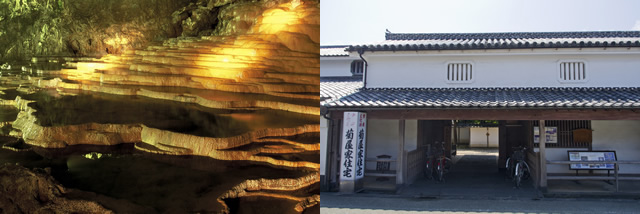
The first stop on your itinerary should be to Akiyoshidai, the largest karst plateau in Japan, located in Mine City in the central part of Yamaguchi Prefecture. Formed under water 350 million years ago when the area was a coral reef, these limestone remains have been eroded by the rain to create unique, strangely shaped rock formations. Stretching beneath Akiyoshidai, is Akiyoshido, the largest limestone cave in the Orient. In addition to the regular tourist route, there is an adventure route available.
Akiyoshido / Kikuya Juutaku
Hagi City in the northern part of Yamaguchi Prefecture is a castle town. Samurai residences and merchant dwellings built about 400 years ago look the same as they did in the old days. With its beautifully laid out streets of white-walled houses, the town is called “little Kyoto” and is bustling with tourists all year long. At its heart is Kikuya Juutaku (Kikuya Family Residence), where valuable artworks are exhibited and visitors can sense the changes in the seasons in its spectacular garden.
Art lovers should check out hagiyaki pottery, a craft that has a 400 year old tradition in Yamaguchi Prefecture. Hagiyaki tea bowls have long been highly prized for use in tea ceremonies. There are numerous hagiyaki studios in Hagi City, some of which offer tourists the opportunity to make their own hagiyaki. Even if you are new to the craft, a veteran instructor will attentively teach you.
If you come to Yamaguchi Prefecture, you absolutely must try its blowfish, a local specialty. You can enjoy blowfish in a variety of ways: savor its natural taste with thin slices of sashimi (raw fish); in nabe (a broth); or as hire-zake (simmered roasted fins in hot sake).
Blowfish sashimi / Tsunoshima Ohashi
Tsunoshima, an isolated island in the Sea of Japan, located to the north of Shimonoseki City, has been getting a lot of attention in recent years as a tourist spot. With its cobalt blue sea and silken white sand beaches, you can soak up the atmosphere of this southern land at this popular resort. The bridge to Tsunoshima is only 18 meters high, low enough to allow those making the crossing to take in the view. Tsunoshima has been used as a location in movies and for a car commercial on TV. In summer, the island is packed with tourists who come to bathe in the sea.
One of Yamaguchi’s famous tourist spots is Ganryu-jima, an island in the Kanmon Straits, which separates Kyushu and Honshu. Legend has it that Japan’s greatest swordsman MIYAMOTO Musashi won a duel against his rival SASAKI Kojiro at Ganryu-jima. The island is accessible from Karato-sanbashi pier by ferry. On the island’s square, statues of Miyamoto Musashi and Sasaki Kojiro stand against the scenic backdrop of the Kanmon Straits. During 2012, various events were held on Ganryu-jima to mark the 400th anniversary of the duel. Other martial art events will also be held in 2013 to commemorate the duel.
Spanning the Nishiki River in Iwakuni City in the eastern part of Yamaguchi Prefecture, Kintaikyo (the Kintai Bridge) is a modern Japanese structure with an old world feel. With its series of five arches, the structure of this arched bridge is one that is not common in any country. The lord of the Iwakuni domain ordered his vassal KODAMA Kuroemon to construct the bridge and the structure was completed under his direction in 1673. Using construction techniques from those days, the present bridge was reconstructed in 2001 and took three years to complete. Both sturdy and beautiful, Kintaikyo was indispensable to the political world of the Iwakuni domain.
Ganryu-jima / Kintaikyo
The steam locomotive that runs between JR Shin-Yamaguchi Station in Yamaguchi City and JR Tsuwano Station in Shimane Prefecture has captured the interest of not only railway enthusiasts, but also international travelers. Having been decommissioned, the train disappeared during the drive towards modernization in the 1960s and 1970s, but at the request of many steam locomotive fans, it was put back into service in 1979 and named SL Yamaguchi-go. Yamaguchi-go travels a distance of 62.9 kilometers in about two hours. The retro interior and the throbbing of the steam engine will make you feel as if you have stepped back in time. The steam locomotive runs from late March to mid-November every year.
A hot spring will revive you after your tiring journey. There are over 50 hot springs in Yamaguchi Prefecture. Yuda Hot Spring in Yamaguchi City is the most easily accessible. A mixture of a bustling shopping district and a hot spring resort, Yuda Hot Spring is said to have been frequented by literary figures. The hot spring waters are effective in relieving neuralgia, muscle pain and fatigue.
It takes about one and a half hours to fly from Haneda Airport in Tokyo to Yamaguchi-Ube Airport or Iwakuni Kintaikyo Airport in Yamaguchi Prefecture. Buses and taxis are available at the airport to take you to any tourist spot. To get to Yamaguchi City, you can take the bullet train from JR Tokyo Station to Shin-Yamaguchi Station, a journey which takes roughly four hours and 20 minutes. To get to Shimonoseki City, it takes approximately five hours by bullet train from JR Tokyo Station to Shin-Shimonoseki Station in the city center. If you use an expressway bus departing from nearby Tokyo Station, it takes about 15 hours and 20 minutes.
Yamaguchi Prefectural Tourism Federation
Text: OMORI Saori
[2013年2月号掲載記事]
本州の最西端に位置する山口県は、本州と九州地方の玄関口として栄えてきました。古くから中国や朝鮮など、アジア各国との貿易も盛んに行われてきたこともあり、現代でも貿易の要所として知られています。北は日本海、南は瀬戸内海に囲まれ、中央を中国山地が横断した地形。県内でも北と南の気候に差がありますが、比較的温暖で過ごしやすく災害も少ないため、観光だけでなく住みやすい場所としても人気です。
山口県は、近代日本の発展に貢献した優秀な政治家や文化人たちを世に多く送り出してきました。とりわけ、明治維新(19世紀後半)--当時の絶対的な封建主義であった江戸幕府を倒した--において中心的な役割を果たした人物たちを育んできました。
旅の始めに訪れたいのが、県中央部の美祢市にある日本最大のカルスト台地、秋吉台です。3億5千万年前、この場所が海だった頃に生まれたさんご礁などの殻が積み重なってできた石灰岩を雨が溶かしていき、独自の奇岩を形成しました。秋吉台の地下100メートルに広がる秋芳洞は東洋最大の鍾乳洞です。通常の観光コースの他、探検コースも用意されています。
県北に位置する萩市は城下町です。約400年前につくられた武家屋敷と商人の住居跡が現在も当時のまま残っています。小京都といわれるほど美しく整った白壁の街並みは、年間を通じて多くの観光客でにぎわいます。中でも中心部の菊屋家住宅は、貴重な美術品などが展示されており、季節の移り変わりを感じられる庭園も見ごたえがあります。
アートに興味がある人にお勧めなのが、400年の歴史を持つ伝統的な陶器である萩焼です。昔から茶道で使われる茶器としても重宝されてきました。萩市内には萩焼の陶房がたくさんあり、観光客が萩焼を作ることもできます。ベテランの先生たちが初心者にも丁寧に教えてくれます。
山口県を訪れたら食べておきたいのは、名物のふぐ料理です。素材を活かした刺身、鍋料理、そしてあぶったひれを熱かんに入れてうま味を楽しむひれ酒など、様々な調理方法で楽しむことができます。
観光地で近年注目されているのが、下関市の北部に位置する日本海に面した離島、角島です。コバルトブルーの海と、白くさらさらとした砂浜は南国のような雰囲気で人気のリゾート地です。角島に行くための橋は、景観を楽しめるように橋の高さが約18メートルと低めに設計されているため、訪れる人たちはその景色を楽しむことができます。角島は自動車のテレビコマーシャルや映画のロケ地としても使われます。また、夏には海水浴客でにぎわいます。
県を代表する観光地の一つに、九州と本州を隔てる関門海峡に浮かぶ巌流島があります。巌流島は、日本一の剣士である宮本武蔵が、ライバルである佐々木小次郎と決闘して勝利した逸話の舞台となりました。巌流島へは唐戸桟橋から観光船が出ています。島の展望広場には関門海峡をバックに宮本武蔵と佐々木小次郎の像が立っています。2012年はこの決闘から400年を迎え、巌流島では様々なイベントが開催されました。2013年も決闘にちなんだ武道や格闘技のイベントなどが開催される予定です。
近代日本のレトロな雰囲気を感じられる場所といえば、県東部の岩国市錦川にかかる錦帯橋です。五つに連なったアーチを描く反り橋は、世界でも特徴的なものです。当時の岩国藩主から命令を受けた家臣、児玉九郎右衛門が指揮をして、1673年に完成させました。現在のものは、2001年に当時の技法を守りながら3年間かけて再現されたものです。頑丈さと美しさを兼ね備えた錦帯橋は、岩国藩の政治にも欠かせない存在となったのです。
鉄道ファンだけでなく、海外からの旅人にとっても注目されているのが、山口市のJR新山口駅から島根県のJR津和野駅までの間を運行するSL列車です。1960~70年代に効率化のために廃止されて一度姿を消しますが、たくさんのSLファンの声によって1979年にSL「やまぐち号」として復活しました。やまぐち号は62.9キロメートルの距離を約2時間かけて走ります。レトロな車内、蒸気機関の躍動を感じることができ、タイムスリップしたかのような雰囲気を楽しむことができます。毎年3月末~11月中旬に運行しています。
旅の疲れをいやしてくれるのは温泉です。山口県には、50以上の温泉があります。その中でも交通のアクセスが最も良いのが、山口市内にある湯田温泉です。繁華街と温泉街が一体となった湯田温泉は、作家たちも愛したといわれています。温泉は神経痛、筋肉痛、疲労回復などの効果が期待できます。
山口県へは、東京の羽田空港から山口宇部空港または岩国錦帯橋空港まで約1時間30分。空港から各地までは、路線バスやタクシーが運行しています。山口市へはJR東京駅から新山口駅まで新幹線で約4時間20分。下関市へはJR東京駅から下関市の新下関駅まで新幹線で約5時間。東京駅周辺から出発する高速バスでは約15時間20分です。
文:大森沙織